“Scare” quotes by Johannes Angermuller
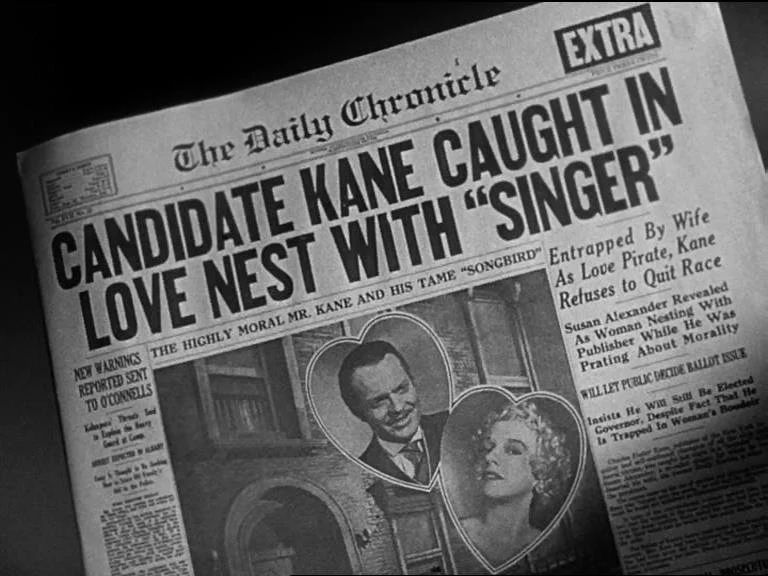
Still image from Citizen Kane, a 1941 drama film directed by, co-written, produced by, and starring Orson Welles.
Guest: Johannes Angermuller
Recorded : Friday 22nd May, 2026, online.
Published : Tuesday 22nd September, 2026.
Recording language: English
Keywords
scare quotes, voice, discourse analysis, political language, media, communication, social semiotics, irony, denigration, stance
Summary
Sophia welcomes linguist Johannes Angermuller to talk about scare quotes. Sometimes termed air quotes or even sneer quotes, Merriam-Webster defines scare quotes as “quotation marks used to express especially skepticism or derision concerning the use of the enclosed word or phrase.” A deceptively simple but politically potent discursive tool, scare quotes can distance speakers and writers from the words they use, question their legitimacy, or subtly signal irony, doubt and disapproval. Sophia and Johannes discuss how scare quotes operate across political, academic and everyday discourse — and what those tiny inverted commas can reveal about stance, ideology and power.
Recorded in May 2026 and released only now, following Sophia’s move to China to take up a new academic position, this episode brings Season One to a close.
Sommaire
Sophia reçoit le linguiste Johannes Angermuller pour parler des guillemets de distanciation (scare quotes). Parfois appelés air quotes, ou même sneer quotes en anglais, ils sont définis par Merriam-Webster comme des « guillemets utilisés notamment pour exprimer le scepticisme ou la dérision à l’égard du mot ou de l’expression qu’ils encadrent ». Outil discursif d’une simplicité trompeuse mais à la portée politique considérable, les guillemets de distanciation permettent aux locuteurs et aux auteurs de prendre leurs distances avec les mots qu’ils emploient, d’en contester la légitimité ou de signaler subtilement l’ironie, le doute ou la désapprobation. Sophia et Johannes examinent leur fonctionnement dans les discours politique, universitaire et quotidien — et ce que ces minuscules signes typographiques peuvent révéler sur le positionnement énonciatif, l’idéologie et les rapports de pouvoir.
Enregistré en mai 2026 et diffusé seulement aujourd’hui, à la suite du départ de Sophia pour la Chine où elle a pris ses nouvelles fonctions universitaires, cet épisode vient clore la première saison.
Chapters (machine generated)
Chapters
00:00 Introduction to the semiotics of scare quotes
01:59 Different purposes and functions of scare quotes
03:57 Scare quotes in political discourse and media
05:53 Semantic and pragmatic implications of scare quotes
07:59 Voices, distancing, and social power
09:58 Cultural and linguistic variations in scare quotes
12:00 Scare quotes in popular culture and history
14:00 The role of scare quotes in academic and everyday language
16:04 Reflections on the power and potential of scare quotes
Johannes Angermuller is a linguist and sociologist whose research lies at the intersection of discourse studies, pragmatics and the sociology of knowledge. Internationally recognised for his work on discourse, subjectivity and social positioning, he has developed a sociopragmatic approach to the ways speakers and writers construct positions, identities and relations of power through language. His research spans academic, political and intellectual discourse and draws particularly on French traditions of enunciative pragmatics and discourse analysis alongside German and international traditions in the social sciences.
He has held academic positions in Germany and the United Kingdom, including a professorship in the Sociology of Higher Education at Johannes Gutenberg University Mainz and a Research Professorship in Discourse at the University of Warwick. His work has also involved extensive research and collaboration in France, and his academic trajectory reflects a longstanding engagement with French intellectual and linguistic traditions.
His books include Poststructuralist Discourse Analysis: Subjectivity in Enunciative Pragmatics (Palgrave Macmillan, 2014), Why There Is No Poststructuralism in France: The Making of an Intellectual Generation (Bloomsbury, 2015), and, with Philippe Blanchard, Careers of the Professoriate: Academic Pathways of the Linguists and Sociologists in Germany, France and the UK (Palgrave Macmillan, 2023). His work has been published in several languages, including English, French, German, Spanish, Portuguese and Turkish.
Angermuller has also played an important role in developing discourse studies as an international and interdisciplinary field. With Dominique Maingueneau and Ruth Wodak, he edited The Discourse Studies Reader: Main Currents in Theory and Analysis (John Benjamins, 2014), bringing together major traditions in discourse research across the humanities and social sciences. His publications address subjects ranging from poststructuralism and French Theory to political discourse, academic careers, higher education, post-truth, subject positions and the relationship between language, knowledge and power.
Personal professional page : https://www.johannes-angermuller.net/francais/index.html
Transcript (machine generated)
Sophia Burnett (00:08)
I'm really pleased that Johannes Angermüller is with me to talk about a particular sign. Hello Johannes!
Johannes (00:16)
Hi Sophia, good to see you. Well, good to hear you here.
Sophia Burnett (00:19)
could you us already which sign you've chosen and it speaks to you in
Johannes (00:23)
let's go for this,
let's go for the scare quote. I think this is a
very interesting sign because it reminds us of the many voices which with which we speak.
Sophia Burnett (00:31)
That's an interesting, the many voices with which we speak. this idea that there's not one single voice in human communication, that there are all these layers to it, especially when we start looking at pragmatics and things like that.
Johannes (00:46)
Exactly.
Sophia Burnett (00:47)
Okay. So is there an example of a scare quote that...
speaks to you particularly or, because I'm thinking of, first Trump administration when he was using scare quotes to talk about things that he was using it for plausible deniability, talking about Obama,
setting wires, in the Oval Office in the White House, you know. So he's scare quotes to distance himself from these claims. So is that how you are talking about? scare quotes, right.
Johannes (01:21)
Yeah, it's really about creating proximity or well, in this case distance. And I think scare quotes are extremely malleable, you can use them for all kinds of different purposes. And you can cite a person, you can emphasize something you can express irony, perhaps you can
say something which
you don't mean to say.
Sophia Burnett (01:45)
Yeah, in America, I think they're called sneer quotes as well.
Johannes (01:50)
Really? Okay, I haven't heard that,
Sophia Burnett (01:51)
like to sneer. there is that element of
sarcasm.
Johannes (01:55)
scare quotes is already quite quite dramatic. And I think
Sophia Burnett (01:59)
Hmm.
Johannes (01:59)
other other languages have very different words for this. think in French, it's guillemets you can say Anführungszeichen in German
Sophia Burnett (02:08)
Okay,
but is that like the, because in the French, 'guillemets' that's just quotes, isn't it? That's just like,
Johannes (02:14)
Yes.
Sophia Burnett (02:15)
But scare quotes is a different deployment of this.
Johannes (02:18)
Well, but isn't it
using a quote for I mean, for highlighting something as being extremely foreign or non authentic in terms of the speaker who expresses a distance.
Sophia Burnett (02:32)
Yeah, it can be used for that. So you have very much a sense of denigration of the word that's encased in scare quotes.
Johannes (02:41)
I understood it as a way of really kind of presenting something which is really not you speaking. is, look at that strange language and I'll put it in scare quotes.
Sophia Burnett (02:54)
Hmm. Yeah. mean, that's
Johannes (02:56)
Wouldn't you agree?
Sophia Burnett (02:57)
distancing. Yeah. Yeah. I think there is, there is obviously that usage of scare quotes is
Johannes (03:03)
How would you define it?
Sophia Burnett (03:04)
distancing. How would I define scare quotes? Hmm.
I don't know, because preparing for this, was like very rapidly thinking about
instances
Johannes (03:13)
you
Sophia Burnett (03:15)
of scare quotes that I come across and
There's quite a few subtle variants of the scare quote. So there's the political discourse scare quote, which
kind of implies something. you know, you have people who have all these theories, know, these conspiracy theories. So typically in that kind of discourse, the word they,
could be put into scare quotes and used by the speaker.
Johannes (03:43)
The word day.
Sophia Burnett (03:45)
they
Johannes (03:46)
I think, yeah, yeah, yeah.
Sophia Burnett (03:49)
what is going to happen with whatever political thing. which affords the speaker great largesse, doesn't it? Because
it's just a placeholder for anything that the listener could have on their mind. the government, some kind of other institution, the FBI, the Feds, 'They' suddenly becomes much bigger than the small word. And the person uses it.
with this sort of the way Trump did, the example from before. So using it with this
deniability in mind, so later on, that person can say, well, no, I didn't mean, I didn't mean the feds, of course, I didn't mean the feds, I meant blah, blah, blah. so there are different usages of It's like early,
don't know, early food, unregulated advertising for food. Cookies containing, 100 % in scare quotes "chocolate". I don't think they can do that anymore, but, definitely scare quotes were used as something to indicate, like you said earlier,
the inauthenticity of something as well.
Johannes (04:58)
and the non-normality,
the outlandish character of something, right?
Sophia Burnett (05:06)
Yeah, it could be.
So it's a semiotic that people are very aware of, I think, to the extent that it was used in fiction, quite a long time ago, was used in Citizen Kane. when Kane is accused by the press of having an affair with
a singer and "singer" was put in scare quotes because this is also still today a way in which the press uses scare quotes to distance themselves from political action.
they'll use it to say things like offence on peace if they don't want to get into trouble taking political sides, you know. So it's, yeah.
Johannes (05:46)
right, it's somebody else speaking
here and it's not me, it's not the journalist, it's not the paper.
Sophia Burnett (05:53)
Yeah, yeah. Or it's somebody else speaking or it's like, "as I understand it", sort of thing, given the information at hand. I don't know if you know, Graham Hancock.
Johannes (06:07)
No, I don't.
Sophia Burnett (06:08)
So he's this kind of very strange fellow. He's got all these wonderful, fantastical theories about archaeology and history.
And
he's done all these series on Netflix and stuff. They're great to watch because it's wonderful to watch, but it's just rubbish really. It's scientifically quite rubbish. He talks about mainstream archeology and
I can't really remember if he uses his hands to do scare quotes when he says that, but there's something in the phonology of how he produces those words that it's almost, one can see scare quotes in how it says it, know, sort of the denigration of it,
Johannes (06:54)
So
do you understand scare quotes as implying the gesture as well? mean, do you do this kind of movement with with the fingers or is it is it just what you write on paper?
Sophia Burnett (07:06)
Well, it can be just written down, but I think with the rise of so much media being easily accessible and so many people communicating, there is this inclination towards people actually expressly saying quote unquote. Now I can understand that because if you're a politician,
in a podcast studio with Joe Rogan, for example, and you don't know how that video is going to be edited. If you don't sort of expressly say quote unquote, it could be that your words could be transformed,
Yeah, the meaning of your communication could be misconstrued.
Johannes (07:49)
Sure, yeah.
Sophia Burnett (07:51)
Hmm.
Johannes (07:51)
And we easily get lost in all these different voices that we need to distinguish between.
Sophia Burnett (07:57)
what do you mean by get lost?
Johannes (07:59)
mean, sometimes it's not that easy to understand who's speaking really. And people, they, they cite other people they speak with and through other people and, and sometimes we don't, I mean, it's left open and people can, can speculate a bit and then something which is just hearsay becomes something which is perceived as a
as an established truth and that's of course because these voices are misallocated in a way.
Sophia Burnett (08:26)
So by voices, perhaps for the listener, if you could explain this notion of voices just quickly, if you don't mind.
Johannes (08:36)
Yeah.
So the idea is that every utterance has has of course a speaker. But in many cases, there's not only one speaker present as it were, but the speaker relates to to other voices. And that's why the utterance normally applies a number of different voice or inundative layers and
This is something of course that depends on the way that different aspects are presented through typographic traces like scare quotes
Sophia Burnett (09:04)
So I understand the idea of a separate voice on one's own being sort of imported within regular quotes.
Johannes (09:15)
regular quotes.
Sophia Burnett (09:16)
Just quotation
Johannes (09:19)
Okay.
Sophia Burnett (09:20)
marks. I see what you were saying before about saying that scare quotes are used to mobilize somebody else's voice, but whilst keeping a distance from them. Is that what you meant?
Johannes (09:34)
Yeah, I mean, I think in the case of scare quotes, you would normally really highlight something and present it as foreign to your position.
So you
Sophia Burnett (09:45)
Right.
Johannes (09:46)
would mobilize two voices. You would of course have your own voice, the authorship, your final kind of responsibility. But at the same time, you let others speak like...
the other pull it aside with their absurd ideas and by using scare quotes, you make it really clear that it's not your kind of idea. So in fact, you give
Sophia Burnett (10:08)
Hmm.
Johannes (10:09)
some voice to the other side by using scare quotes because you let another person, as it were, speak.
Sophia Burnett (10:17)
Hmm. I suppose then it's semantic reframing as well of the word that's targeted. in the United States, this idea of, social security and things like that, what we consider to be basic human rights in Europe now, you know. So I can imagine
right-winger in the States saying, something about.
social welfare and somebody else could retalk, they could come back saying you shouldn't be afraid of "communism" in scare quotes.
because that kind of, that isolates that scary word and because there's been an inflation in the sort of representation of these
socialist ideologies. So for basically for many Americans, just basic social welfare as being "communist", Or having communist inclinations. so that word could be re-classed, couldn't it, with the scare quotes.
Johannes (11:21)
Yeah, but it's not semantic, I guess it's really, it's attributing a different origin of speaking to this word. So you attribute it to the other in your discourse. It is not you speaking, it's something, somebody else speaking and you cite the other person for what the other person has said.
But it's not semantic,
Sophia Burnett (11:45)
Mmm.
Johannes (11:45)
I think. I mean, it's very fundamental for any kind of understanding of what's the idea, the message of the utterance I think it's just the way that the voices are orchestrated in the discourse.
Sophia Burnett (12:00)
Yeah, I mean, it does mess with the indexicality though, doesn't it? Because if somebody says you
Johannes (12:05)
Yeah.
Sophia Burnett (12:06)
shouldn't be afraid of communism, scare quotes, then that's redefining communism. Or it's mocking someone for saying that they think that basic social welfare is being communist.
It indexes something different to the actual word and in that sense it plays around with the semantics of it.
Johannes (12:27)
Sure, yeah, yeah. I mean, definitely it's connected and it's very difficult not to see how any kind of semantic phenomenon has some pragmatic applications. And obviously, who is speaking has a huge impact on what is said.
Sophia Burnett (12:46)
Absolutely, Yeah, because its context is a bit like dog whistles, you know, I feel that as
Johannes (12:53)
Yeah.
Sophia Burnett (12:54)
scare quotes function in a very similar way, because they rely on the social semiotics, and they rely on the not the shared knowledge of that sort of notion that you're skirting around. So if I say, Oh, that guy, he's a movie producer.
and he's not available today for coffee because he's rehearsing scare quotes.
Johannes (13:20)
Yeah.
Sophia Burnett (13:20)
Yeah, scare quotes with a young actress. that rehearsing just becomes highly euphemistic.
So
Johannes (13:29)
Sure.
Sophia Burnett (13:30)
it no longer means there is semantic distortion. It no longer means rehearsing. We all understand what it means
Johannes (13:39)
Yes.
Sophia Burnett (13:41)
because of various tropes around.
the movie industry or theatre and producers and older men and young actresses. So, we have all that sort of shared information about those persona. So, yeah, the implicature is huge or can be huge, it?
Johannes (14:00)
Yes. So it's really about the implicit knowledge we have about the situation, about the genre, about the typical people that would normally participate in the debate. And yeah, that's why our world knowledge is very important for this kind of phenomenon.
Sophia Burnett (14:19)
Yeah, so it's quite a powerful semiotic really. I think people, I mean, have you used scare quotes in academic writing? I know that some people do and they're not entirely convinced of their own.
Yeah?
Johannes (14:35)
Well, I've worked
on on these things quite a lot. And, and so you can ask yourself, I mean, you can use a scare quote, like he's rehearsing with the young actress. But then, of course, it's clear that that very example is given as another quote. So you can go on kind of
'mettre en abyme' the whole thing as many times as you want and it's great fun. can really play around with it and every time it changes its meaning.
Sophia Burnett (15:05)
Yeah, I think, you know, there's, there are plenty of old movies that toyed with euphemisms in that way without necessarily making them explicitly scare quotes. In pop culture references is like, I think a nineties movie.
was it called? It was a Dr. Evil, like Austin Powers, there we go. And he used them wrong. He used scare quotes. You know, on the wrong words and it was immensely funny. Yeah, like laser.
Johannes (15:34)
Yeah, exactly. Yeah, I remember. Exactly. Yeah, exactly. Yeah. That's a good example for, I mean, and
then of course, awesome power powers become this becomes this iconic figure which people can can bring in with a scare quotes. I mean, this is I mean, this is great fun.
Sophia Burnett (15:54)
So
that just shows how how powerful scare quotes are at sort of repositioning the words and, redefining words.
Johannes (16:04)
Yeah, and
I think what I did in my own work is I, when I started my career, I used scare quotes too often to kind of
Sophia Burnett (16:13)
Mm-hmm.
Johannes (16:14)
position myself in a very complex scenario with many different voices and different schools and ideas and
Sophia Burnett (16:22)
Mmm.
Johannes (16:22)
references coming from all kinds of different places. And of course, mean, academic discourse is about
securing a place and defending your place, also reflecting on how you construct your own place in relationship to the many other places. And yeah, I think I have a tendency to of using scare quotes in my own work. And it doesn't make it much more comprehensible, I think it's
not necessarily a good thing. People just want to hear what you think, I think, in most cases, they don't want to reflect on all these other are there that make possible your own voice.
Sophia Burnett (17:03)
yes, to an extent. I know the French system is still very much attached to the literature. So quoting,
Johannes (17:12)
Yeah.
Sophia Burnett (17:13)
you know, which is a good thing, if it's not to excess, I think it's a good thing. yeah, didn't, you see, we're back at the same point where I think we're talking about two very slightly different things.
So like scare quotes in academic literature. that's going to be, if I qualify, for example, something in a specific way, right? And I put scare quotes around it. So for example, could say, I think, you know, scare quotes.
allow for the, cause a semantic reconfiguration, right?
Johannes (17:52)
Yep.
Sophia Burnett (17:52)
If I'm not too sure that, I'm scared of getting heat for that from other academics. I could put semantic reconfiguration inside scare quotes. Yeah.
Johannes (18:05)
Yes, exactly. And
I think people in academia, they always try to hide themselves behind those other references and authorities. so
Sophia Burnett (18:20)
Well.
Johannes (18:21)
people sometimes they lose track of their own voice, which is terrible, of course.
Sophia Burnett (18:26)
Hmm, yeah, but I suppose in a way like scare quoting one's own voice in academia for just very specific words that I suppose it allows it allows one to be braver than one might be otherwise, you know.
because everybody's scared of saying something ludicrous, aren't they? I mean, that's the big,
Johannes (18:50)
Yeah, yeah.
Sophia Burnett (18:51)
it's the big fear in academia that you just get carried away with your own hypotheses and you just say something outlandish.
Johannes (18:59)
But that's terrible, isn't it?
Sophia Burnett (19:06)
yeah, I mean, I don't know. I think it's good that people are kept slightly in check.
Johannes (19:11)
want to hear outlandish things and
it's all so smoothened and kind of controlled and you don't really
Sophia Burnett (19:20)
Hmm.
Johannes (19:21)
see that many instances of people speaking really on their own behalf and I think scare quote is a symptom of a tendency to hide yourself.
Sophia Burnett (19:28)
Hmm.
Yeah, possibly. That's interesting. Yeah. I mean, I don't know. I think it's very different schools and very different sort of ecosystems of academia. think, you know, of course,
Johannes (19:38)
Yeah.
Sophia Burnett (19:39)
we're in humanities and social sciences. Probably when you're in the hard sciences, you really don't want to be saying anything outlandish, Although, I don't know.
A lot of progress was made by quite outlandish minds, wasn't it, back in the day. But yeah, I've gone off the thread. But you know, in the States, have science even is put into scare quotes like global warming, you know, all the MAGA caps, they would use scare quotes.
to say "global warming" or "climate change" because for them it's not a reality, it's fake.
Johannes (20:18)
Yeah.
Sophia Burnett (20:19)
So, I think it's very much hand in hand with the post-truth world of the United States.
Johannes (20:25)
Yeah, I mean, it's where you can see that language is so important in terms of how people are made responsible for what they say or not. And scare quotes, of course, is
Sophia Burnett (20:36)
Mmm.
Johannes (20:37)
one of these many devices that we have in order to be ourselves or not.
Sophia Burnett (20:47)
Hmm. Yeah, I suppose. Yeah. And it's quite understandable in an age where public figures especially can be canceled so rapidly for personal opinion. Well, used to be canceled so rapidly for personal opinion. It's taken quite the turn recently, hasn't it? So, yeah.
Johannes (21:07)
Yeah.
Sophia Burnett (21:09)
but that may be, because the United States has historically been more legally reactive, hasn't it, to things. So I suppose there's slightly more wariness, in, in any kind of public statements, than per...
perhaps in the UK or something. I don't know. I'm going out on an there.
Johannes (21:30)
there's an ideology of free speech, which I think we don't have as much in Europe, which basically boils down to the idea that if people are not allowed to say anything they want, then it's censorship.
And I think that's a big problem.
we need some idea of restrictions in discourse if we want to communicate in a civilized way. We need to
follow certain rules of politeness or rational debate. And of course, there's also the question of how to make sure that's not a few people that can can say everything but that there's some sort of equality of participation between people. And
Sophia Burnett (22:14)
Mm.
Johannes (22:15)
And I think a scare code can be a mark of resistance where there's a very strong voice that dominates in public discourse. And people have no other choice than to kind of reenact that voice by referring to it and repeating it. But at the same
Sophia Burnett (22:35)
Hmm.
Johannes (22:35)
time, putting it at a distance.
Sophia Burnett (22:37)
Yeah, very good. Yeah, exactly. I think you're spot on with that. particuar analysis. Yes, it is a means of reappropriating voices that are perhaps outlandish or even hurtful,
Johannes (22:55)
I mean, we always speak to other people when we speak in public, or even in a small kind of private situation. We never speak just to ourselves. And so we always negotiate the presence of the other. And sometimes the other is overwhelming or threatening or
too dominant and then I think we like to keep them at bay and
Sophia Burnett (23:19)
Hmm.
Johannes (23:20)
then we use scare quotes
And maybe it's really very typical for our times where, I mean, discourse multiplies all the time and we understand that human society is very discursive. And so we reflect on the way we talk about things to each other.
in very advanced ways. and so, yeah, we bring in the other the voice of the other, through these escape scare quotes, or through other citations, references, and, and at the same time, I think scare quotes are interesting, because they even I mean, the word conveys the idea of a certain emotion of some dramatic relationship.
some emotional comment polarization. So I think that's very much our age.
Sophia Burnett (24:11)
Yeah, yes it is. perhaps we've... Peut-être on a fait le tour du scare quote?
Johannes (24:17)
Okay, of course.
Sophia Burnett (24:19)
I think there's possibly more to say on it, but I don't want to keep you too long.
the flu.
Johannes (24:25)
Yeah, I've been maybe
Sophia Burnett (24:26)
Yeah.
Johannes (24:27)
less dynamic than I should have
Sophia Burnett (24:31)
No! It's lovely that you're taking part. I'm just trying to think if there's anything very obvious that hasn't been said, but I don't think so.
Johannes (24:41)
Haha
Sophia Burnett (24:43)
I'm very grateful and I hope you recover soon.
Johannes (24:46)
So yeah, I will.
Sophia Burnett (24:48)
And yeah, that was great talking about scare quotes. I'm sure that it's a semiotic that people will notice in the coming weeks if they've listened to this particular episode.
Johannes (24:59)
Sure, yeah, was lovely getting back in touch with you and
I hope that everything turns out well for you.
Sophia Burnett (25:03)
Okay, me too.

Myth by Santiago Guillén Rozo
By Harrison Schmitt / Apollo 17 - https://tothemoon.im-ldi.com/gallery/Apollo/17/6#AS17-148-22727, Public Domain, https://commons.wikimedia.org/w/index.php?curid=171069392
Guest: Santiago Guillén Rozo
Recorded : Monday 18th May, 2026, online.
Published : Tuesday 26th May, 2026.
Recording language: English
Keywords
myth; semiotics; mythology; media discourse; ideology; ecological discourse; artificial intelligence; transhumanism; science fiction; digital culture; rhetoric; institutions; collective identity; religion; ritual; discourse analysis; symbolic systems; political semiotics; systems of meaning and value
Summary
In this episode of Sign(e)s, Sophia speaks with semiotician and linguist Santiago Guillén Rozo about his ambitious new book Sémiotique du mythe — a ten-year research project tracing theories of myth from Ferdinand de Saussure and Claude Lévi-Strauss to Roland Barthes, Ernst Cassirer, Bruno Latour, and beyond. The conversation moves from Barthes’ Mythologies and contemporary media discourse to ecological narratives such as Gaia theory, political symbolism, AI anxiety, transhumanism, and science fiction as the mythology of technological modernity. A rich discussion on semiotics, language, ideology, and the enduring human need to narrate the abyss.
Sommaire
Dans cet épisode de Sign(e)s, Sophia reçoit le sémioticien et linguiste Santiago Guillén Rozo pour parler de son ambitieux ouvrage Sémiotique du mythe — un projet de recherche de dix ans retraçant les théories du mythe, de Ferdinand de Saussure et Claude Lévi-Strauss à Roland Barthes, Ernst Cassirer, Bruno Latour, et bien au-delà. La conversation traverse les Mythologies de Barthes, les discours médiatiques contemporains, les récits écologiques comme l’hypothèse Gaïa, le symbolisme politique, les angoisses liées à l’IA, le transhumanisme, ainsi que la science-fiction envisagée comme mythologie de la modernité technologique. Une discussion foisonnante sur la sémiotique, le langage, l’idéologie et le besoin profondément humain de raconter l’abîme.
Chapters (machine generated)
00:00 Introduction to semiotics and myth
01:29 Myth as a semiotic object
04:26 Exploring surface and profound myths
09:41 The role of myth in institutions
17:52 Religion and contemporary myths
19:30 The pragmatic approach to belief
20:13 Confronting the unknown: the role of myth
21:17 Contemporary myths and environmental crisis
22:10 Gaia hypothesis: science meets myth
24:31 Myth as a rhetorical tool in science
27:19 The social function of myths
29:39 Myth and accessibility in science communication
30:54 Myth in the age of digital systems
32:30 Critique of evolutionary views on myth
34:23 Myth in the context of environmental and technological unknowns
36:29 Science fiction: a modern mythology
38:11 The comprehensive study of myth
Santiago GUILLÉN ROZO holds a PhD in Language Sciences and Semiotics from Université Lumière Lyon 2. Since 2024, he has been a fixed-term lecturer in Language Sciences and Semiotics at the LESLA Faculty (Letters, Languages, Linguistics and Arts) of Université Lumière Lyon 2. He has been teaching at university level since 2015. He has taught, among other subjects, courses in semiotics, pragmatics, discourse analysis, semantics and general linguistics.
His book Sémiotique du mythe was published in 2026 by Classiques Garnier in the “Sémiotiques” series, edited by Astrid Guillaume, Senior Lecturer with HDR at Sorbonne Université (https://dx.doi.org/10.48611/isbn.978-2-406-18801-8).
He was a member of the editorial board of the international scientific journal Les Cahiers de Sémiotiques des Cultures between 2023 and 2025. He is a member of the Board of Directors of the French Semiotics Association (Association Française de Sémiotique).
He is multilingual: He speaks French, English, Spanish and Portuguese, and he is currently learning German, Italian and Ancient Greek. He is the author of conference papers in French, English and Spanish presented at international conferences and congresses. He has taught courses in Language Sciences and Semiotics in French, English, and Spanish at university level, and he was admitted in 2015 to the University College London.
He also served as a Spanish language tutor within the international MINERVE programme, which brings together the following universities: Université Lumière Lyon 2 (France), Goethe Universität Frankfurt am Main (Germany), Universitat de Barcelona (Spain), and Università degli Studi di Bergamo (Italy).
Book details :
Santiago GUILLÉN, Sémiotique du mythe, Classiques Garnier, collection « Sémiotiques » dirigée par Astrid Guillaume, maître de conférences avec HDR à Sorbonne Université, 2026. ⟨10.48611/isbn.978-2-406-18801-8⟩
https://classiques-garnier.com/semiotique-du-mythe.html
Résumé : Le mythe peut être appréhendé comme notion et forme discursive en sciences du langage et en sémiotique. Des lectures critiques (1858-2025) de courants variés : linguistique (Bréal, Saussure), sémiotique (Jakobson, Cassirer, Greimas), histoire des religions (Frazer, Müller, Dumézil, Eliade, Vernant), anthropologie (Lévi-Strauss, Leenhardt, Ingold, Moiseff), philosophie (Platon, Blumenberg) permettent de proposer des cadres théoriques et méthodologiques pour étudier les mythes contemporains dans des domaines différents comme la science, l’économie ou la philosophie.
Abstract: Myth may be approached both as a concept and as a discursive form within the fields of language sciences and semiotics. Critical readings (1858–2025) drawn from diverse intellectual traditions—linguistics (Bréal, Saussure), semiotics (Jakobson, Cassirer, Greimas), the history of religions (Frazer, Müller, Dumézil, Eliade, Vernant), anthropology (Lévi-Strauss, Leenhardt, Ingold, Moiseff), and philosophy (Plato, Blumenberg)—make it possible to propose theoretical and methodological frameworks for the study of contemporary myths in various domains such as science, economics, and philosophy.
ISBN : 978-2-406-18801-8
Nombre de pages : 790
Personal professional page : https://icar.cnrs.fr/membre/sguillen/
Linkedin : www.linkedin.com/in/santiago-guillén-rozo-ph-d-194ba2ab
Transcript (machine generated)
Sophia (00:05)
For this ninth episode of Sign(e)s I'm delighted to welcome Santiago Guillen Rozo. Santiago holds a PhD in language sciences and semiotics from the Université Lumière Lyon 2, where he currently teaches semiotics, discourse analysis, pragmatics, semantics, and general linguistics. He is the author of the recent book, Semiotique du Mythe, published by
Classiques Garnier in the semiotic series and serves on the board of directors of the French Semiotics Association.
Sophia Burnett (00:44)
I'm delighted today to receive you, Santiago. today you're going to talk object myth
as a semiotic, right? So here we have the cover of your book, La semiotique du mythe.
Before we begin though, many listeners might instinctively think of the semiotic object as something relatively tangible or perceptible, like an image or a text or a gesture, like we've discussed in previous episodes. But myth seems so much more abstract and more diffuse. So just to ease us in, please.
How can something as intangible as myth become a semiotic object?
Santiago GUILLÉN ROZO (01:29)
Yeah, thank you so much for inviting me. I'm very glad to be here today with you to discuss this work on my book, Sémiotique du Myth. So yeah, that is a very good question. How can it become a semiotic object? Well, in reality, myth has always been studied in linguistics and semiotics. Most of the most brilliant linguistics and semioticians did study myth. For example, Ferdinand de Saussure, who was the...
the founder of semiology in Europe. And he studied myth also. He was studying linguistics, of course, but also myth. And before him was Michel Brial, who was his teacher at Paris. And many other semioticians and linguistics such as Grébens, Jakobson, Claude Lévi-Strauss also.
who was very inspired by the linguistics, founded the structuralism with Cassidere also, was also a semiotician, philosopher and semiotician. Semitician we can say because he was developing the works of Ferdinand de Saussure. so, yes, many of the greatest linguists and semioticians did study myth. Peirce didn't do it, but the other ones, most of the other ones did it.
And so in my book, I study all of those works from 1858 to 2025. Then I propose my own methodology in order to study myth as in all the French you say, plan d'immanance or you would say all the imanence planes. I don't know how you would say that. That's the notion of Jacques Fontanille in Pratique Sémiotique in 2008.
And then I analyze contemporary myth in different discourses, philosophy, science, politics, economics and mediatic discourse. But in order to answer your question, so myth can be, as I was saying, myth can be deployed in all the plans d'immanence. I don't know how you say that, but it can be a sign.
It can be a text, can be incarnated in an object, it can take place inside of a practice, inside of a strategy, and inside of a way of life, Lebensform, that is the notion from Wittgenstein. So actually, conceived a form symbolique, symbolic form, that is the notion from Cassirer
For Cassirer there were several symbolic forms. There was verbal language, science, art, but also myth. And what that means, it means two things. means that myth exists in every culture, such as verbal language and science and art. But also it means that it can be deployed. It can be a sign. It can be a system of meaning and value. It can be an object. It can be a practice.
So yeah, myth exists in all the aspects of culture and I think it exists in all cultures and even in our contemporary culture.
And so it can be studied as a semiotic object, course.
Sophia Burnett (04:24)
Yeah.
Yeah, fantastic. Yeah, that's clearer. mean, 'plan d'immanance' apparently, is not translated. from Deleuze. Yeah. Yeah, that does make sense that these people all studied the myth. There's a very famous one, it's Mythologie.
Santiago GUILLÉN ROZO (04:33)
Mm-hmm.
Sophia Burnett (04:45)
I think a lot of people who aren't even semioticians maybe have come across that work.
Santiago GUILLÉN ROZO (04:44)
Mm-hmm.
Yeah, super soon.
Sophia Burnett (04:52)
So his description of myth would be a second-order semiological system. Is that something that your book sort of transgresses or pushes back on beyond simple bourgeois mystification?
Santiago GUILLÉN ROZO (05:08)
Yeah, yeah, and so just in order to say something about the plan d'immanance the idea of plan d'immanance is that there is the the idea that ⁓ Minimal units can become higher units in different planes of semiotic level So you have the sign the sign can become a text the text can be incarnated in an object the object can take place in a practice Inside of a strategy inside of a way of life
Sophia Burnett (05:13)
Hmm.
Santiago GUILLÉN ROZO (05:35)
And each plane has its own epistemology. So one to study practice, comes from pragmatics, one to study text, and it comes from linguistics and the symmetry of text, and so on. And yes, for answer your questions, yes, so Roland Barthes writes the Mythologie. It's in 1957 that is published. And the idea behind the book of Roland Barthes is, Umberto Eco has a
has a paper that was published in Spanish in a journal that is called the Signis in Spanish and talking about myth and he was talking about Barthes and he was he was very critic about Greimas and he was very kind to Barthes and what I like about that is that he explains the idea behind
the mythology of Roland Barthes that as you said, it is very well known beyond the semiotic sphere and academics. when Roland Barthes talks about mythology, as you say, it's a second system, second semiologic system. His idea is that mainly mediatic discourse can transform some figures, some objects,
into myths but he was talking about in a very ironic way because he was comparing the myths from the Greek culture to ancient Greece and he was comparing it
to the media discourses of his time, the 1950s in France and in Europe. And so he was saying, look, this is the myths that we have today, compare it to the myths that we have in the ancient Greece. And so for me, when I analyze Barthes, I talk what Barthes was calling mythology, I call it surface myths.
why I call it surface myth and I oppose it to what I call profound myth. So surface myth for me, in my book, I define it as a myth but only in the plane of expression, is the signifiant, the So that means it's a discourse that wants to copy myth but it has not the profound, it's not as profound as
the myths from ancient Greece, for example, who have a conceptual, they are very profound conceptually. And so I oppose these two kinds of myth. And what I do in my book is obviously myth has been studied by many, many scholars in many, disciplines. So what I try to do is to see what are the compatibilities between all these definitions. Because for example, ⁓ when Roland Barthes
writes Mythologie in 1957. Then you have the books by Claude Lévi-Strauss that are called Mythologiques. And for me that is an ironic response from Lévi-Strauss to Roland Barthes in order to say that
Levi-Strauss has another way of defining myth. For him myth are more systems of meaning and value. So mythologies.
And yeah, just in order to develop on that idea, I try, as I was saying, to compare all the different definitions of myth. And I try to see if we can connect all of those definitions. For me, we can do it because we can place those definitions in the different plan d'immanance, it's in the different semiotic planes. So what Roland Barthes calls a myth, it's in the plane of text.
what Klobhavish draws called myth and especially mythologic in his work mythologic is in the plane of system of meaning and value.
And yeah, in order to develop on that, and also you can, there are other definitions of myth. So example for Levi-Strauss also myth can be analyzed as a is the minimal unit of myth.
and you also have other definitions of myth so myth as a practice there will be a rite we call in french a rite or a cult so I try to analyze I do analyze all that in my book
I
Sophia Burnett (09:42)
so this idea of second order with Barthes know, perhaps just like, I don't want you to dumb down your research, but just the second order semiological system. So the way that people have just, you know, people who perhaps are not semioticians access
the meaning of mythologies of myths is through the perceptual, through these objects, these tangible productions that remain in the world. Now, how do some other approaches to the semiotic of myths
differ from
from the access via the objects, as it were.
Santiago GUILLÉN ROZO (10:23)
Yeah, what is the difference between a standard approach to objects to the mythic, to approach to mythic objects?
Sophia Burnett (10:32)
Yeah, to bring it to just to pop culture very briefly, because I think it's a way in for people, you know, there's the new version of The Odyssey by Nolan, by Christopher Nolan, and his choice of representing Helen
Santiago GUILLÉN ROZO (10:38)
Yeah.
Yeah.
Sophia Burnett (10:52)
using a black actress, Lupita Nyong'o. that's this...
Is that when the second order semiological system is not successful, for example, in the sense that there are people who are detracting from these filmographic choices about the depiction of Helen.
Where does that sit in perhaps Barthes construction of myth as a semiological system? If we could attach it to something that people might be able to grasp more easily, you know, these representations in the media.
Santiago GUILLÉN ROZO (11:33)
Yes, of course. the, in the Barthes so Barthes proposes a visual representation in order to explain the way that myths are created in contemporary culture. So specifically in media discourse or mainly through media discourse. And so his, his idea is that you have a sign, you have a first sign and that sign is reinterpreted as just being a signi
signified a signifiant and then that sign becomes the signifiant, the signified to a new sign. So you just, take one sign that already exists and then you reanalyze it and you give it another signifier that means another concept and so you transform it a little. That is the idea of Barthes he talks about meta language for met and actually
Actually, the visual representation that Barthes proposes, my research found that was already proposed by someone else It is the idea that you have a meta-language. Myth for him is a meta-language, so something that comes after something else, a sign that already exists. And this idea about re-enunciations of myth. So obviously every text is
has some values, it's axiological. For Greimas there is a difference between axiological and ideological, but the idea is that through text you are always communicating values. And so in the re-enunciation of myth, you have an axiological part. So you have new values that are proposed by new cultures and obviously cultures change during time.
So which generation proposes the values? And obviously there's a confrontation from the people who who like those values, the person who don't like it, or just the fact that you are changing some elements, some figurative elements of the original text. So yeah, I can understand that there is a controversy about that. And the other thing is that myth can be...
Myth is very interesting because it can be used in two ways. That's why I say in my book, several ways, but this specific case in two ways, ⁓ myth can be used to found institutions. So that is the work of Georges Dumézil who was a historian of religion. And his main idea was that mythologies were the way to found new institutions.
For example, he was studying Indo-European cultures, also non Indo-European cultures, but mainly Indo-Europeans in the first part of his work. And Jimézil says that in Indo-European culture, you have three functions, what he called three functions, the priests, the warriors, and the people who work the...
the laborer the paysan you would say in French I forget the word the the people who were the peasants that is thanks so much so the laborers so I have the priests the warriors and the laborers and the idea is that you have that in mythological text but the idea is that those texts were used to found institutions so
Sophia Burnett (14:16)
Peasants
or the laborers, I suppose. Yeah.
Santiago GUILLÉN ROZO (14:33)
In all the Indo-European societies, have the three distinctions of social classes. And from Dumézil the origin of that is mythological texts and there is a relation between mythological texts and the organization of society. So myth can be used to found institutions, but also myth can be used to destroy institutions, to deconstruct institutions. And yeah, so it can be used for both.
Well, thanks.
Sophia Burnett (15:00)
Yes, so that means that the objects that represent the myths in the tangible world can be reinscribed with alternative meanings at any moment. Yeah.
Santiago GUILLÉN ROZO (15:12)
Yes, of course. Yeah, obviously
meaning is always changing. don't have the... so, you don't have the idea that meaning will stay the same because meaning depends on the interpretation. So, it always changes. Of course, the meaning depends on the interpreter for Peirce So, yeah, meaning always changes and that's the idea. Also, you have the same myth, but new generations are going to interpret in different ways. Of course, they're going to appropriate it.
have some kind of appropriation of myths and re-enunciation of myths.
Sophia Burnett (15:43)
I suppose myth as its narrative, essentially, isn't it myth? Its narrative with the pretext of a fictional narrative with the pretext of a real tangible origin, authentic sort of historical value.
That's to me what myth is. So yes, it's really interesting listening to you say about this, you know, the priests, warrior and laborer, how powerful myth can be in the creation of institutions. That is...
Are there any examples of such institutions that you could perhaps share?
Santiago GUILLÉN ROZO (16:20)
Yeah, of course, in my book, study several cases of that several examples. but obviously
there's something that is that I found very interesting about the reflection about institutions. There is a book by Mary Douglas that is called How Institutions Think.
I was asking myself in the book how myth thinks and what is the relation between myth and institutions.
And yeah, normally what what Mary Douglas says in her book, one of the things she says is that institutions always try to say that they're
that their base is in nature, that they're justified by nature. So for example, why do you do that? Because it's natural. So institutions tend to justify its existence by referring to nature, nature laws. So that happens a lot with institutions, but in some cases you cannot use nature. You have to use something that is over nature.
say supernatural in French so overnatured, so something that is fantastic supernatural correct supernatural supernatural supernatural and that's where myth enters and when you can't use a natural basis in order to justify institutions you use a supernatural basis and that's what myth comes into into play
Sophia Burnett (17:21)
supernatural.
Hmm.
Santiago GUILLÉN ROZO (17:38)
And obviously what we call myth is just the religions of other cultures, of polytheist religions of other cultures, or just archaic, ⁓ etap, archaic struts of our own culture.
Sophia Burnett (17:38)
Excellent.
Mmm.
Yeah, I mean, I suppose with Western culture being quite polarized now, have you?
What is the role of religion today in the creation or maintaining of myths? you think that is shifting?
Is it happening on such a long time scale that it's extremely difficult to have any kind of opinion on those sorts of things?
Santiago GUILLÉN ROZO (18:16)
Well, in my book, you see the works of Jean-François Lyotard. Jean-François Lyotard was talking about great narrations, grand récit, great histories. And for him, he was talking about post-modernity. For him, post-modernity is the fact that there is not a big narration. And the characteristic of a big narration, a big story is that ⁓
you have a meaning of value, a ⁓ system of value, an axiology that is defined. so, yeah, for him there was no system of value that was defined because for him, well, there are several big narrations. One, was the Enlightenment in 18th century.
But yes, we can ask ourselves if today we have something like that that unifies us all or not. Yeah, we can ask ourselves that question. Something that I found interesting in my book about religion and mythology, well, there are...
The thing that they have in common, obviously we can find differences, but the thing that they have in common is what in French you talk about modalité, modality, it's the epistemic modality. So that would be the fact of believing in something or knowing something.
and
And so in a pragmatic way of view, we would ask about not deontological question if God exists or the gods exist, but what are the practical effects of the fact that someone believes in something, in the way that he acts, that is the way of William James studies religion.
And yeah, what I found interesting about that is the following. Hans Blumeberg, was a German philosopher, he says that there is never a final winning of the consciousness in relation to, in French you say the abyss. So you never win in face of the abyss, something like that. The conscious.
Sophia Burnett (19:50)
So...
Santiago GUILLÉN ROZO (20:13)
the consciousness will never win in face of the abyss. So the idea is that human being has always something that he cannot know, something that is on a better mind, something that he cannot know. There is always an area that we don't know about. For example, what is going to happen after we die or maybe the origins of life or that kind of questions.
So myth is one possible response to that. You have other responses, but myth is a possible response to that in order to respond to confront what is unknown, to confront the unknown. so that's interesting for me because yeah, correct. that is interesting because it justifies the fact that myth continues to exist.
Sophia Burnett (20:50)
Hmm. Yeah. And to appropriate it. Sorry. Yeah.
Santiago GUILLÉN ROZO (21:00)
Myth will always exist because the unknown will always exist. So myth is always a possibility. So that's why in my book I study contemporary myths, uses of contemporary myths. For example, in relation to environmental crisis or other aspects.
Sophia Burnett (21:05)
Hmm.
Okay, so just for the audience who perhaps hasn't read your book, and just say your book is in French. So, especially for the readers who don't speak French, if you could give us an example of ecologically based myths in contemporary culture.
Santiago GUILLÉN ROZO (21:25)
It is.
Yes, of course. the first I would love to translate my book, so I hope I will do it soon to translate it to English.
Sophia Burnett (21:44)
Good, good, yes.
Santiago GUILLÉN ROZO (21:46)
And yeah, well, in relation to ecological crisis, I studied the way that myth is used in science, in contemporary science. So I study both natural sciences and cultural sciences, with the difference in German. So the natural science, I study the way that James Lovelock uses the figure of Gaia.
So James Lovelock is an engineer from his British and he made these hypotheses that he called Gaia, Gaia hypothesis. And did he do it? Because he was reflecting about the relation between geosphere and biosphere and his idea is that geosphere and biosphere
have complex relationships and that they generate a new system and this new system, its particularity is that it tries to, he tends to auto-regulate itself and so he named this system Gaia. Why he named it Gaia? Because he was friends with William Golding,
the author from Lord of the Flies. And so he proposed this title Gaia. So Gaia is the goddess of Earth for the Greeks. It's called Gaia. So that is the Gaia hypothesis. So it was very criticized. He worked with some researchers that had good reputation in natural sciences, such as Lynn Margulis.
but also ⁓ he was very criticized in the scientific sphere because they said that he was attributing some intention to the earth, like the earth was a human being or had some intentionality. James Lovelick said that he didn't, that he was thinking about Gaia as a system such as a thermostat that auto-regulates itself.
But he was very criticized. So I studied that and I also studied the work of Bruno Latour. Bruno Latour is a sociologist in France. He first studied the sociology of science. So he was interested about how science is created. And he applied sociological and anthropological
methodologies in order to study some science laboratories in the United States in order to see how science is created. And so he was also talking about Gaia, Gaia in his work, because he was developing the works of James Lovelock, but in the domain of social sciences and humanities. So what Bruno Latour says, so in my book, I asked myself why
science is invoking myth, why science is using myth today in the context of environmental crisis. So my hypothesis was that when science uses myth, it's for epistemological reasons. what do I mean about that? Because myth allows science to reflect, to have, yeah, to reflect.
on something that science has not yet the answer. So maybe myth can inspire science about something that science cannot yet explain. That was my hypothesis. But then when I analyze the work of Bruno Latour, I think that is, well, I say that is not for epistemological reasons, but mostly for rhetoric reasons. Why do I say that? Because the figure of Gaia doesn't allow Bruno Latour to think
beyond what science could allow him because he could use another concept. There is the concept of "biogée" for example, proposed by Michel Serres, that is almost the same. But he uses the almost the same as this idea that the Earth is a complex system. But he uses the figure of Gaia. So why? Because I talk about two notions, three notions that I take from ancient Greece.
the notions of Phoibos, Thambos, and again I use Mutos. So what is that? Phoibos for the ancient Greek is the fear of nature, the fear of nature. So you have nature, have fear, that is Phoibos. And that is the case today with the environmental crisis, when you have all this natural phenomena that people are confronted to.
the fires etc on the the on the environmental phenomena so that is phoibos but there is the this other concept of thambos or the greek thambos is the fear of of divinity of religion figures of divinity so for me Bruno Latour uses gaia in order to transform the phoibos into thambos it means that
he sees that the fear of nature is not enough to make people act for the environment. So he says maybe with the use of mythological creatures and religion we have a religious fear that may make people act. So that is the first thing I said, my first analysis about Bruno Latour's work.
And the other one is the notion of genaios mutos. There is a concept developed by Plato and Plato says that myth can have a function. That means that myth can serve society in general. So that is the way that I see for the work that myth, it's
It's used for rhetoric purposes, but in order to serve society, in order to make people act for the environmental crisis, against the environmental crisis. Yeah, and also another thing that I say about Bruno Latour. Bruno Latour says that we have to... He was engaged for the environment, He says in his words that we have to create
the Le peuple de Gaia, so the community of Gaia or the community of Gaia, something like that. A group of persons that have the same interests and that going to act in order to preserve the environment. So myth is also used as a ⁓ totem, a totem figure. And a totem figure is a symbol, a symbol that is used
to give an identity to a community and to make that community function and to join people into our community.
Sophia Burnett (28:13)
Yeah.
And like you said, to give this totem can give, I mean, that's a wonderful explanation. I really enjoyed that explanation of your hypothesis of, you know, of the rhetorical response, not an epistemological one, opposing Phoibos and Thanbos Because, you have the
the collective and the collective able to pin their imaginary upon a singular object of myth. You know, that's very useful and very powerful tool in the, not just the construction of institutions of communities, but also I imagine the coercion and the maintenance of those.
collectives, you know, to have these instantly recognizable totems that ⁓ crystallize quite often quite complex ideologies, I imagine, you know, historical cultural ideologies.
Santiago GUILLÉN ROZO (29:15)
Yeah, yeah. Yes, of course. Yes, of course. There is a social ⁓ function of symbols and myth, mythological symbols in order to make society function. yeah, Franco Saziotta talks about big, big narrations, as I said. So yeah, in order to maintain the meaning of value and the ideology of the community, need signs and you need that signs to be effective.
Sophia Burnett (29:17)
Yeah.
Santiago GUILLÉN ROZO (29:40)
Sometimes you use mythological signs to do that.
Sophia Burnett (29:43)
Yeah, that's particularly interesting. Oh, sorry. I was just very quickly just to, as professors, as educators, we know how there are different levels of access to information by different individuals.
Santiago GUILLÉN ROZO (29:43)
and also... ⁓
Sophia Burnett (30:01)
So, you know, the function of myth also societally as access to science on a level that is perhaps less intellectually demanding than, there must be a hierarchy of science communication and
I imagine that myth is somewhere towards the bottom.
You know, it's a form of, you were saying your example of ecology, if people aren't going to...
If the science of nature, of natural science, isn't scary enough for they need to be scared by God or a religion or some kind of religious event that might cause them pain and suffering. So that's quite a primitive...
Yeah, it's quite a primitive aspect, isn't it, of the myths, communication, use of the myth.
yeah.
Santiago GUILLÉN ROZO (30:55)
Yeah, yeah, yeah, I don't know.
Sophia Burnett (30:55)
So it's
just basically repeating like, it's just repeating what you said about it being an useful social tool, know? Yeah. But, you know, today and today's contemporary media myths are also circulated and repeated with algorithms. So.
and they can emerge even through architectural, you through platform architectures. So do you think semiotics currently has the conceptual tools to analyze the myths that are produced by next, like digital systems, or will that be a whole new sort of field of theoretical?
semiotics.
Santiago GUILLÉN ROZO (31:36)
But I think you understand that you were talking about the thing that myth is at the bottom of the knowing scale in society in relation to science was the first part. And the other part was the use of myth in contemporary context, such as in algorithms and technology.
Sophia Burnett (31:46)
Mmm.
Santiago GUILLÉN ROZO (31:59)
⁓ So yeah, so about the first part, thing that we were saying that myth is very primitive, a sort of narration that is primitive. So yeah, there's some in the studies of myth, some authors may say that there is, for example, George Fraser, is a British, that was a British researcher.
Sophia Burnett (31:59)
Yeah, yeah. I mean.
Santiago GUILLÉN ROZO (32:21)
historian of religions.
And so for Fraser, well, may say to be working...
in anthropology also, history of religions but anthropology. But Fraser, he had this idea that he has a... Well, I criticize a bit Fraser, but I'm not the other one, Wittgenstein does it too, but for Fraser there was this kind of evolutionary vision of cultures in relation to myth. So his idea is that what he calls the primitive cultures had myth in order to explain...
natural phenomena, but then in contemporary society you have science. So for Fraser, science replaces myth in cultures. And so primitive cultures, what he calls primitive cultures, have myth and modern cultures have science. That is one way of thinking. So I do not think that, I criticize that vision, because for me myth continues to exist even in today's culture.
and for other reasons but that is the main reason I criticize that division and why modern cultures have myth because of the thing that Blumenberg said that I talk about in my book and that I just remind the thing that for Blumenberg there is never a final victory from the consciousness ⁓ in relation to the abyss so there's something
there's always something that is undetermined that we don't know. There's ⁓ something that we don't know in nature. Nature is what escapes the culture and human. so there's always something that we don't know. So for example, today, most biggest unknowns for me are the environmental crisis. We don't know what's going to happen and how it's going to happen. We only know
that it may be terrible for humanity. And also the other thing that we don't know is the development of technology. so face in front of these two horizons that we don't know, you have mythical discourses that are created and we have that in contemporary society.
So I talked a bit about environmental crisis. give another example in my book, but there's also myths about technology obviously. So in relation to artificial intelligence and other. So for example, there is the idea about singularity. Singularity is the idea that the machines will be more developed than the human being. And so you have all these discourses today.
and talk about the future where the machines are going to dominate the human or this kind of discourses. And in transhumanism, you also have some uses of mythical themes, mythical themes about the origin, about the relations with other things, like superior to...
to human beings. Transhumanism for example you have some mythical themes that are re-initiated. Something that Blumenberg says also that I like very much is that he says that in the myth of Prometheus you have already said everything that you have to say
in relation to humanity because that is the myth of origin, the origin of humanity. So that is a question that you would very difficultly have a definitive answer to. And for example, what I say in my book also is that the contemporary discourses that are the most...
the most, the closer to mythical texts are the texts in science fiction because in science fiction, because the myth you have a different temporality so it's very far away in the past but in science fiction you have the same but it's very far away in the future as well. Francois Astier talks about this study takes something that is very far and so because of that
you have on the level of figurativity in semiotic terms you have some similarities also in relation to the actor the what we call the actors the actor in french because you have metamorphism the changing of form you have different figures in math and in science fiction
And so I think that today science fiction is a way to think about the unknown, about what would come next. And yeah, so something that I'm interested in.
Sophia Burnett (36:30)
Yeah.
Yeah, absolutely. Yeah, yeah.
And that really uses myth in the way that you were saying earlier about that citation that you gave us about the abyss. This need, this desire to fill an area of knowing that it will just remain empty because that's just
our human condition and regarding sort of AI and technology and transhumanism and all of these things. It just made me think of Nina Begus at Berkeley. She's working on, she has worked on the Pygmalion myth, you know, in writing as a kind of vehicle for
Santiago GUILLÉN ROZO (37:21)
Okay.
Sophia Burnett (37:28)
the ideologies and anxieties around the future of artificial intelligence and transhumanism and all of these things. I think there's obviously your book is really interesting and there's lots of interesting work coming out about these, you know, these reflections actually weave in very transdisciplinary aspects.
I find that very stimulating. Is there anything in your book that, there'll be lots of things that we haven't covered because it's, we only have a finite amount of time and it's not very much, but is there anything you want to touch upon before we close up?
Santiago GUILLÉN ROZO (38:11)
Not just the thing that in my, well in my book I, I.
I remind all the theoretical basis and methodological basis of linguistics and semiotics and that allows me to characterize myth in all the different domains, all the different spheres and all the different planes of immanance if you can say that way. Because there obviously before this book there was a lot of authors that
tried to study myth, that studied myth for several years in some cases. But you have had very different definitions of myth. And so I give you an example. is this work in there is an article by a Canadian anthropologist that is called John Levitt from 2005 that is called Le Mythe Aujourd'hui, Myth Today. And he was
making a synthesis of all the current works about myth and past works about myth and his definition of myth is the following he defines myth as an important story that is his definition of myth so it is a definition but for me it is a very vague definition because you can there's a lot of stories that are important so for me that is very troubling for research
So for me, there was a real need for the study of myth in order to have a very consequential work. This work took me 10 years of research in order to compare all the different definitions of myth, analysis of myth. And for me, it was important to do it from the point of view of linguistics and semiotics, because obviously in linguistics you study a verbal language, semiotics you study all the language, verbal but ⁓ also pictures.
also photography, etc. So myth is mainly, not only, but it mainly exists through and inside verbal language, Also in other pictures and other languages, but mainly in verbal language. So for me, it was important to do an analysis of myth from the perspective of linguistics, because in linguistics you have
all these declinations of linguistics, you have a minimal sign, you have a phoneme, have a morpheme, you have a syntax, a sentence, a text that is in a practice, etc. And you have the same thing about myth. You have a minimal unit and then you have a text, you have a system of meaning and value, you have an object, you have a practice. So I think that is the contribution of my work, the way of analyzing myth.
as everything as a minimal structure, mythème I talk about mythologème. So obviously I give very different definitions of myth in all this order of domains. For example, for me, is mythème minite minimal, minimal unit. Then you have ⁓ mythologème that is a narrative structural, intertextual narrative structure. Then you have myth, that is one myth with all its re-elaborations.
Then you have myth as a discourse genre. Then you have mythology as a system of meaning and value. Then you have mythical objects. Then you have mythical practice such as rituals, for example. And then you have myth as a way of life as I live and so on So for me, that is the main contribution of my text. And it's important for me because myth continues to exist today. It was very criticized.
For Cassirer, for example, the use of myth in politics as a book that is called the Myth of States. And so myth continues to exist if we look closely today.
Sophia Burnett (41:41)
Absolutely. ⁓ That's yeah, I think it is too. I think it's a very good book and a very interesting book. And I do hope that you get it translated to English very soon.
Santiago GUILLÉN ROZO (41:42)
So that's why I think my book is important. I hope.
Yeah.
Sophia Burnett (41:57)
⁓
All the links to Santiago's work, to the book, etc. will be on the website page, just remains for me to say thank you so much for coming on to talk about myth as a sign and Semiotique du Mythe And yeah, I wish you the best luck with your future research.
Santiago GUILLÉN ROZO (42:21)
Thank you so much Sophia, I was very happy to be with you today.
Sophia Burnett (42:25)
Okay, bye bye.
Santiago GUILLÉN ROZO (42:26)
Bye-bye.
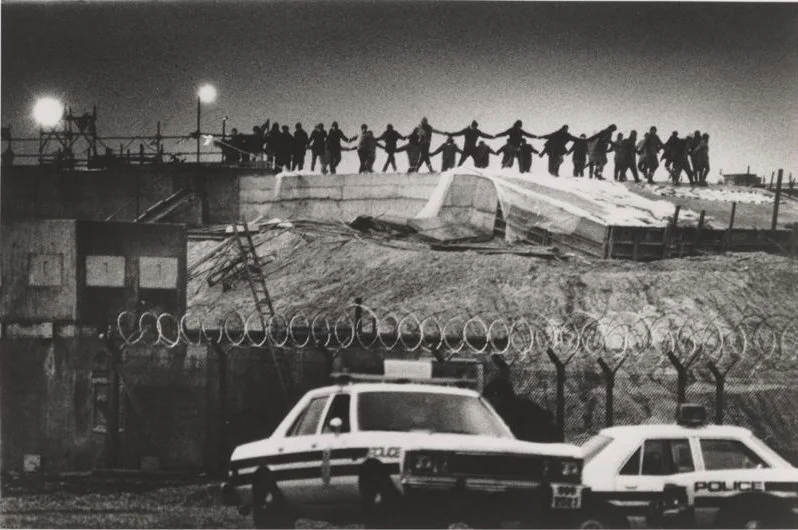
Greenham Common Webs by Anna Feigenbaum
Guest: Anna Feigenbaum
Recorded : Wednesday 25th March 2026, online.
Published : Wednesday 16th April, 2026.
Recording language: English
Keywords
Greenham Common; feminist protest; anti-nuclear activism; web symbolism; material protest culture; creative resistance; nonviolent action; solidarity networks; ecofeminism; policing and surveillance; pre-digital activism; protest semiotics
Summary
In this episode, Sophia speaks with Anna Feigenbaum about the Greenham Common Women’s Peace Camp, a landmark anti-nuclear movement in the UK. Moving beyond the familiar CND symbol, they focus on the “web” as a distinctive sign emerging from the camp’s everyday practices. They explore how the military fence became a medium of protest, woven with objects and messages to form a living network of creativity, resistance, and solidarity. The conversation highlights the camp’s scale, its women-led dynamics, and the differentiated identities of its gates, alongside forms of nonviolent disruption shaped by persistence and everyday acts of nuisance. Greenham’s symbols from the web as a model of transnational solidarity to the feminist reclamation of the “witch”,also allows refelction on the shift from pre-digital collective action to today’s highly mediated protest cultures.
Sommaire
Dans cet épisode, Sophia s’entretient avec Anna Feigenbaum autour du camp de paix de Greenham Common, un mouvement antinucléaire majeur au Royaume-Uni. Au-delà du symbole bien connu du CND, la discussion se concentre sur la « toile » comme signe distinctif issu des pratiques quotidiennes du camp. Elles analysent comment la clôture militaire devient un support de protestation, tissé d’objets et de messages pour former un réseau vivant de créativité, de résistance et de solidarité. L’échange met en lumière l’ampleur du camp, sa dynamique largement féminine, ainsi que les identités différenciées de ses « gates », tout en examinant des formes d’action non violente fondées sur la persistance et des tactiques de nuisance au quotidien. Les symboles de Greenham — de la toile comme modèle de solidarité transnationale à la réappropriation féministe de la « sorcière » —ouvrent une réflexion sur le passage des formes d’action collective pré-numériques aux cultures protestataires contemporaines, fortement médiatisées.
Chapters (machine generated)
00:00 Introduction to Anna Feigenbaum and Greenham Common
02:59 The evolution of the Greenham Common movement
06:02 Gates and the symbolism of activism
09:03 Policing and its impacts
11:52 Creativity and women’s empowerment
15:05 Gender dynamics within the movement
17:58 The cultural and musical impact of Greenham
21:03 Conclusion and final reflections
22:37 Creative resistance and protest
25:00 The criminalisation of protest
28:04 The impact of media on protest
30:34 Differences between past and present movements
33:31 Symbolism and feminist identity
36:04 Media coverage and feminist solidarity
39:46 The return of witches and feminist culture
42:52 Archives and the memory of feminist movements
45:15 Solidarity beyond borders
Anna Feigenbaum is a writer, professor, and interdisciplinary scholar working at the University of Glasgow. Her research and practice explore culture, communication, and social movements. She has published widely on Greenham Common, documenting feminist peace activism, memory, and media. Her books include Protest Camps (Bloomsbury 2013, co-authored), and Tear Gas (Verso 2017).
Books: https://www.waterstones.com/author/anna-feigenbaum/1407924
Photographic credits of images used in this episode:
Getty Images (Greenham Common protest, women at fence)
Unknown photographer (Greenham Common protestors along fence line)
Press Association Images / PA Images (Greenham Common human chain, aerial view)
Unknown photographer (Greenham Common night protest on missile silo)
Lesley McIntyre (police confrontation; sit-in at fence)
Monica Sjöö (Women for Life on Earth march, 1982)
Raissa Page (rainbow web installation at fence)
The Women’s Library, London School of Economics (Greenham camp life photograph)
Unknown artist (Greenham Common “Women Come Together” web illustration, 1983)
Unknown maker (Greenham Common Women’s Peace Camp banner)
Transcript (machine generated)
Sophia Burnett (00:47)
So hi Anna Feigenbaum. So I'm absolutely thrilled that you can come on today and talk about Greenham Common.
Anna Feigenbaum (00:56)
Great, thank you for having me. Looking forward to it.
Sophia Burnett (00:59)
So initially the sign that I was interested in exploring was, you know, the anti-nuclear sign that a lot of people know about Greenham Common. And in your response, you said that actually the sign that was perhaps more motivating, stimulating intellectually for you to explore was the sort of spider web.
non-violent webs that appeared all over Greenham Common.
Anna Baum (01:24)
Yeah, so the Greenham Common is associated with a number of different kinds of signs and symbols. And they did, of course, use, if you mean the P sign by the anti-nuclear sign, like the CNDs, anti-nuclear sign. Yeah, yeah. Yeah. Well, they did have lots of that too, but we've seen that across a lot of movements. it historically is from a bit earlier than Greenham. So I was thinking about the web because it's something that was quite distinct.
Sophia Burnett (01:34)
The CND, yeah, the peace sign, yeah, there's a lot of, yeah.
Anna Baum (01:48)
to Greenham and it's something that really captured the way that as a social movement it grew over time because one of the things people don't realize is that while Greenham started in 1981, it actually the last women to leave left in 2001. So the camp actually had a really long and rich, know, varied population, but a long and rich history in it went through a lot of different changes. And so the web captures a lot of the different moments and different things about Greenham.
Greenham's politics that hopefully we'll dive into today.
Sophia Burnett (02:19)
Yeah, yeah, it's a good reminder actually that just how long it perdured could you would Greenham He died. I didn't realize it carried on so long. So, so that ended so recently. Of course my imagination of it is linked very strongly to the 80s. And so that has.
particular colour doesn't it I'm sure that the as you said the the type of woman the type of person the type of activist who went to Greenham Common in the 80s would be different now to the type of activist who would go in the early 2000s.
Anna Baum (02:59)
Yeah, I think it was kind of like stragglers that were left towards the end of the camp. The people who had really made their lives there, moved their caravan in, were just kind of set up. So I don't know how, the headcount was pretty small in the last few years. So yeah, was in that, the early 80s is really the kind of peak time. And one of the interesting things, and I don't know if you want us to just give the listeners a little bit of the background of how the protest camp started.
Sophia Burnett (03:27)
Absolutely, yes please.
Anna Baum (03:27)
Yeah, it might be
useful. So it was actually semi-accidental that there was a protest camp there. So a group of women had agreed to march from Cardiff in Wales to the nuclear military base in Newbury because they wanted to mark the sitting of US nuclear cruise missiles. It's a little too eerie how much this sounds like today, but they wanted to mark that the UK was being used as part of the kind of US war machine.
And so they went to this nuclear base to raise attention, get some media coverage of the sitting of these US nuclear cruise missiles. And the idea was that that base is closer to Russia. So this is in the Cold War kind of context. So when they got there, they just decided that they weren't going to leave. So the protest camp kind of started with people just bringing things in and starting to build there. And then it was the
military base had a nine mile perimeter fence, if I'm not mistaken on the number. And so there was lots of different gates all around this military base. And so it started quite small. This was just like, I think it was something like 30 or 35 women did the first march. And then people just started coming slowly, slowly. And then they started doing these bigger events. And at the peak, were, you know, dozens, hundreds of women at all of the different basic base encampments all around that.
fence and at the kind of peak of the big actions, you would have tens of thousands of people gathering at Greenham. So, and lots of visitors, you had people who were living there, you had people who would come for the weekend, you had people that would come just for the day. So you had this kind of really, what we talk about in social movement studies is a kind of convergent space or convergent center, like almost like a big kind of expo of activism going on.
So all kinds of things got done there and made there and that's where a lot of the signs come in.
Sophia Burnett (05:17)
Absolutely, and these different gates you're talking about, I seem to remember there were different colors, it was almost color coded as well, which I think is a wonderful form of sign symbolism. Like the colors representing difference, I forget exactly.
Anna Baum (05:25)
Mm-hmm.
Yeah, was the colors of the rainbow. So there was a different, think they had a gate for every color of the rainbow. I know that the big ones were yellow, green, blue and indigo. And then the gates had different personalities and that they decided to do, which I think is a brilliant bit of politics, is they, think like one gate you were like allowed to express more religious stuff at. And then there was another gate that was, I think it was the blue one that was like a little more anarcho.
Sophia Burnett (05:41)
Yeah.
Anna Baum (06:01)
And so like, if you wanted certain kinds of self-expression, you could go to the gate that like best matched your self-expression. And so was a way of including everyone, but at the same time, kind of, I would imagine there were a lot of fights that went on in meetings over like what was allowed and not allowed as part of the protest. And so instead of having to make a decision, they're like, okay, we'll put you at this gate and you can be at this gate. And then I think the gates also like developed their own sort of microcultures because people, you know, were living there. And so.
they had different kinds of personalities, which I just find fascinating as a bit of collective living, you know.
Sophia Burnett (06:32)
Yeah.
Absolutely, as a sort of organic creation of different forms of activism as well. I may be mistaken, but the Blue Gates being associated with more direct action.
Anna Baum (06:42)
Mmm.
That rings a bell to me as well because it was kind of the more anarcho, ⁓ you know, gate. So there was a little bit more like direct action that was happening there. And then Yellow Gate was like that people came to. So I think Yellow Gate was a little bit more public facing, media savvy kind of welcoming the visitors. Yeah.
Sophia Burnett (06:57)
Yeah.
Yeah, with them.
Yeah, yeah,
Yeah, so you'd have this contingency at gates like the Blue Gate where you'd have this meeting of public and institutional bodies, you know, that the potential violence perhaps was greater at certain gates. I can imagine, you know, the Green Gate, which was linked to...
Anna Baum (07:25)
Hmm. Yeah.
Sophia Burnett (07:29)
ecology because you know we're very creative aren't we as human beings. was yeah that was effectively wonderful to learn about how the people that the populations are gradually increased and created these different spaces that were needed that were
I mean, I always wonder how, I suppose people have done studies about that as well, about the sort of the complexity of the organization of these things, how they come to emergence. But I mean, you know way more about this than I do, but I was wondering actually about, you've written about,
Anna Baum (07:59)
Mm-hmm.
Sophia Burnett (08:08)
levier d'état, why can I not think in English today? ⁓ You know the Foucaudian punier surveiller, all of these devices that the state has, in particular tear gas that you've written about, I think. ⁓
Anna Baum (08:12)
Thank you.
I have no
tear gas at Greenham.
Sophia Burnett (08:28)
Sorry?
Anna Baum (08:29)
There is not to your guess at Greenham.
Sophia Burnett (08:30)
No, right, okay, was that because it wasn't, it just didn't exist as a device at the time?
Anna Baum (08:38)
Tear gas is not as used. I don't know if you want to, this is going to be like a big digression, but yeah. So I don't know. You can always cut it out. It's okay. ⁓ Yeah, no, we can talk about it, but I'll just tell you what, then just like kind of interrupt if you want me to stop talking about tear gas. yeah, so it's not that it didn't exist in the 1980s in the UK, because the UK was one of the earlier producers of tear gas, but they were using it at that time.
Sophia Burnett (08:43)
Sorry, yes it is a bit, but I'm entrusted.
Yeah, yeah, yeah.
Yeah, yeah, yeah.
Anna Baum (09:04)
was a little bit more, would be like individual officers and it wasn't regular, like it wasn't rolled out to the police until the 90s in the UK. So in France, I'm sure they would have been using it. People, love using tear gas on people in France and in the US, they would have been using it. But ⁓ it's just not very commonly used on protesters in the UK. Like it's actually just quite rare. If anything, it's like more of the spray that is used on individual situation and even that is much less than in other countries.
Sophia Burnett (09:19)
⁓ gosh.
Okay.
Anna Baum (09:32)
So it just has to do with there's different modes of policing and the UK does a lot more of containment and surveillance style policing. So it's just a different kind of like protester police interaction than you get in a more brutalist kind of French and US system of policing. Yeah, which has different historical roots. France is in fact the originator of tear gas, we think, we think.
Sophia Burnett (09:33)
Right.
Yeah.
Yeah, yeah. Wow, that's interesting.
really? How am I not surprised? Yeah.
Anna Baum (09:56)
Yeah, we think, historians think, yes. And it's because
you'll like this, this is a fun French fact. It's because the French are so good at building barricades, the French protesters, and the police needed ways to break through French barricades. So they experimented with tear gas. This is what we think, we haven't found earlier historical records. So they think that it was police experimenting with it the early
Sophia Burnett (10:16)
my gosh, we need a new version of Les Miserables, don't we?
Anna Baum (10:19)
And then in the war,
Sophia Burnett (10:20)
⁓ my gosh.
Anna Baum (10:21)
they developed it in the First World War. so the French were actually thought to be the first to use it in the First World War. And then the Germans caught up and retaliated and then it became global after that. Yeah. So not to say that the police weren't violent at Greenham, to bring it back to Greenham, but they did a lot of like destruction, like destruction of the camp, demoralizing of the women.
Sophia Burnett (10:29)
Right, right, right. Yeah, yeah. Yeah, there were various gases floating around at that time. Yeah.
Hmm.
Anna Baum (10:46)
Occasionally, think people would get like pushed or shoved or maybe, you know, like with a billy club, but it was much more of a kind of psychological wearing down. It's the British policing way and making it really hard for them to live, you know, to stay there.
Sophia Burnett (10:54)
Right.
Yeah, yeah, like the material existence was just, yeah, just not possible.
Anna Baum (11:04)
Yeah, yeah, like destroying the camp. Yeah, yeah. And then they build
all these shelters and a kitchen and then the police, you know, the police or the bailiffs would come and just like knock it all down and ruin all of it. And then they'd have to rebuild. So it's kind of similar to the ways that refugee camps are sometimes policed. This kind of just moralization.
Sophia Burnett (11:14)
Wow.
Yes, it's like we're not saying this is over.
We're not categorically shutting it down, but we're going to a bit like the. What is it, the cat and mouse thing during the suffragette movement, you know, where they'd the the women would go on hunger strike and then get better and then be released and then be caught again. And yeah, yeah, yeah. And just like after four times, then yeah.
Anna Baum (11:36)
Mm.
Same again, yeah, yeah, yeah. Wearing down, yeah, yeah.
Using people as an example publicly, so, you know, to try to get other people not to go. So yeah, different kinds of policing tactic. And then one of the big things in both the, that's important, I think, for understanding the kind of policing or the violence agreement, but also its signs, was the role that this perimeter fence played.
Sophia Burnett (11:46)
God.
Yeah.
Yeah. Yeah.
Anna Baum (12:06)
in the life of the camp because the perimeter fence was what would keep the soldiers, RF. Sometimes the police would be on the inside. the, you know, and obviously the kind of war machinery was all on the inside of the fence. And then the women's camps were on the outside of the fence. So the fence itself became a sign of Greenham, like a symbol of Greenham.
Sophia Burnett (12:07)
Right.
Hmm.
Anna Baum (12:27)
⁓ But then, and also this kind of, I talk about in my work that it was almost like a communication technology, like it mediated the communication between people on both sides of the fence. Also the women would climb over the fence to get into the camp, probably especially at Blue Gate. They would cut the fence. They would make sculptures out of bits of wire for the fence. They made like cooking grills out of bits of fence, know, hang their clothes on bits of fence.
Sophia Burnett (12:51)
Shhh!
Anna Baum (12:54)
And then they also use the fence as a canvas and they would decorate the fence. And that was one of the places where webs appeared among many other things. ⁓
Sophia Burnett (13:03)
And in some ways
from what you're saying, the web was, the fence was already a form of web because it has this duality of function and form. And it's wonderful to hear how they were using it. know, the, yeah.
Anna Baum (13:19)
Yeah, I mean, and if you think of things being like caught
in the web, like they were using the fact that you could stick things to the, you know, the open whole structure of this fence ⁓ to create, like to make protest art, to make signs, to put signs up, you know, to dry their clothes. So there was this, yeah, functionality of creativeness and expressiveness that was happening through that.
Sophia Burnett (13:31)
Yeah.
Anna Baum (13:45)
through the technology of the fence and the fence is this kind of poster board, you know, or exhibition wall for the camp.
Sophia Burnett (13:52)
Yeah, I mean, that sort of, I suppose it's a cliche to, and not true, you know, that women are these sort of sole detainers of sensibilities and creativity. But one can imagine quite a different set up with a fully male population with the fence, you know. ⁓
Anna Baum (14:10)
Mm-hmm. Yes, probably wouldn't
have been pinning baby clothes on it, you know, or doing your knitting, knitting into the, you know, these beautiful rainbow sculptures and often of webs. So one of ways of webbing was webbing the fence, so creating the kind, you know, like with yarn, like knitted webs around the fence.
Sophia Burnett (14:15)
Hahaha
wow.
right, right,
using it as a sort of matrix ⁓ to make the fantastic, like a loom, yes, yes, yes, like the functional. I love how women get very functional quite quickly. okay, what can this be?
Anna Baum (14:37)
Yeah, exactly. Yeah, like a loom. don't know. Yes.
Yeah, and I think that's to me, so
in the broader work that I do on protest camps, like this is one of my favorite things about them is like, you're living there, you're camping, right? And when we camp, we do, we turn all kinds of objects into other objects and we make do with very little and we get really creative in how we set up our home because we're living there. We're living there in the outside with a tent and a few objects. And so there's this, yeah, like level of creativity that has to...
come into just reproducing daily life. And then they're also protesting at the same time. So you get this creative artistic functional kind of thing going on, which is really, really neat to watch.
Sophia Burnett (15:25)
Yeah. And I wonder what the...
you know, the attitude of, because you were saying before, you know, this is a very, before the arrival of the protesters, this is a very testosterone heavy place. I'm probably using the use of hormones incorrectly, but the army personnel and you have,
Anna Baum (15:38)
Thank
Sophia Burnett (15:45)
police at the time, like in the 80s, I cannot imagine that the police force was very mixed in terms of gender. Right.
Anna Baum (15:52)
No, think it was almost all men. I think there was mostly.
And then the kinds of depictions you see, like the drawings that they did and the photographs that you can see in the archives, and the video, the few videos that exist. You, you, it's very much like that. Like, it's, very much that the soldiers are men, the police are men, the bailiffs are men. A lot of the journalists are men, not always. But there's, there's that kind of
Sophia Burnett (16:12)
Right?
Anna Baum (16:15)
Yeah, that kind of offset. there weren't because I think, I think men were occasionally allowed to come to the camp to visit her like for the big event days, but they weren't allowed to stay over though. I'm not sure exactly. I can't remember exactly what the rule was, or maybe they were allowed at like the yellow gate to visit only. So you also had what is a super, super rare, which is like a women's only space that went on for years, right?
Sophia Burnett (16:40)
Yeah.
Anna Baum (16:41)
And so all the time, yeah. Yes, yeah, not nuns. Very much not, very much not nuns. In fact, Greenham was known for a place that women came with husbands and left with girlfriends. So.
Sophia Burnett (16:42)
wasn't theological. Yes. Yeah. Yeah.
Yeah, yeah there are some passages in my mother's book Yeah, let's say pages were turned rapidly.
Anna Baum (17:03)
Hahaha
by you so you didn't have to see what your mum was up to! amazing! i wanna know!
Sophia Burnett (17:06)
But yeah, yeah, absolutely. Yeah, yeah. I don't need to know that much detail.
No, I mean, I'll just talk about that very briefly because it's not the point, but it's sort of semi autobiographical. And what she brought to the character was actually kind of condi'd. She was working class from Liverpool, Liverpool 8. So she brought this very
Anna Baum (17:14)
that's fun. Yeah.
Sophia Burnett (17:36)
different mindset to a place where it was essentially very middle class women at that point when she joined. And so the class aspect was quite interesting as well. But yeah, this is just, yeah, a digression. But
Anna Baum (17:40)
Thank you.
Yeah.
yeah, so I think, but the fact that it was this very women's centered and sapphic, guess, for the words that they use then, the words we use now, of course, are not the same. And what we mean by women is not the same. So, but like, because it was this,
Sophia Burnett (18:02)
Yes!
Anna Baum (18:07)
you know, certain kind of energy and symbolism, you also saw a lot of the two women signs like the conjoined kind of Venus, is it Venus? signs. And you saw a few other kinds of, I guess what we'd say are lesbian or sapphic symbols. And you had just a lot of this kind of like, anarchic sexual energy. But there were also were lots of nuns there and other kinds of, you know, you know, that were
older people that were coming from different kinds of life, people from the unions, people from the CND or the larger anti-nuclear movement. So had all different kinds of intersections of people coming together. So there wasn't really like a kind of, I wouldn't say that the queer symbol like ideology was dominant, but it was very prevalent and sat alongside these other kinds of ecological, more religious, more anti-nuclear kinds of symbolism.
Sophia Burnett (18:57)
Yeah.
Anna Baum (18:57)
more used to seeing in a kind of peace movement or protest.
Sophia Burnett (19:01)
Mm-mm-mm. And probably sat alongside them in such a way that was quite, didn't need to be stated. So I can imagine that women who had perhaps thought outside the box when they got to Greenham, was for many of them the first time that they talked to other women. I mean, it's like, is it the, what test is it, Bechdel Yeah, yeah.
Anna Baum (19:19)
Mm-hmm.
Yeah, yeah, but the back thing
with the two women talking to each other and there's not like a man in the scene. Yeah, Bechdel test Yeah.
Sophia Burnett (19:25)
Yeah, exactly.
So I can imagine that for most of the women who went, well, a lot of them, they were having conversations about, for the first time, about something other than their husbands, their sons, their daughters, their domestic obligations, but still taking care them.
Anna Baum (19:33)
Yeah.
Mm-hmm. Mm-hmm. Mm-hmm. Yeah. Or if they had had, yeah.
Yeah. Or if they, like I was just going to say, they had, maybe they had more women friends, but then they went into domestic life and then they came from domestic life back to this more women's only space. So yeah, you had all kinds of, know, yeah. Because I think the, there were of course a population of women who lived, you know, as dykes and lived.
Sophia Burnett (19:59)
Yeah.
Anna Baum (20:09)
queer lives already that came to Greenham. But there was many more that were, yeah, like you're saying, that were married, that had kids, that were young and in university and hadn't kind of started thinking about any of this stuff yet. And this was like a moment of awakening. Yeah, and the other thing I found really interesting, and if anyone listening wants to know lots of things about the gay women at Greenham, Sasha Rosenil has two books just on queer stuff at Greenham that are
Sophia Burnett (20:11)
Of course.
Anna Baum (20:36)
yeah, so they also like, they did all these songs, there's all these very gay songs that came out of Greenham and that people loved singing. I have a paper that's published on that, but that has some of the amazing kind of song lyrics in it. But yeah, so one of the other things that the women said was that a lot of them didn't know the functional skills. So things like, you know, how to fix stuff, how to use tools.
Sophia Burnett (20:48)
You
Anna Baum (20:58)
how to use a bolt cutter, how to use a hammer. Like these are things that they wouldn't normally have done because they would have turned to the men in their lives to do them. And all of a sudden it was women teaching women how to do all of this kind of like DIY functional stuff, which I also think is super cool. And something that just doesn't happen that much, you know, like even with as far as we've gotten, that's still something that's really rare, you know, that women teaching women these kinds of skills.
Sophia Burnett (20:58)
Hmm.
Mmm.
Absolutely, yes. don't think
we've moved the mark of the cursor very far, Yeah. And if anything, the men also have unlearned how to do those So now we're...
Anna Baum (21:28)
Yeah.
Which not to digress,
is a shame, real shame because they're struggling with what to hold onto with masculinity and DIY skills is like a positive, like why can't the manosphere be full of men teaching men how to do DIY?
Sophia Burnett (21:41)
I know.
But instead we have this sort of descent to equality, which isn't very good for anyone. Anyway. Yeah, to come back to the sign and the symbolic of the fence So you mentioned these webs that were
Anna Baum (21:51)
Yeah.
Sophia Burnett (22:05)
were knitted by, well, the few things I've seen about it. You shared a paper with me with some images, et cetera. And that was quite interesting because...
Anna Baum (22:14)
Mm-hmm. Yeah.
Sophia Burnett (22:20)
Yeah, the intervention of the police was, I don't know,
yeah, the fact that these, webs were quite annoying for that, it was difficult to remove them apparently.
Anna Baum (22:30)
yeah.
Yeah. mean, so I mean, causing a nuisance was one of the main sort of daily protest tactics of the women. And I think there was. And that's again, I think there's something quite British about that form of creative resistance, like because the police are not as heavy handed. What historically has happened in England is is that you can get away with a lot more sort of nuisance based creative or destructive.
tactics without the police, without putting your life in danger. And that's of course not going to be true for everyone who's embodied in every way. But for the most of the women who were there, the police wouldn't have wanted to be seen like beating someone to a pulp and they didn't use things like tear gas. they are water cannons or any of these other kinds of mass dispersal things. So that you could kind of just like be a nuisance until you got arrested or you got detained or they took something away from you.
Sophia Burnett (23:00)
Yeah.
Hmm.
Anna Baum (23:21)
And so there was a lot of that, like you were saying, the cat and mouse, there was a lot of this kind of chasing. And they actually described it often as a cat and mouse kind of game between the police. And probably some of that was boredom. you they were all day, like every day, you know, they needed stuff to yeah, I mean, and there were larger acts of...
Sophia Burnett (23:29)
Right.
Anna Baum (23:38)
I guess what the police would call vandalism where they broke in and would paint things or do things on the military base. There's a famous image of women dancing on the top of the missile silos, which is quite an amazing sign or symbol to have emerged out of Greenham. We still see that one come up sometimes. And they were doing something called the spiral dance, which comes from Starhawk's work, who was big in that.
Sophia Burnett (23:41)
Yeah.
Anna Baum (24:00)
I mean, she's still big, but was big in the 1980s and influential in these movements. And the spiral dance is a dance where everybody comes face to face with each other. So it's quite symbolic in itself. It's also a symbolic dance on this symbolic scene of dancing on top of the missile silos. And I love this as a kind of image of.
how we intervene in that sort of dominance of Imperial war technology. Like there's something so irreverent about that sort of interruption of that technology. Now you'd probably be shot if you broke into a military base and dance on top of silence. So this was a different time. I'm not suggesting that we dance on top of things in military base. Yeah.
Sophia Burnett (24:27)
Yeah.
Yeah, yeah, the people do this. ⁓
But effectively at that time that really, and that's what's why I'm so happy to have you today is that because we're at a time when I think it's important to remember that those times existed and it wasn't actually very long ago, that protest could take a creative form without
Anna Baum (25:00)
Mm-hmm.
Sophia Burnett (25:05)
endangering the person doing the creative protest, you know, that because I think it's good to keep in mind that it's not that long or go, we could perhaps go back to something. You know, I mean, I'm just being positive and utopian today.
Anna Baum (25:21)
Yeah, I mean, I
think what we have seen in the UK is an interesting, you know, case study for this because the UK tends to do, you know, surveillance, containment and legislation more than direct violence as its means of protest policing. And so what we've seen the last few years in the UK are very extreme laws coming out against protest. And that's where we're seeing like the criminalization of any
pro-Palestinian types of protests, anything. Anything they remotely consider to be like a direct action is like a jailable offense. And even though these cases are all being brought to court and the police of the state are losing the legal cases, but they're making the laws, they're putting the fear in there, changing the nature of what you can do in protest. And this has a whole history in the UK. In the 90s, they tried to make...
noise like sound illegal so that people don't have street parties and then now they're trying they again went with the decriminalization of certain kinds of sound and certain kinds of signs and that was a lot targeted against extinction rebellion and now against pro-palestinian demonstrators so it's yeah like it's it it it limits what then you feel as a protester you can you can do creatively as a form of protest expression ⁓ because of because yeah
Sophia Burnett (26:12)
Yeah.
Yeah.
Yeah.
Anna Baum (26:38)
of the repercussions. mean, you know, even if you win your lawsuit, that's three years of your life, two or three years of your life that have been incredibly messed up, you know, and emotionally messed up. So it's not so simple. For the rest of us, it's nice to hear the victories of the cases, living through it is, you know, a really hard experience. Yeah.
Sophia Burnett (26:45)
Yeah. Yeah.
Yeah.
Absolutely, especially if you're young, but I was thinking of the
young ladies who are the Extinction Rebellion for the Campbell Soup thing. Not the Campbell Soup, that's Warhol. I'm conflating two things. You threw the soup, yeah. I mean, that was disproportionate ⁓ justice.
Anna Baum (27:03)
Yeah.
The throw in the soup. Yeah. Yeah.
Yeah, yeah. then even,
and it's stuff even that like some of the groups that I was involved in in the early 2000s, like the stuff that we could do and not really worry about that sort of repercussion was so much greater than what's possible now. ⁓ And that is, yeah, it's a real shame because it's very hard to get the media to change the narrative or to cover issues in a different way. And if...
Sophia Burnett (27:24)
Mm. Yeah.
Yeah.
Yeah.
Anna Baum (27:38)
recriminalizing
basic symbolic acts of protest, then we leave very little room for dissent and for democracy. ⁓
Sophia Burnett (27:45)
Absolutely, yeah. Yeah, and I
think unfortunately, I don't know if you agree with this, that, you know, because these things were relayed in the media, and so people were able to see these forms of creative descent, you know, the embodiment and the recuperation of the public space, you know, in such a way that I...
I don't know, my sentiment today is that even the civilian public space, even when it's protesting, is policed in such a way that people, I don't know, I have the impression people are more sort of self-centring in the public space.
Anna Baum (28:24)
Yeah, yes, yes.
Yeah. And that I think there probably is an intersection there with the rise of social media as well. So, which is also, know, police and people also stop what they're saying, but that a lot of the kinds of expression that we would have had to do in public spaces together outside, you know, has moved into digital territory. And so the interaction between the digital and you know, and the street.
Sophia Burnett (28:32)
Of course.
Anna Baum (28:47)
could say, and the organizing, know, all the organizing we don't see in the closed rooms and the assembly halls, that social media has really changed the landscape of that. And one of the things that fascinated me about Greenham, you know, as someone who was only a young child when it was happening and lived in the US, not the UK, was when I accidentally actually found the Greenham archives, I wasn't looking for them. I was interested, though, in feminist activism before the internet.
And it was really fascinating to think about Greenum as kind of one of the last movements that happened before the start of the web. And so even in the nineties, we start to see a little bit of like nacent websites being used or like, know, ticker tape texting being used, whereas this was a period, mobile phones, you know, no, they didn't even, they had, sometimes they were using mimeographs and not even photocopiers for, for distributing or copying some of the
some of their leaflets. if you had to, maybe they had walkie talkies, but they would like bicycle around the gates of the camp, like send messages. Like they weren't just like, texting in real time. And it's just a completely changes like what communication was like and what, and probably part of the reason we have so much rich making is because people weren't on their phones making memes all the time. They were actually like making, you know.
Sophia Burnett (29:47)
Yeah. Yeah.
Yes.
Well, they were, yeah, yeah, they were completely, they were integrated and it wasn't meta, was it? And they weren't also thinking about what they were sounding and looking like as they were doing it for sure, which I think probably takes, yeah, yeah, it could take the edge off what you're doing considerably.
Anna Baum (30:15)
Yes, that's really interesting. That's really interesting. Other than maybe to each other. Yeah. Yeah.
Yeah, yeah, that you're not going to be recorded in the same way. mean, likewise, you're not able to record the police or the violence in the same way. it does have, you know, effects on both sides. But yeah, I think probably particularly for young people, you know, and I think if we think about the exploration, like the self-explorations that people were doing at the camp, then
knowing that that wasn't all going to be documented on social media. So you could have, you know, you could explore outside your marriage, your new found sapphic, you know, existence without thinking that it was going to be documented all over, you know, so that probably that was probably a big change in, in what in how people act.
Sophia Burnett (31:01)
Yes, and just have the time, suppose
it's such social media is such a time sink that of course, if something, a version of Greenham existed today, of course activists, the women would be on their phones doing a mix of diverse things and not having those conversations because I think, aside from the sort of sapphic explorations,
Anna Baum (31:08)
Yeah.
Sophia Burnett (31:29)
There were conversations about quite simply their lack of agency or their situation in their real lives back home.
Anna Baum (31:35)
Yeah.
Yeah, yeah, yeah, that were quite transformative for them. Yeah, and all these skills of self discovery, talking about politics with other women, I really like your idea of thinking about it as a Bechdel test, but for real life, these would have been, maybe they would have talked about environmentalism and nuclear disarmament with their husbands or maybe with some coworkers, but not in groups of women like this. And I think that is a really powerful thing. And I think, we haven't really had, it's been a long, because
Sophia Burnett (31:40)
Yeah.
Anna Baum (32:04)
single gendered spaces are different in the world that we're in now and they have different politics. because we don't have as many of them, and certainly not at that scale, we don't really know what would it look like if we had something like that now. It would have different parameters, but that it would still probably do a lot of the consciousness-raising work that
Sophia Burnett (32:18)
Mm.
Anna Baum (32:29)
you know, that Greenham did, particularly for women who went who weren't already in those kinds of spaces, you know, before they got there. And a lot of times, know, camps now they do have rules around phones and places phones can't be and phones not in meetings. And so we do still have, I think protest camps still do provide a sense of convergence in chat and connection that like just a demo or just a march isn't kind of long enough.
doesn't have enough downtime to have those same kinds of interactions. ⁓ Yeah, and when you're figuring out how to live with someone and not just protest for two hours or three hours with them, right? So very different days. And I think that's why we see such interesting politics emerge, particularly at places like a tar sands protests, like in France, in la ZAD in Italy against the trains, like things that are a little more rural or not.
Sophia Burnett (32:58)
That's interesting. Yeah.
Anna Baum (33:22)
just like in a city in an urban context, which also is an important thing about Greenham. It's in the, that base camp is like, there's not stuff around it, you know? Like it is removed from a kind of city or urban environment. And I think that's actually really important for thinking about the ways that connections develop slowly and creativity develops slowly. And there's all this downtime and they're battling the weather, you know, and the elements and all this is going on too, which is really different than a demonstration that takes place for two or three hours in an urban city street.
Sophia Burnett (33:31)
Yeah. Yes.
Yes.
Hmm, yeah,
it's a destination. mean, it's not, it's such a more weighted decision to go all the way to Greenham Common than to, I'm not saying, you know, of course, like people who go to Trafalgar Square, but that you could go almost like on your lunch break, couldn't you, to, and then it.
Anna Baum (34:00)
Hmm.
Yeah, yeah, in fact, I
used to go to Occupy London on my lunch break. You could just go for a couple hours. took my students one day. like, let's just go to St. Paul's Cathedral. So yeah, yeah, it's completely different.
Sophia Burnett (34:18)
Yeah,
yeah.
Do we have any idea of the...
Yeah, the media reception of Greenham and you know, because I imagine that for a lot of people they're seeing this array of women, but you know, in the photographs, it is quite moving actually to look at the photos because you have an array of women and some of them do just look like someone's mom, you know, in
Anna Baum (34:39)
Moon.
Yeah.
Sophia Burnett (34:48)
In the nicest possible way I can say that.
I can't remember how it was received because I was, you know, a preteen.
Or teen. Yeah.
But yeah, the UK media, you know, is renowned for being absolutely savage, especially the tabloids. So, but we didn't get tabloids. So I don't know what the, I don't know if you have an idea of what the reception was.
Anna Baum (35:03)
Yes, yes, yes.
Yeah, was pretty, yeah,
it was savage. And there was a lot of the kind of belittling that you would imagine of like feminists and a lot of kind of calling people dykes and a lot of like, ⁓ not in the reclaimed way. And a lot of just like making the women look really like the ugly witch or like really, with all the body hair like is everywhere and the kinds of stereotypes that you would get, especially in the eighties of what. ⁓
Sophia Burnett (35:23)
Right.
Mmm.
Anna Baum (35:39)
kind of a feminist would be. And the women had a lot of fun with this. I mean, I'm sure it also occasionally like stung, but the women would, you know, kind of, we're quite good. Kind of like the Green Party is right now. We were quite good at like knowing what to expect, not taking it too seriously, giving it back, turning it around, reclaiming the things that they were called in their songs and in their flyers. And ⁓ so it was a really powerful. And I think that's another thing that happens when you have a big group of people, you know, you have a big group of women together that it's much easier.
Sophia Burnett (35:47)
⁓
Right.
Yeah.
Anna Baum (36:08)
when
you're a big group to reclaim those kinds of derogatory or hate speech ⁓ of insult.
Sophia Burnett (36:14)
Yeah, yeah, yeah, it's absolutely
a lot easier to do as a group. Yeah, yeah, yeah.
Anna Baum (36:19)
Yeah.
yeah, it's the kind of media coverage I would say that you would expect. And occasionally there were also positive stories, especially in the more liberal leaning press, like The Guardian would be quite supportive. And then you also had at the time a lot of alternative press was thriving in the UK. so the ⁓ CND had its own publication, Peace News.
You had Spare Rib with this feminist magazine. You had something called Outright, which is a POC women of color led newspaper. There was some feminist newsletters. There was quite a lot of alternative press circulating around. So if you were in those scenes already and you were hanging out in the radical bookshops and cafes, and in the 80s, there was still a lot more of those kinds of community spaces also. Then.
Sophia Burnett (37:01)
Yeah.
Anna Baum (37:05)
You also saw a lot of positive news and a lot of debate. So a lot of the discussions about, know, Greenham and solidarity, what was nonviolence, what was violence, ⁓ was the camp too white, like was there space for different kinds of sexualities? Like those debates were happening a lot in that movement media. that.
that was, know, again, we don't have the internet, so these discussions aren't happening on Instagram or the Facebook page, you know, or TikTok, they're happening in newsletters and letters to the editors and, you know, debates or dialogues that are being captured in print, because that was how we had to circulate information before we had social media. So, again, all this kind of making and crafting that was happening, and that's where, to go back to the symbols,
We also see a lot of webs and other kinds of these key Greenham symbols because they would be sort of scrawled into the margins, right? You have marginalia when you have hand photocopied print things. And so you would see a lot of the kind of symbology of Greenham sort of reproduced through this kind of media. And then the Greenham women also made their own media.
So they made zines and newsletters at the, you know, they put together stories at the camp and then they would, someone would like go to an office and, you know, piece it together and get it photocopied. And they're beautiful. Like they're like works of art, you know, then, yeah. And they're, just covered in cartoons and little drawings and graphics of all of these, you know, symbols of the camp.
Sophia Burnett (38:28)
Yeah.
Wow
I was wondering what you were saying about the symbology and the marginalia and stuff. That's really cool, actually. And like young women today and older women, actually, and trans and anyone, you know, identifying with these feminine, feminist creative ideas, like I see online the idea of the witch.
Anna Baum (38:55)
Mm-hmm.
Sophia Burnett (39:01)
has returned. ⁓
Anna Baum (39:01)
Yes, yes, the witch is very big right now.
Sophia Burnett (39:04)
I was in Edinburgh recently and there's several shops, know, with queues, humongous queues, lines outside of young people waiting to get their various instruments for the art. And it's not Harry Potter, because initially I thought it was Harry Potter adjacent, but it's really about, yeah, it's sort of...
Anna Baum (39:20)
Yeah. Okay.
Sophia Burnett (39:28)
moon calendars and all of these sort of ancient things actually.
And I've got lost in my question, but that's fine. So.
Anna Baum (39:37)
Yeah, no, we can talk about
witches, witches and webs. So yeah, the witch was one of the reclaimed symbols at Greenham. And there's actually a lovely song called We Are the Witches song. And the web and the witch are linked as well as they are in popular culture. So that was one of the reasons, another reason for the popularity of the web because the web meant many things.
Sophia Burnett (39:42)
Was it linked? Okay.
Anna Baum (40:01)
But yeah, the reclamation of witches then is very similar to why we see it now. So it was about, you know, these were the healers and the feminists of their time that were persecuted and pushed out. And again, I think what we were talking about, about like, all of a sudden you have this group of people together. So they're not feeling like the isolated one who's causing trouble by speaking up. All of a sudden, all the isolated ones who...
⁓ speak up are living together, right, or are brought together into this space. And so that's a really powerful, you know, transformative moment. And so this idea that we are the witches together is, I think, yeah, quite kind of powerful movement. ⁓
Sophia Burnett (40:42)
Yes, it's probably
a lot harder to be an isolated witch. Yeah.
Anna Baum (40:45)
Yes, yeah. And
I'm not sure how many people would have taken that identity prior to coming to Greenham. Like it's another one of those identities that I think was spread and shared as part of the culture of the camp. Whereas I would say now, witchiness is a little bit more mainstream and a little bit more kind of quite overtly linked to feminism in a kind of reclaimed way.
Sophia Burnett (40:51)
Hmm.
Yeah, there's a kind of
semantic bleaching or at least a semantic sort of transition, isn't there, with the whole idea of what a witch is.
Anna Baum (41:20)
Yes,
yeah. And going back to the kind of pagan healer roots of witchiness. And so I think that that line of, mean, God, there's so many, I had a book that goes through all the different types of witches. There's so many types of witches. But I think if we generalize them as the kind of healer, pagan-y types of witch, green witches, ⁓ then yeah, we have a lot more identity for that.
Sophia Burnett (41:25)
Yeah.
Yeah.
Yeah, yeah, yeah, yeah. But that comes back to what you were saying
before. Yeah, the the healer pagan thing of the you mentioned before, you know, the one of the confrontations every day was with the weather, you know, that so it all that ties in as well. It's a very embodied situated.
Anna Baum (41:53)
Yeah.
Yeah, yeah.
Yeah, totally. You know what, and I didn't, I wasn't as witchy as I am now when I was writing my PhD and doing this research in the archives, but I wonder if any young people listening who are going to research Greenham Common, I think it would be really fun to go back to the archives and look and see what other kinds of witchy behaviors there might've been there. Because I wonder if they did talk a lot about things like the moon phases and menstrual cycles and these other things that we would associate with a more kind of modern.
which I my guess would be that there is stuff in the archive that would show them and someone might have written this paper I haven't come across it if they have but it's one of these things that's you know yeah.
Sophia Burnett (42:34)
I mean, possibly somebody's written about the
massive synchronization of everybody's menstrual cycles. Yeah. That's possible.
Anna Baum (42:40)
Yeah, everyone's. But yeah, it was one of those
and I think this is an interesting thing with any of these kinds of archives. And I'd really encourage, you know, young feminists or listeners to go to one of your archives and look through this kind of material, particularly from the kind of 70s and 80s and 90s before the internet. Because it's just the actual symbols, the signs, the ways that they're creating and using these are absolutely fascinating.
and really help contextualize and connect us to the present moment and to our kind of, not necessarily our own ancestors, but our kind of political, know, ancestral paths. And there's gonna be all kinds of things in the archives that people haven't researched yet. So I remember when I was a wee researcher and I was asking Sasha Roseneil, who's written these books on queer greenum, you know, I think I was asking her maybe about bisexual and trans, like,
issues at the camp and she was like, you know, one for the bisexual, she was like, well, I wasn't looking at that. So like, I'm sure there were loads of people talking about bisexuality, but I didn't ask them in my interviews. So like, there's good, that's one of these things that probably you could write an entire dissertation on bisexuality at Greenham Common and what it meant. But like, it's just never been researched, it's never been asked. So and then, you know, trans, wasn't even like really in the vocabulary in the way that it is now at that time. And so you didn't have, you know, who counts?
as a woman debates of who gets to be in this space because they just, those debates also weren't quite yet happening, at least not in the language we recognize today in the movement more broadly at that time. yeah. Yeah. And like non-binary didn't exist as a gender category, you know, as a gender identification. So you could definitely go back and look at precursors to that.
Sophia Burnett (44:14)
Yeah, yeah. They were still so marginalized, weren't they, trans at that point.
Yeah.
Anna Baum (44:26)
And you could probably find some really interesting things around more complicated gender identity looking through the lens of today. But nobody's done that, or at least to my knowledge, no one's done that research yet because it requires to be really contemporary and then trying to understand the past through a contemporary lens, which is a challenge and certainly not a traditional historical approach. So you might need to be in cultural studies if you're doing that. yeah.
Sophia Burnett (44:44)
Yeah.
No,
for sure. I mean, I think it would probably be for people who do digital humanities, there's probably sort of ways of exploring all this because there must be quite a lot of data to go through. Yeah, yeah, that'd be fascinating.
Anna Baum (44:57)
Yeah.
Mm.
And a lot of the legacies, like a lot of these symbols moved. And so the web in particular was a very reproducible symbol about Greenham. So you started to see the web in the other camps that were the kind of solidarity or sister camps that started. So the one in Italy was actually called La Ragnatella, which is the web and then lots of witches in the Italy camp. And the kind of slogan of
Greenham women everywhere, we are everywhere, would often use the web as its kind of symbol to kind of show that connection and that solidarity beyond the geographic location of Greenham itself.
So in terms of also that idea of like the web linking the different camps together, that at one point I feel like it was 1983.
used the web as the main visual image for the kind of promotion of a big kind of event that was happening. And it was talking about widening the web. And then around the outside of the web, you had written all of these different kinds of campaigns, know, so linking it to things like anti-apartheid, linking it to things like nuclear testing in the Pacific. And there was really this kind of effort to reflect on the whiteness of Greenham Common, the middle classness of Greenham Common.
and think about what it would mean to kind of be in solidarity with other kinds of issues, other kinds of causes. What was the link between UK-US imperialism and these other movements around the world? So there's a really interesting moment that happens a few years into the camp where people start thinking more broadly about their own identities and about solidarity and about what that might look like and how you might support other campaigns from the place or the site of Greenham Common.
And I love how the web became the symbol for this idea ⁓ of widening our solidarity networks.
Sophia Burnett (46:52)
I think we'll end it on that. That was so well said. Thank you so much for coming in. It was an absolute pleasure listening to you talk about...
Anna Feigenbaum (47:00)
Yeah, this was really fun!
Sophia Burnett (47:13)
So I'll just say officially goodbye. So goodbye, Anna Feigenbaum
Anna Baum (47:18)
Alright, thanks for having me. Great to talk to you.
i par Sophia Burnett
Une i minuscule (1SG anglais non-standard), la taille du’ne maison. Image © Sophia Burnett et remerciements à Narr pour l’autorisation d’utilisation.
Guest: Sophia Burnett
Enregistré : dimanche 22 mars 2026, en ligne
Diffusé : mercredi 25 mars 2026
Langue d’enregistrement : Français
Mots clés
i minuscule ; anglais numérique ; grapholinguistique ; indexicalité ; iconicité ; pragmatique ; variation graphique ; face ; écriture numérique ; subjectivité
Sommaire
Le i minuscule en anglais : faute ou ressource ?
Dans cet épisode de Signes, les rôles s’inversent : Sophia Burnett est invitée par Nicolas Pommier pour parler du i minuscule dans les écrits numériques. Loin d’une faute, il apparaît non comme un remplacement du I standard, mais comme une forme supplémentaire, créant un contraste signifiant au sein du système. Une exploration à l’interface de la pragmatique, de la sociolinguistique et de la grapholinguistique.
Burnett, Sophia. 2026. Non-standard typography as performative protection: From indexicality to enregisterment.In Florina Zülli, Ronja Eggenschwiler & Christa Dürscheid (eds.), Sprachgebrauch und Sprachidentitäten. Variationslinguistische Perspektiven. Tübingen: Narr Francke Attempto. 230–251. Narr, Tübingen.
Burnett, Sophia. 2026. Reconfiguration de la tonicité pronominale en écriture numérique. https://doi.org/10.13140/RG.2.2.21629.22246
Burnett, Sophia. 2023. White Flag Typography”.Doctoral thesis. Thesis Commons, May 7, 2024. doi:10.31237/osf.io/wzxp3.
Chapitres
00:00 Introduction
02:34 L'impact des réseaux sociaux sur l'écriture
04:17 La phonologie et la graphophonologie des minuscules
06:26 Endophasie et perception des minuscules
07:44 Les idéologies autour du i
08:36 L'usage du i minuscule en ligne
10:51 La dichotomie entre majuscules et minuscules
12:20 L'indexicalité et l'appartenance communautaire
13:54 Nonchalance active
15:46 Les implications sociolinguistiques des minuscules
17:48 Avant le i, le langage SMS
25:55 Les actes de langage et le signe
28:33 L'utilité pragmatique des variantes
31:36 L'anthropomorphisation et le minuscule
33:27 Le minuscule dans les forums
36:47 Marqueur d'état psychique?
38:31 L'évolution des normes linguistiques avec l'IA
44:08 La Neutralité du Propos
45:08 Impact de la Typographie sur la Lecture
46:14 Déni Plausible et Atténuation
48:53 Complexité des Langues et Typographie
52:01 Symbolisme du Drapeau Blanc en Typographie
54:47 Grapholinguistique et Choix Typographiques
56:22 La fin: Dissonance Typographique du Comic Sans
Sophia Burnett est enseignante-chercheuse à l’Université de Toulouse (laboratoire LAIRDIL) et chercheuse associée aux laboratoires AGORA (CY Cergy Paris Université) et IDEA (Université de Lorraine). Ses travaux, à l’interface de la sociolinguistique, de la grapholinguistique et de la cognition, portent sur la manière dont les formes écrites acquièrent une valeur sociale en usage, comme le montre sa thèse de doctorat dirigée par Julien Longhi, consacrée au i minuscule non standard en anglais numérique et à sa capacité à encoder des variations de sens pragmatiques, indexicales et iconiques.
Elle s’intéresse actuellement, d’une part, à l’identification de signes incarnés et situés dans les productions hybrides humain–modèles de langage et, d’autre part, aux effets morphosyntaxiques de la variation graphique.
Elle a présenté ses travaux lors de conférences internationales, notamment NWAV (New Ways of Analyzing Variation) à New York, ILA (International Linguistic Association) dans le New Jersey et HisPhonCog à Séoul, et a publié dans des revues et ouvrages parus chez De Gruyter et Narr, avec des travaux sur l'iconicité à paraître chez Benjamins.
Linkedin: https://www.linkedin.com/in/sophia-burnett-7989692b8/
Website: https://sophiaburnett.github.io/
Transcription (auto-généré)
Sophia Burnett (00:01)
Bienvenue dans Signes, le podcast dédié aux signes. Chaque épisode est centré sur un signe choisi par l'invité Il peut être visuel ou sonore, icône, symbole, indice, geste, inscription, objet, tout ce qu'il lui parle. Nous examinons le fonctionnement du signe, les contextes dans lesquels il apparaît et les manières dont il est interprété. Cette semaine, je suis ravie d'échanger les rôles.
et de parler du i minuscule anglais avec Nicolas Pommier qui était invité lors de l'épisode numéro 5.
Sophia Burnett (00:48)
C'est donc moi qui reçois exceptionnellement Sophia Burnett, la créatrice de ce podcast. Sophia Burnett est enseignante chercheuse à l'université de Toulouse, rattachée au laboratoire LAIRDIL et chercheuse associée au laboratoire Agora de CY Cergy Université,
Ces travaux, situés à l'interface de la socio-linguistique, de la grapho-linguistique et de la linguistique cognitive, portent sur la manière dont les formes écrites acquièrent une valeur sociale en usage. Sa thèse de doctorat dirigée par Julien Longhi est consacrée aux usages non standards du i minuscule comme pronom de première personne s'agulier en anglais numérique et à sa capacité à encoder des variations de sens à la fois pragmatiques, indexicales, et iconiques.
Ces travaux actuels s'intéressent d'une part aux effets morphosyntactiques de la variation graphique et d'autre part à l'identification de signes incarnés et situés dans les productions hybrides, humains, modèles de langage. Elle a présenté ses recherches lors de diverses conférences internationales à la New Ways of Analyzing Variation à New York.
à l'International Linguistic Association dans le New Jersey et à la Han yang International Symposium on Phonetics and Cognitive Sciences of Language à Séoul. Elle a publié dans des revues et ouvrages paru chez De Gruyter et Narr mais aussi chez Benjamin avec des travaux à paraître sur la notion d'iconicité. Vous pouvez retrouver sa biographie et les références de ses travaux sur le site signspodcast.com
Sophia Burnett (02:24)
Ok.
Nicolas Pommier (02:25)
Une des questions que je voulais poser au début c'est pourquoi tu as commencé à t'intéresser à ce phénomène à l'origine.
Sophia Burnett (02:34)
À l'époque, c'était Twitter. Oui, donc j'étais de savoir pourquoi des personnes utilisaient les minuscules parfois et d'autres fois pas.
Nicolas Pommier (02:34)
en ligne ? D'accord.
Sophia Burnett (02:48)
C'est vraiment parti d'une simple
Nicolas Pommier (02:51)
D'accord.
Sophia Burnett (02:53)
Si une personne à l'école, au collège, lycée, écrit un incluant un minuscule, c'est vraiment aujourd'hui considéré encore comme une faute grammaticale, une faute il y a ces deux aujourd'hui qui
d'appréciation très différente
Oui, comme pendant si longtemps, en c'était le Il n'y avait que des artistes ou des qui jouaient avec osaient le subvertir parce que ça voulait vraiment dire quelque chose.
comme E. E Cummings poète, ou Bell Hooks, qui écrivait son nom tout en minuscules,
Il y a d'autres mouvements artistiques aussi.
Nicolas Pommier (03:46)
Oui, je pensais
en typographie, à partir du Bauhaus, on a commencé à rejeter toutes les lettres capitales, un peu pour des raisons politiques, pour avoir une forme d'égalité entre toutes les lettres. Notamment Herbert Bayer qui a théorisé ça, mais aussi des artistes comme Hermann De Vries qui, dans les années 60, refusaient toutes les capitales, etc. C'est quelque chose qui était assez présent en typographie.
Sophia Burnett (04:14)
Absolument. Ce que tu viens de dire, démontre à quel point le graphique qui incarne des Et on a tendance à l'oublier. Mais ces graphismes font partie de nos mots que l'on met dehors l'idéologie derrière ça, c'est vraiment quelque chose à ne pas ignorer, Même lorsqu'on parle de linguistique.
l'arrivée d'Internet a bouleversée dans monde. on le mais aussi parce que juste le nombre de communications par qu'on n'avait jamais vu auparavant dans l'histoire de l'humanité. Donc on
désormais une ontologie dans la première personne du singulier est utilisée à une fréquence Puisqu'en anglais avec les verbes qui la première personne du singulier SVO, donc c'est une construction grammaticale qui...
qui met la première personne tout le et on ne peut pas faire Zipf au début du 20e siècle avait une approche mathématique par rapport à la qui disait qu'il y plus il a de fréquences
moins long et le de Zipf, Et...
Nicolas Pommier (05:34)
C'est la loi de Zipf, c'est ça ?
Sophia Burnett (05:38)
C'est intéressant aussi parce qu'il y a des gens comme Joan Bybee qui ont repris ça plus dans la linguistique de l'usage et qui ont démontré plus un mot est plus ce mot sera...
à s'effacer, destinée à phonétique, mais après on peut parler de la graphophonologie aussi parce qu'il y a des choses aussi qui se passent là-dedans et c'est très parce que le I...
Nicolas Pommier (06:00)
point de vue phonétique.
Sophia Burnett (06:13)
majuscule, d'avant, le seul ai qui c'était un diphtongue alors moi-même et d'autres personnes, je pensais
McCulloch qui avait écrit ce livre Because Internet et d'autres personnes encore théorisent que le minuscule est une forme
plus faible Il y a Ça s'appelle
où on passe d'un diphthong, c'est une articulation en deux temps, à une les monophonisations en très souvent, c'est le fini les réductions Très souvent, c'est...
Ça va les sons de génial
Nicolas Pommier (07:03)
c'est monophtongaison .
Sophia Burnett (07:08)
majuscule standard, c'est un Et I minuscule, je le pense, un monophtongue. Donc, c'est un processus qui adoucit, qui rapetisse ce plus vers un cheva.
qui est le cas d'ailleurs lorsqu'on parle des Voilà, donc je trouve
Nicolas Pommier (07:30)
Et là, cette monophthong,
ce serait en lien avec l'endophasie, parce que si c'est à l'écrit, c'est pas prononcé tel quel, c'est ça ? Donc c'est une supposition ou c'est vraiment à attesté comme monophthong
Sophia Burnett (07:44)
oui, l'endophasie, c'est effectivement lorsque l'on lit quelque ou même sans lire, mais...
surtout lorsqu'on lit, c'est la petite voix dans la qui lit en même donc c'est une voix intérieure.
comment cette notion cette possède un de monophthong et non de diphthong, c'est un...
attesté à des études que moi-même j'ai fait des étudiants, avec des de sons et de graphiques qu'ils devaient faire
Il y a plusieurs expériences qui ont été faites par des chercheurs qui cette idée que...
Les sont intimement la variation ne faisons que ça toute la On ne se rend pas nos voix intérieures, alors il y a des personnes qui souffrent certaines conditions qui n'ont pas du tout de petites voix.
Nicolas Pommier (08:52)
Mm-hmm.
Sophia Burnett (08:52)
Mais la plupart des lisent avec une petite voix dans la donc en réfléchissent ainsi la réception du i pour le coup, effectivement, moi je comme d'autres.
que ça ne va pas être reçu de la même en le la phonologie, effectivement, c'était important de le dire endophasie parce que les travaux de Bybee étaient surtout sur
l'effacement donc la restructuration de cette ça fonctionne également sur des la particularité de ce mot écrit, c'est que c'est un tout petit mot. on un glyph un morphème
C'est déjà petit dans son état standard et ce qui me fascine c'est que la fréquence et ce que Zipf a dit, ce que Bybee a c'est malgré sa petitesse au départ, ça a réussi à être encore plus petit.
Nicolas Pommier (10:06)
Donc ça c'est un usage du i minuscule pour première personne du singulier en anglais, ça se rencontre uniquement en ligne, a priori. Qui est-ce qui utilise cette forme-là et quels sont les usages qu'elle recouvre ?
Sophia Burnett (10:26)
Alors, oui, c'est une bonne y a des dualistes et Voilà, est-ce qu'il y a deux mondes qui existent ou est-ce que c'est le même et le monde en ligne est informé par le monde Je pense qu'effectivement, le monde en ligne est informé par le monde hors ligne et vice versa, mais qu'il y a quand même une distinction assez nette entre les deux.
massivement utilisé en mais justement les institutions dont on parlait les écoles, les
les de la langue en qui disent ce qui est juste et pas ce qui est là dans ce monde-là, hors ce n'est pas possible
sans que ce soit soit une faute orthographique, soit le signe de quelqu'un qui n'est pas très intelligent, qui n'est pas très ou voilà. Donc ça paraît exactement...
Donc il y a des idéologies assez négatives autour du hors Alors qu'en avec l'arrivée des réseaux sociaux...
qui est très important, je pense, de se rappeler, c'est que ce n'est pas un Ça arrive en supplément. Le minuscule n'a pas...
obliteré la Et donc, désormais nous avons deux J'aime bien penser à une sorte de mitose Donc le mitose c'est biologique, donc c'est un processus biologique où il a une cellule qui se divise en deux.
recopier. Donc ici ce serait pas une vraie mitose mais une le majuscule d'avant qui était la seule forme possible de la première personne en se en et qui
qui produit ce minuscule cette dans le même redouble de force par Le i standard est plus fort que le i standard...
Qu'est-ce que je veux dire par plus fort, c'est dans les idéologies qui sont peut-être même la phonologie, peut-être que le diphthong sera marqué en au minuscule. Voilà, donc à l'arrivée.
Nicolas Pommier (12:58)
Donc ce sera une affirmation plus forte de sa
subjectivité, c'est ça ?
emplois du i C'est associé à une affirmation plus forte de soi.
Sophia Burnett (13:06)
oui
Oui, oui, oui. Donc on est là dans la psychosémiotique. Donc effectivement, En opposition, ça de confiance entre guillemets Oui, on parle d'égo, en fait, tout
comme il y a non seulement maintenant ce "i" minuscule, donc cette variante atténuée, il y sa version opposée. pour parler en ligne et créer des choses dans les forums, c'est parfois diplomatiquement complexe, de prendre la parole, je pense, pour les utilisateurs.
C'était vraiment quelque chose de excessivement bienvenu que d'avoir ce dans la proposition de sa face au
Yeah.
Nicolas Pommier (13:56)
Je trouve
ça amusant que ça soit un peu concomitant au développement du iPhone où justement le i est minuscule.
Sophia Burnett (14:06)
oui, oui, Bon après, on appelle le stylistique et les reprises et circulations avec le monde du marketing sont multiples et complexes, mais là, pour le coup, il a une juxtaposition minuscule et puis, PHONE ! Oui. Mais c'est un peu comme les Y, une fois qu'on commence à le regarder, on le voit partout.
Sophia Burnett (14:32)
on voit les deux choses en C'est pas juste qu'il n'y a plus que le minuscule maintenant. C'est pas le cas que tout monde écrit un minuscule partout tout le temps maintenant. Par exemple dans certaines langues c'est encore
nécessite que les noms soient en majuscule et ça c'est encore quelque chose qu'on voit en quelque chose qui perdure
Je vais vous pas si c'est peu dexicalité.
Les minuscules arrivent en deux.
Peirce, donc parlait de l'index comme étant extérieur à l'énonciation. Quelque chose qui pointe vers un objet extérieur à l'énonciation. grammaticalement, c'est la référant à la première personne, donc l'auteur.
Mais justement, si on dit que c'est un remplacement et non pas une substitution, le i minuscule, c'est une dichotomie qui se met en place qui est super intéressante, parce que peut-être que ça renvoie à quelque chose qui n'est pas tout à fait exactement pareil que le i c'est en opposition.
aux notions Saussuriens le signifiant et le c'est arbitraire.
Pour moi, ce changement de signes, cette modification dans la forme du ça évoque un changement de Évidemment ce n'est pas, "je ne suis pas cette mais il y quelque chose qui se joue dans la couche lexicale qui est modifié.
Donc la couche grammaticale reste intouché
Nicolas Pommier (16:23)
ça permettrait une sorte de partition
du moi et de faire appel à différents aspects de ce moi.
Sophia Burnett (16:33)
Exactement. Et ça, on le fait déjà, on n'a pas besoin de l'arrivée du minuscule pour faire ça. C'est quelque chose que l'on fait avec des mots à chaque fois qu'on écrit à quelqu'un ou en ligne.
...
Au début, je McCulloch le dit dans Because Internet
Très clair, c'est que ça a été repris immédiatement et forcément par une population assez Ce qui est souvent le cas de nouveautés. C'est souvent le cas que ce sont des choses qui sont testées entre guillemets par une population Et puis après, repris par des populations...
et c'était le cas avec le i minuscule. David Crystal en parle texte speak. Ça c'est un peu différent parce qu'au tout début c'était des avec des touches, on ne pouvait pas accéder très facilement à des de caractères.
C'était une sorte d'acronymes et de... C'était très cryptique, en fait. C'est ça, exactement, SMS. Text-speak. Oui, langage Et ensuite est et malgré la facilité...
Nicolas Pommier (17:53)
Le langage SMS, c'est ça ? Au départ ?
Sophia Burnett (18:09)
après de pouvoir taper sur un clavier ou d'avoir un téléphone des touches de l'alphabet, il y a des gens qui l'ont préservé. ces gens qui l'ont une C'était une ingrouping, c'était pour signaler qu'ils appartenaient à un
groupe social, donc en l'occurrence là, les plutôt jeunes qui avaient l'habitude d'être avec une au départ, a du i minuscule. Aussi, je pense pour des raisons idéologiques, parce que justement, si on a une
Nicolas Pommier (18:39)
Mm-hmm.
Sophia Burnett (18:52)
à rigueur, on veut, i majuscule imposée par l'État, imposée par sa et donc d'une manière Sans trop de danger.
est assez facile d'accès de rébellion et puis d'appartenance quelque chose, à une communauté via le i minuscule qui raconte « je ne suis pas un banquier, j'ai 17 ans, tout ça
Nicolas Pommier (19:10)
Mm-hmm.
C'était plutôt à l'origine un usage peu subversif et c'est après que ça aurait pris d'autres significations.
Sophia Burnett (19:40)
oui oui, donc...
Silverstein parle d'indexicalité, d'enregistrement. L'indexicalité est processus super parce que...
ça permet à un phénomène d'être identifié à l'intérieur d'une communauté qu'il par d'autres personnes, et puis de l'emprunter et pour leurs propres besoins qui seront peut-être un peu différents.
dont l'index, départ, intact. C'est-à-dire j'appelais ça active nonchalance. La forme utilisée par les jeunes, j'appelais ça nonchalance active. C'est-à-dire que pour pouvoir, au début, mettre un i majuscule, il fallait...
faire tout un truc dans les paramétrages de son téléphone pour pouvoir passer outre le Donc c'est pas mal de travail juste pour paraître nonchalant.
Nicolas Pommier (20:57)
pour mettre le
i C'est ça ? D'accord.
Sophia Burnett (20:59)
Exactement.
Donc c'est très intéressant parce que c'est ce, je pense, ce nonchalance qui a a écrit avec ce minuscule massivement au début. Et c'est un nonchalance qui a été repris
par pour justement dans des en ligne un peu compliquées, parce qu'en ligne on peut parler de politique ou des choses vraiment qui où très vite les passions montent ça peut être terrible.
Nicolas Pommier (21:42)
...
Sophia Burnett (21:44)
Le fait de se présenter un peu la tête en utilisant cet index de nonchalance. Voilà. Je dis ça, j'ai une opinion, je dis c'est... Sachez que je le dis de manière
y a d'autres formes extra-linguistiques qui servent cette y a des emojis, y a des tone indicators qui sont utilisés beaucoup sur Mais ce n'est pas toujours l'endroit où les communautés, ce n'est pas toujours l'endroit pour utiliser ce genre de choses.
La première personne minuscule est vraiment reconnue par tout et permet de façon très très économique d'apporter une stance en fait. Là on est dans la pragmatique.
désamorcer des choses ou éviter des prises de position potentiellement trop conflictuelles. L'indexation faite par les jeunes avec ce nonchalance a vraiment été identifiée par des personnes qui l'ont pour d'autres fins.
Nicolas Pommier (23:00)
C'est vrai que j'ai découvert
ça en parcourant la thèse, les tone indicators, je connaissais pas. Donc c'était des sortes d'abréviations de quelques lettres en tête de message pour indiquer comment ça doit être. J'ai pas l'impression que ce soit très répandu encore mais bon.
Sophia Burnett (23:13)
...
Non,
non, ça c'était vraiment plus sur... Et puis je pense que c'est un peu passé de monde maintenant, y a des effets de monde avec ces Là c'était plus sur Reddit, la plateforme Reddit, où il a beaucoup de forums et c'est assez policé en fait, il y a des modérateurs.
Nicolas Pommier (23:27)
Mmh.
d'accord
Sophia Burnett (23:43)
Donc le ton est très Ça peut être abordé comme un Et ça peut être abordé également comme une icône.
dans le sens c'est-à-dire quelque chose qui a une très à son objet.
et ça vaut que le... Yeah, on est en plein Et l'incarnation et tout ce qui intéressant, c'est que ça fonctionne aussi, je pense, comme c'est...
Nicolas Pommier (24:09)
Là est dans l'anthropomorphisme à nouveau.
Sophia Burnett (24:24)
fait petite expérimentation au tout début de la l'intelligence artificielle générative de l'image. Dali, j'avais demandé à un prompt sur...
désolée.
Nicolas Pommier (24:41)
Je crois que c'était dans la thèse, j'ai vu un où il y avait des
images de femmes incarnées en Je ne pas si c'est à ça non tu?
Sophia Burnett (24:48)
Oui, c'est ça.
C'est exactement et donc j'avais demandé à si la lettre était une femme et c'était très parlant parce que le il y avait une corrélation avec une...
formes stylistiques qui démontrait une sûre d'elle, qui à le minuscule était une femme sans traits
vraiment amoindri. C'était un petit expérience comme Je pense que ce n'est pas dingue d'imaginer que la plupart des personnes font...
en être fort sûr confiant et le humble, ou tout simplement amoindri
Nicolas Pommier (25:50)
Mm-hmm.
Sophia Burnett (25:55)
aussi grand que... si on fait un i minuscule la d'une ça va toujours représenter quelque chose Et c'est le phénomène qui se passe là-dedans lorsqu'on
Nicolas Pommier (26:08)
Mm-hmm.
Sophia Burnett (26:09)
Mais ça vient rejoindre et soutenir, je pense, des théories, par exemple, de Goffman. Je ne sais pas si tu connais Goffman, mais il a sa théorie de la face, donc c'est de la Et donc la face, donc c'est une image sociale.
Nicolas Pommier (26:22)
Un peu oui.
Sophia Burnett (26:32)
que l'on crée et qu'on partage avec le monde. c'est très très c'est une sorte de visage symbolique. ça peut être par tout un ensemble d'écrits, comme ça peut être construit par le choix stylistique à tout plein de niveaux. On construire
et le Donc il parle de face saving, c'est la de ce visage symbolique que l'on a Et c'est vrai l'on ligne, en particulier
dans des conversations avec des personnes qui sont plus ou moins anonymes.
Il peut être très la version amoindrie comme face surtout pour émettre des pour ne pas être...
Nicolas Pommier (27:29)
C'est ce que tu appelles
Sophia Burnett (27:33)
Oui, oui,
J'ai un peu conceptualisé ces usages en fait dans la le face de Goffman, c'est incompatible non plus le pragmatique d'Austin, par Austin...
a écrit sur ces Un de ces actes, c'est l'Acte Perlocutoire ça m'intéresse ici parce que l'Acte perlocutoire, c'est la conséquence que nos paroles provoquent chez
et encore une fois, je rapporte aussi au niveau graphique parce que je pense que ce n'est pas impertinent de le tout Le fait de se présenter d'une telle manière va quelque chose chez
Si c'est un niveau iconique et on peut imaginer par si on rencontre un chien qui ne bouge pas du tout, mais c'est chien, un on va avoir une réponse autre que si ce chien c'est une caniche.
Nicolas Pommier (28:40)
Mm-hmm.
avoir des impacts importants. Je crois que tu évoques le All Caps tout en capital qui est... paraît très agressif. Et même certaines personnes se sont agressées quand dans les messages il y a des points à la fin. Ça paraît trop affirmatif. voilà, il y a des choses comme ça qui sont constatées.
Sophia Burnett (28:58)
Absolument, absolument le all caps d'ailleurs c'est un phénomène.
avéré et constaté. c'est intéressant parce que justement les extra lexicaux pour l'emphase, abondent, a les all caps, les majuscules, les points d'exclamation, on peut mettre en italique, en gras, on peut souligner. Par contre, des signes extra linguistiques d'atténuation...
on n'en a pas.
Nicolas Pommier (29:28)
C'est vrai qu'il a des signes de distanciation,
peu. Les guillemets, l'italique peuvent aussi jouer ce jeu, mais d'atténuation, a pas vraiment beaucoup.
Sophia Burnett (29:35)
Oui.
je pense que les utilisateurs surtout sur les réseaux ont vu ce vraiment comme un d'atténuation, de ton, de stance
Nicolas Pommier (30:00)
Je crois que tu
as recensé au moins six usages distincts dans la thèse.
Sophia Burnett (30:05)
Donc la non-chalance active, on a parlé de ça brièvement sur plutôt, la première utilisation plutôt par des jeunes, repris par pour une...
une certaine Ensuite, le shielding, dont c'est d'utiliser et l'enregistrement de cette comme une sorte de bouclier en ligne très efficace.
Nicolas Pommier (30:23)
...
Sophia Burnett (30:45)
Il a un où c'est plus... Là, c'est beaucoup plus compliqué à prouver, mais c'est attenuating,
Non, non, non. L'atténuating, Il faut que fasse encore beaucoup plus de travail dessous. donc effectivement, je pense qu'il y a une...
Nicolas Pommier (30:54)
que t'appelles le petit moi ?
D'accord.
Sophia Burnett (31:10)
configuration de la tonicité du i majuscule la Est-ce qu'il y a d'autres impacts ?
Nicolas Pommier (31:19)
Donc ça deviendrait
un critique, c'est ça ? C'est l'idée ?
Sophia Burnett (31:23)
où dans sa forme nouvelle pourrait avoir un...
un impact un peu comme le la des doublements de la
Nicolas Pommier (31:37)
Parce que c'est vrai qu'actuellement j'ai l'impression que c'est plus Quand on insiste sur le I, c'est pour différencier de par exemple I want, c'est pas you want, c'est I des choses comme ça un peu plus un peu...
Sophia Burnett (31:38)
⁓
Oui,
oui, juste pour reprendre, donc, attenuating, ce plus l'impact des effets qui peuvent s'apparenter le à gauche en français du "moi je" par des choses comme ça.
Ensuite, il y a le petit effectivement c'était l'étude d'une par de personnes sachant...
sachant très bien en fait ce que ça de manière iconique et entre guillemets jouons là-dessus.
le petit mot, c'est cette incarnation anthropomorphisation.
du minuscule qui permet aux gens... Ça sachant très parce que les gens, gens sont des linguistes, tout monde. des gens qui utilisent...
Nicolas Pommier (32:47)
Mmh mmh.
Sophia Burnett (32:50)
Les réseaux sociaux, beaucoup sont experts en pragmatique. Sans le sans le savoir que c'est Austin et que c'est l'acte prélocuteur, ils savent très bien qu'en utilisant le petit i, ça va faire plus mignon, où ça va être
une énonciation écrite sans danger, voilà, c'est tout doux, voilà. petit
Nicolas Pommier (33:25)
Ahahah
Sophia Burnett (33:28)
c'est une version...
de...décolicité qui a...
qui n'est pas abouti en fait. Donc il y a une chose qui s'appelle la fonction Donc la fonction réflexive permet tout de se faire une image mentale de qui on est, qui nous quelque chose, par exemple...
des personnes qui souffrent Là, j'ai regardé des communautés de personnes souffrant d'anorexie mentale.
sur Reddit et donc qu'ils peuvent avoir, lorsque ça prend une qu'ils peuvent leurs fonctions réflexives atteintes. C'est comme ça qu'on voit par exemple des phénomènes terribles de une personne qui vraiment très très maigre.
va se regarder dans la glace et qui va voir une Donc ce n'est pas du tout une réalité.
Nicolas Pommier (34:26)
D'accord.
Sophia Burnett (34:31)
Et donc, la petite étude que j'ai fait à l'intérieur de ma thèse n'est pas du décisive et a vraiment besoin avec beaucoup de Je pense que ça serait très important. Mais ce que j'ai vu, c'était...
Nicolas Pommier (34:48)
Mm-hmm.
Sophia Burnett (34:51)
à ces parlants, c'est-à-dire que j'ai pris deux a priori parce que c'est l'internet, donc on peut jamais être sûrs. C'est le gros problème de l'ethnographie en ligne. Mais je pars le principe que les personnes pour la plupart ceux qu'ils et elles disent Voilà.
Nicolas Pommier (35:00)
Mmh.
...
Sophia Burnett (35:13)
j'ai fait un etage avec un forum sur le et un forum sur l'anorexie.
l'utilisation du i minuscule
plus fréquente dans le data venant peut y d'autres L'accommodation, ça peut être très fort dans les forums où on partage le même souci. n'est pas un topic aussi léger que le maquillage, donc peut-être qu'il a le...
phénomène d'accommodation graphique va être beaucoup plus fort, sais pas. Mais en tout cas,
Ça revient, je reviens toujours à la Ce n'est pas une substitution, un supplément. dès lors qu'il a le choix entre deux formes et qu'une personne choisit une forme plutôt qu'une pour moi, ça veut dire quelque chose. Maintenant, si c'est exactement que c'est le marqueur de la fonction réflexive.
Nicolas Pommier (36:18)
le i minuscule était plus utilisé dans les forums sur l'anorexie que sur le maquillage, c'est ça données D'accord.
Sophia Burnett (36:20)
Yeah.
Oui, oui oui.
la possibilité de prendre une icône qui est ressemblant, être représentatif de soi-même. Je ne pense pas que c'est un délire d'imaginer qu'il a quelque chose là-dedans.
noté ça dans les sur la dépression.
Nicolas Pommier (36:52)
D' accord
Sophia Burnett (36:52)
Évidemment, les personnes souffrant d'anorexie mentale ne sont pas dans un état psychique très très bien. se peut que c'est plus la dépression qui est marquée ce choix de...
en tout dans la forum dépression ce qui vraiment très intéressant.
de voir que non seulement c'était très répandu, mais qu'il y avait une sorte d'utilisation du y avait un exemple d'une qui racontait son Aujourd'hui guéri.
et qui racontait un temps où il était malade, avec des idées très Ce qui m'a frappée, c'était l'utilisation du i pour parler de lui-même au présent de l'i minuscule lorsqu'il parlait de lui-même malade dans le passé.
encore une fois, ça peut random, aléatoire sur le clavier, c'est énormément
Nicolas Pommier (38:07)
Ce serait intéressant de voir... Je ne pas si ça peut intéresser des psychologues aussi, parce qu'il a de plus en plus de consultations psychologiques qui se font en ligne sur des chats et ça peut être des de l'état mental de la personne aussi, d'une certaine manière.
Sophia Burnett (38:08)
C'est tout à fait naturel en fait. Pardon.
Les marqueurs, c'est compliqué parce que ce sont des choses qui Par exemple, la communauté en ligne Reddit d'anorexie mentale est très méta, en fait. C'est une population qui est sans cesse en train de faire des
Nicolas Pommier (38:48)
D'accord.
Sophia Burnett (38:48)
Et donc il suffirait je pense de dire que c'est un marqueur pour ce soit repris.
tout cas, oui, consciemment utiliser comme effectivement, je pense que des hors ligne, ce serait très intéressant. Je pensais à des de demander...
Nicolas Pommier (38:54)
consciemment utilisé, c'est ça ?
Sophia Burnett (39:12)
Il faudrait faire ça en collaboration avec des psychologues. Je ne suis pas psychologue. Donc avec des personnes qui pourraient faire vraiment un essai et inviter des personnes à s'exprimer.
à la première personne pour voir si ça...
des choses séminaires qui se passent.
Nicolas Pommier (39:32)
Tu penses que
ces usages peuvent ensuite se généraliser aux écrits hors ? ça reste très circonscrit aux usages numériques
Sophia Burnett (39:45)
pense que Il y a évidemment du passage entre les deux
mais la transgression hors ligne est plus forte quand même que...
en là où l'i minuscule est naît C'est là où ça a pris émergence, c'est là où ça a été créé. Donc organique,
Nicolas Pommier (39:59)
Mmh.
Sophia Burnett (40:13)
je dis d'une certaine génération parce que je ne suis pas un digital native ne pas née avec le Donc j'ai un rapport à ça qui est différent d'un jeune qui est né avec le numérique et qui toujours passé de l'un qui a peut-être moins de...
moins de avec le minuscule. Mais c'était dans... Pardon.
Nicolas Pommier (40:39)
Je crois que tu avais fait une étude,
Tu avais fait une étude dans la thèse qui montrait que les jeunes étaient moins sensibles à ça dans les écrits un peu plus officiels manuscrits mais que ça restait quand même très présent.
Sophia Burnett (40:53)
Oui,
avait une question, par exemple, le fait d'utiliser le I-minuscule pour invitation de mariage. Voilà, sur un carton.
invitation de Les plus jeunes n'étaient pas forcément contre. En tout cas, il y avait de hurlement de la part des gens plus
Ce qui intéressant, c'était de voir une sorte de bell curve dans les âges.
dans l'appréciation idéologique du i minuscule, parce que les gens vraiment plus âgés étaient moins gênés, fait, plus tolérants de la variante que des personnes et 60 ans.
Nicolas Pommier (41:31)
Mm-hmm.
je les rends
Salut !
Sophia Burnett (41:53)
Oui. Donc je pense que c'est c'est un tranche
ou professionnellement on est très actif a priori, ou peut-être on fait plus attention à à ce genre d'erreur entre guillemets, on fait plus attention à sa face, parce qu'il a un enjeu professionnel derrière ça aussi.
Nicolas Pommier (42:18)
Oui oui.
Même j'avais vu cette mention d'une étude qui montrait que la correction orthographique était un des critères les plus importants dans les critères d'embauche. Je crois que c'était cité dans un des papiers que tu m'avais envoyé.
Sophia Burnett (42:19)
Yeah.
je pense que c'est une étude qui date un peu maintenant, qui des modèles de langage. Ça va être intéressant de voir si les choses changent avec l'arrivée massive de qui est très conservateur.
Nicolas Pommier (42:48)
Décor.
Ça dépend peut-être des modèles. Ben
Est-ce qu'ils vont re...
Sophia Burnett (43:02)
Oui, alors, je...
Nicolas Pommier (43:03)
Ça dépend si l'IA est entraîné à partir uniquement de textes plus officiels ou est-ce que ça prend également dans tous les forums, mais peut-être que dans ce cas-là, ces certains usages vont aussi être reproduits.
Sophia Burnett (43:18)
Oui,
Je pense que le modèle commercial standard vraiment s'appuie sur un langage, un langage, un langage très standard. Après, effectivement, très normé peut effectivement avoir des plugins soit imiter son propre style
y des applications dits "humanisantes"
Nicolas Pommier (43:47)
Mmh.
Sophia Burnett (43:49)
Il consiste juste à mettre des erreurs syntaxiques. langage sociolecte, idiolecte, tout ça.
En tout cas je n'ai jamais vu...
une production de Chat Gpt avec un i minuscule en début de phrase.
Nicolas Pommier (44:06)
D'accord. Oui, que c'est quelque chose que je me demandais
à quel point ça interagit avec la règle du "I" capital et la règle de l'initial de phrase capitale. que même si des personnes ont tendance à utiliser le i minuscule, est-ce qu'ils vont quand mettre une capitale en tête de phrase ou pas
Sophia Burnett (44:27)
Oui, exactement. Il y a des personnes qui utilisent des minuscules un peu partout. Donc ces personnes-là m'intéressent moins parce que un usage, je dirais, c'est un calque stylistique. pas tout ce qu'on a dit là sur qualité ou l'iconicité.
Nicolas Pommier (44:34)
Mmh
Mm-hmm.
Sophia Burnett (44:50)
C'est pas vraiment de la pragmatique non plus.
C'est de l'esthétique.
Et donc le dernier le minuscule comme effet de puisque le i majuscule est très saillant comme lettre.
Et
Et ça c'est une hypothèse aussi, c'est que Il y a certains usages de...
de qui poussent un peu le amoindrissement.
de la première personne, de au bout et plus loin encore pour dire qu'il n'y a pas d'auteur en fait. Et ce serait éventuellement utile dans les cas où on veut dire des choses vraiment pas très
Nicolas Pommier (45:36)
C'est une forme de position
neutre, de neutralité du propos ? Pas forcément.
Sophia Burnett (45:42)
dirais que c'est...
Je pense que le processus est double, c'est-à-dire a un camouflage traitement orthographique, dans le processing. Donc il a des personnes qui ont fait des études avec du eye tracking. Comment ça s'appelle, le eye tracking ? Donc on suit le...
Nicolas Pommier (45:57)
Mm-hmm.
blage oculaire
non je
Sophia Burnett (46:04)
On est capable maintenant de suivre le travail oculaire lors oculométrie! D'accord.
Nicolas Pommier (46:08)
Oculométrie
c'est ça, l'oculométrie !
Pas sûr que ça soit très utilisé comme thème.
Sophia Burnett (46:18)
Et donc ce sont les études qui permettent de savoir exactement où la personne regarde lorsqu'elle lit quelque chose. c'est vrai que l'absence de majuscule impacte Ça impacte la vitesse de lecture.
c'est un bac sur la rétention de l'information. Donc c'est pas en sans punctuation par donc je me dis que une personne qui...
qui veut dire quelque chose de vraiment, je ne sais pas, raciste, ou en général c'est raciste ou sexiste, mais qui a un peu peur quand même, parce que, hein, on sait jamais.
c'est une manière à travers le tout et en particulier le premier personne... Premier personne du singulier tout en disant des de...
Nicolas Pommier (47:09)
personne du cycle.
Sophia Burnett (47:18)
quelque sorte de ne pas être là, de se fendre un peu dans le... en plus c'est dans un flux, c'est dans un flux de Et qu'il y a un problème avec il y a cette presque de...
Nicolas Pommier (47:27)
Mm-hmm.
Sophia Burnett (47:39)
et c'est là où ça rejoint attenuation un petit peu c'est à dire c'est moi mais ce n'est pas exactement moi qui a dit ça. c'est un petit peu comme si on prenait un dans ce cas.
Nicolas Pommier (47:53)
crois qu'on dit « déni plausible » en français, mais je ne suis pas sûr que ce soit utilisé.
Sophia Burnett (47:59)
Oui, voilà possibilité de déni de de ne pas dire en fait, juste d'utiliser cette non pour dire des choses et c'est un peu comme...
Nicolas Pommier (48:13)
C'est pas tout à fait moi qui l'ai dit.
Sophia Burnett (48:18)
Absolument. C'est un peu comme tu as dit tout à l'heure sur les les scare Quand on n'est pas sûr que quelque chose va passer, on va le mettre entre guillemets. Et pour cette de l'I est un peu comme mettre scare quotes autour de son propre nom.
Nicolas Pommier (48:22)
Hum.
Sophia Burnett (48:40)
C'est dire que... Ouais, c'est donner son avis sans le donner.
sans le donner de manière officielle.
Nicolas Pommier (48:47)
C'est un peu
' for I is another' est être un autre Rimbaud
Sophia Burnett (48:53)
Oui, Il y a d'autres langues et...
C'est vrai. ⁓
Nicolas Pommier (49:01)
d'autres.
Sophia Burnett (49:04)
Dans la thèse j'ai regardé un peu le traitement orthographique, visuel, et je me suis posé la question sur la complexité des formes S'il y avait quelque chose qui était en jeu comme ça et le...
Donc j'ai fait une comparaison entre dix langues plus ou moins complexes, dans le sens visuel, avec des glyphes de la c'est vrai que c'est bon.
Encore, c'est qu'un seul étude il faudrait faire plus, c'était intéressant de voir.
plus une langue complexe dans le sens de ses glyphes.
Nicolas Pommier (49:52)
parle notamment des diacritiques, ce genre de choses.
Sophia Burnett (49:57)
Dans la date que j'ai recueillie, fait, il y avait...
minuscules en début de Ça veut dire ce que ça veut Mon interprétation de ça, c'est un petit peu l'hypothèse que j'avais en entrant,
des langues comme l'anglais qui sont au fur et à graphiquement on a besoin de re-complexifier en notre pour pouvoir exprimer.
Nicolas Pommier (50:17)
graphiquement.
Sophia Burnett (50:26)
des de manière efficace, ça, des choses pragmatiques, de manière extrêmement A voir faudrait une expérimentation pour voir si ça a le même résultat, mais...
avec beaucoup plus de de autour des lettres montraient beaucoup d'utilisation de minuscules en début de phrase. Mais bon, ça pourrait juste dire que ces sociétés-là sont plus...
Nicolas Pommier (50:53)
D'accord.
Sophia Burnett (50:58)
enfin...
Nicolas Pommier (50:58)
crois que les tchèques sont particulièrement
attachés à leur diacritique, il y avait une conscience de ça, une fierté, il avait l'impression qu'ils avaient vu
dans les écrits de Kundera notamment.
peux se demander à quoi ressemblerait ce type de typographie atténuante dans des écritures qui n'ont pas l'alphabet latin, qui ne sont pas l'alphabet latin ou par exemple les synogrammes ou les kanji, à quoi ça ressemble la typographie atténuante.
Sophia Burnett (51:32)
Mais est-ce que c'est même pas possible ? Non
Nicolas Pommier (51:36)
J'imagine que
Après, a la distinction en caractère simplifié traditionnel déjà, qui est politiquement très marquée entre Taïwan et la Chine Mais après, c'est à d'autres niveaux, j'imagine.
Sophia Burnett (51:51)
Oui oui
Non, tant de à explorer encore, je pense.
Nicolas Pommier (51:56)
Je me posais la question sur le terme de white flag typography. C'est vrai que pour la traduction française typographie du drapeau d'un point de graphique, ça m'évoque beaucoup de choses mais pas tellement l'atténuation en fait. Le drapeau en graphie désigne une forme d'alignement du En anglais, je crois que ça se dit...
Sophia Burnett (52:03)
Oui.
Nicolas Pommier (52:24)
J'avais noté ça. Flush left, flush right. Quand c'est pas justifié. On parle de drapeau en français. Et c'est vrai que le Il y a la notion aussi de blanc typographique qui est justement tout ce qui entoure les Et puis même aussi de... Peut-être de l'écriture blanche qui est une forme d'écriture très neutre et distanciée et qui fait aussi écho à la théorie.
Sophia Burnett (52:30)
Aie ! Aie oui !
Oui.
Ça c'est
intéressant parce que là ça marche pour le coup. Qui fait écho à la théorie de... Oui !
Nicolas Pommier (52:51)
Ça peut, ça peut marcher. Ça, crois que ça avait été théorisé par Barthes. C'était
sur le degré zéro de l'écriture, il me Et aussi qui rejoint une forme de... En design graphique, y tout de une métaphore qui a été développée par Beatrice Varde la... crystal goblet, le verre de cristal, la typographie comme un verre de cristal qui doit être invisible.
Sophia Burnett (53:16)
Hmmmm
Nicolas Pommier (53:16)
C'est
un peu cette sorte de neutralité du signe qui doit juste porter le message. finalement, évoque aussi un peu, ça rejoint d'une certaine le White Flag typographie. Mais c'est vrai qu'il y a tous ces signifiants qui sont convoqués.
Sophia Burnett (53:22)
Oui.
effectivement, dans le White Flag, ⁓ c'est une C'est ça qui un peu en tension avec ce que ça raconte, fait, dans ce que je raconte comme implémentation de l'amouant l'amoindrissement
quelqu'un qui veut arrêter la guerre et ne veut pas être tiré dessus, doit quand prendre le de montrer ce drapeau blanc et il y a une sorte de petite analogie là la de ne pas...
utiliser la norme, le standard.
Nicolas Pommier (54:13)
Je ne pas comment
on appelle ça les connotations. Le terme white flag typographie sera reçu de la même façon dans le monde anglophone et francophone. Je ne sais pas si les associations sont les mêmes.
Sophia Burnett (54:29)
drapeau blanc je pense que...
Nicolas Pommier (54:31)
Le symbole drapeau blanc le Mais dans la typographie, il y a le « » du drapeau blanc. Peut-être qu'on pense moins au symbole directement du drapeau blanc. Symboles pacifiques, je ne pas. Mais c'est vrai que ça m'avait un peu marqué. Après, c'est peut-être mon prisme de graphiste qui touche.
Sophia Burnett (54:35)
C'est le même !
Oui peut-être.
Nicolas Pommier (54:54)
Finalement ce serait typographie atténuante, je ne pas si ça marche en France. Si c'est ça l'idée.
Sophia Burnett (54:54)
Comme
c'est la grapholinguistique en fait donc c'est toujours le souci on peut choisir des titres très...
Oui, très long, très ou des titres courts qui embêtent tout le monde parce que ce n'est pas exactement de la typographie non plus dont je J'avais un problème avec l'utilisation du mot orthographe dans mon titre parce que orthographe veut dire...
Nicolas Pommier (55:11)
Oui
Hum.
Sophia Burnett (55:34)
le contraire de ce que je voulais étudier.
Nicolas Pommier (55:37)
Ça m'a fait penser au red flag aussi.
Sophia Burnett (55:40)
vrai qu'il y a des "flag" partout maintenant dans l'esprit, mais white flag je pense que c'est effectivement, tu as raison, que c'est un qui invoquée beaucoup plus dans le monde que dans le
Nicolas Pommier (55:42)
Oui.
Sophia Burnett (55:58)
Yeah.
Nicolas Pommier (55:58)
D'accord.
Ouais c'est possible parce que moi ça me... Je pense que ça me parle moins en tant que...
Sophia Burnett (56:01)
Ouais.
Mmh.
Nicolas Pommier (56:03)
Mais
bon, c'est un détail.
En tout cas, c'est vrai que c'était intéressant ce côté, justement, tu parlais de grapho linguistique, c'est quelque chose qui m'intéresse parce que finalement, c'est un étudier des choix graphiques, typographiques avec des outils linguistiques et c'est un peu entre les deux domaines qui m'intéressent.
Sophia Burnett (56:05)
Quoi ? Non mais...
Et c'est vraiment super intéressant, Je pense qu'on a passé dernières décennies où il y avait une séparation comme ça entre diverses et de linguistique et maintenant...
il est accepté les tous majuscules par exemple reviennent à créer une ça veut dire que graphophonologie c'est une chose, c'est une discipline et c'est fascinant, c'est vraiment fascinant.
Nicolas Pommier (56:54)
C'est vrai
que moi quand j'avais commencé à écrire mon mémoire sur le Y, j'étais en première année de licence de linguistique et on revient à la base, Saussure tout ça, et j'avais envie, j'ai ressenti presque le besoin de me justifier, d'utiliser des concepts linguistiques dans ouvrage qui s'intéressait à des usages graphiques. Et en fait on se rend compte que c'est des choses qui sont aussi très étudiées finalement par des linguistes.
Sophia Burnett (57:20)
Oui, mais totalement. y a Jürgen Spitzmüller qui a fait un super papier il y a quelques années sur le Black à un aéroport de Berlin, je pense, l'ancien aéroport.
Nicolas Pommier (57:21)
Hum.
Let's gothic
Sophia Burnett (57:38)
Il y avait un café avec l'écriture gothique comme ça, idéologies et tout ce que véhicule. Effectivement, ce n'est pas le crystal glass, hein.
Nicolas Pommier (57:49)
Moi, me penser à la thèse de Charles Gauthier que j'avais citée dans mon mémoire. Il s'appelle l'image, la graphie et le politique. Et justement, il fait une étude assez large de tous ses emplois politiquement chargés de la graphie. fait référence au gothique au roman. donc, oui, c'est jamais neutre.
Sophia Burnett (57:50)
C'est d'ailleurs
Non, non,
Nicolas Pommier (58:16)
de ces choix-là.
Sophia Burnett (58:18)
Non, c'est jamais neutre on va peut-être finir. j'étais contente, oui, de visiter ma tante à Edinbourg Et elle m'a emmenée voir la chapelle Et il y a un cimetière en Et il y un tombeau assez neuf avec une...
une pierre tombale, très joli, visiblement très cher.
Et l'inscription était en Comic Et je suis restée longtemps. Ça a créé une sorte de dissonance dans ma tête. Je ne pouvais accepter l'existence des deux choses dans une
Nicolas Pommier (58:45)
Ha ha ha
Sophia Burnett (59:01)
Et c'est... voilà. C'est jamais neutre et cette pierre tombale
est un tout petit peu ridicule quand même.
Nicolas Pommier (59:11)
C'est marrant parce qu'en parlant de ça, y beaucoup de... Il a un style qui se retrouve beaucoup dans les cimetières, notamment en France, avec les... Dans les capitales, avec le i, qui est un point sur la capitale. Et ça, c'est quelque chose qui... J'ai l'impression qu'il se retrouve uniquement dans ce style-là, des pierres tombales, et très peu ailleurs. Et je me demande si finalement, les usages du i minuscules se...
peut-être que l'anglais va réutiliser ce signe-là qui est utilisé en turque notamment il a le distinction i avec et sans point, ces deux glyphes bien distincts et peut-être que ça va être réintroduit en anglais on ne pas
Sophia Burnett (59:48)
Exactement. Oui, oui.
Donc une troisième proposition semiotique pour le même...
Nicolas Pommier (59:58)
Non mais pour distinguer
le i en initial de phrase,
Sophia Burnett (1:00:06)
oui, donc... bas ?
Nicolas Pommier (1:00:10)
Mais grand !
Sophia Burnett (1:00:10)
Oui, c'est ça, bas mais majuscules avec le...
Nicolas Pommier (1:00:16)
je ne pas que ça se fasse, mais ça pourrait être une manière de régler le conflit.
Sophia Burnett (1:00:20)
On ne sait jamis…
Kaleidoscopic Eye by Brendan Graham Dempsey
From https://brendangrahamdempsey.substack.com/p/emergentism-chapter-5-designing-meaning © Brendan Graham Dempsey
Guest: Brendan Graham Dempsey
Recorded : Wednesday 18th February 2026, online.
Published : Monday 2nd March, 2026.
Recording language: English
Keywords
kaleidoscopic eye, symbolism, consciousness, mandala, spiritual architecture, Jungian psychology, collective vision, sacred geometry, mysticism, evolution of consciousness, psychic architecture
Summary
In this episode of Sign(e)s, Sophia Burnett talks with Brendan Graham Dempsey about the “kaleidoscopic eye”—a mandala-like symbol of nested vision, spirals, and fractal consciousness. Drawing on his work in complexity, theology, spirituality, and systems thinking, Brendan unpacks the symbol’s deep structure: from Dante’s celestial architecture to contemporary visionary and AI art. He shows how this recurring motif encodes an evolutionary movement toward integration and the divine center, while also acknowledging its inverted, darker expressions.
Sommaire
Dans cet épisode de Sign(e)s, Sophia Burnett s’entretient avec Brendan Graham Dempsey autour du « kaleidoscopic eye » — un symbole de type mandala, fait de visions enchâssées, de spirales et de conscience fractale. S’appuyant sur ses travaux en complexité, en théologie, en spiritualité et en pensée systémique, Brendan en déploie la structure profonde : de l’architecture céleste de Dante à l’art visionnaire contemporain et aux images générées par l’IA. Il montre comment ce motif récurrent encode un mouvement évolutif vers l’intégration et le centre divin, tout en reconnaissant ses versions inversées, plus sombres.
Chapters (machine generated)
00:00 Introduction to the Kaleidoscopic Eye
03:53 Exploring the Mandala Structure
06:48 Historical and Cultural Contexts
09:52 Contemporary Interpretations and Artistic Representations
12:39 Symbolism of the Eye and Consciousness
15:13 Jungian Perspectives and Therapeutic Applications
20:04 Evolutionary Spirituality and Collective Vision
29:52 The Spiral of Consciousness and Nature
32:29 Kaleidoscopic Eye: A Tool for Meditation
36:17 The Hierarchy of Spiritual Experience
38:47 Personal Evolution and Symbolic Engagement
43:43 Systems Thinking and Complexity Science
Brendan Graham Dempsey is Director of Research at the Institute of Applied Metatheory, where he studies the evolution and development of worldviews and human meaning-making systems. He holds an advanced degree from Yale University, where he studied religion and culture. His primary interests include theorizing developments in culture after postmodernism, productively bridging the divide between science and spirituality, and developing sustainable systems for life to flourish. His books include Metamodernism: Or, The Cultural Logic of Cultural Logics and the multi-volume Evolution of Meaning series.
https://www.brendangrahamdempsey.com/
https://www.youtube.com/c/BrendanGrahamDempsey
https://brendangrahamdempsey.substack.com/
Books (available elsewhere also): https://www.amazon.com/stores/author/B07NC16F9R
One of the artworks shown in this podcast, “Collective Vision” is by artist Alex Grey. You can visit their site here to learn more about their work: https://www.alexgrey.com/
Transcript (French below)
Sophia Burnett (00:00)
So welcome Brendan to I'm so excited that you accepted this invitation.
Brendan Graham Dempsey (00:08)
I'm very excited to talk to you and ⁓ go through this material. This is really exciting, a little bit different from the sort of things I usually get to talk about. So I'm taking this as a fun opportunity to ⁓ go in directions I don't often get to explore with people. So thank you very much for the invitation.
Sophia Burnett (00:24)
welcome. That sounds wonderful. Also, I know that your, sign that you chose for this week's episode is very interesting. And we'll get straight into that if you please. If you could tell us what it is. If you're watching this on YouTube, you'll have a better idea of what's going on. So I strongly advise it. What it is and...
you know, what it means perhaps to you in the first instance.
Brendan Graham Dempsey (00:54)
Yeah, great. So I'll do a little description and then I've got a couple of slides here I can show your audience. yeah, optimal is a visual experience, but hopefully it also will come through in an auditory format. So the sign ⁓ I'll be talking about, I refer to as the kaleidoscopic eye.
And in terms of its basic structure, it is a kind of mandala composed of eyes with an eye at the center. That I think is basically the major kind of architecture that I'm working with, but there's a lot of different permutations to this and there's a lot of conceptual overlay and symbolic sort of depths to this. But in terms of the kaleidoscopic eye, that's essentially it. There's a kind of radial kaleidoscope.
usually of a spiraling fractal nature with an eye radiating from the center and specifically kind of in its fullest form radiating a spiraling fractal kaleidoscope of eyes. So ⁓ that's the description and then I've got some examples that I can share. Let me see I'll share my screen and then
Let me know.
Sophia Burnett (02:02)
Well that's very blue.
Brendan Graham Dempsey (02:05)
Yeah, let me ⁓
the full version of this. Here we go.
Great, so are you seeing the full screen there?
Sophia Burnett (02:15)
Wonderful, yes, thank you.
Brendan Graham Dempsey (02:17)
Great.
All right, so this is a ⁓ very rough rendition of this. This actually comes from a book that I did a couple years ago called Emergentism ⁓ in which I was exploring a new symbolic architecture for a kind complexification worldview. And I introduced this symbol in that book. And for the purposes of that, I tried to just ⁓ make something that would work.
as a visual component. This was actually before generative AI. Now this would be very different. At the time, I was kind of just working with some various available graphics I could find online and using my rather limited visual editing skills. So this is just a very rough sketch of the idea, but I want to walk through a couple of permutations. One of the things I'm really interested about with this sign is the different places I see it. And I actually recently started a
a Facebook page just to keep track of some of these as I come across them online. But this is my sort of little template. And I want to go through a couple of different versions of this. First, I'll just kind of point out some of the historical, you could say, precedents or antecedents or other kind of archetypal representations of this. You know, the mandala structure that's core to this whole ⁓ sign is obviously ancient and ubiquitous.
and you see it, you know, cross-culturally, but there's a very rich mandala heritage, of course, ⁓ from Eastern traditions. Of course, mandala means circle. so, of course, in Tibetan Buddhism, various forms of Buddhism, there's mandala drawing and all of that. And I'll talk a little bit about some of that as it relates to some Jungian stuff in a minute. But...
basic point is that the notion of the mandala structure is certainly a cross-cultural thing, which is a core element of this. This is an example with some eyes at the center ⁓ and kind of radiating out. ⁓ The other thing about the mandala more broadly is, again, it's sort of cross-cultural and I think one of the most powerful versions of that that you find in the Western tradition is the Empyrean, which is a
which is the representation of sort of the celestial ⁓ hierarchies all encircling the center fire of God in heaven. Here's a medieval depiction of that. And again, a kind of classic mandala structure, you know, ⁓ converging towards the still center ⁓ and going through increasingly divine spheres of angels as they converge.
towards God at the ultimate center of everything. And here's a rendition of that, by Dore. ⁓ by the way, I'll note just this, presentation slide deck I'm giving here. I regret to say I don't have attributions for any of these. So my apologies to everyone. I'm going to be showing their work here, but, didn't have time to kind of put that together. This one though is Dore and it's his ⁓ representation of the Empyrean, because Dante has this beautiful sublime presentation of
the Empyrean at the kind of climax of his divine comedy. And the final cantos of the Paradiso are ⁓ a ⁓ mystical move into the center of the of the divine mandala. You you see this, of course, also in kind of broader Christian iconography, particularly in the high Middle Ages with ⁓ the rose windows and the stained glass windows, that sort of thing.
Which was actually, do I want to go there? I'll just say briefly, this whole moment in cultural and Catholic history was actually really informed by the return of Pseudo-Dionysius into the kind of theological conversation. ⁓ That's a long convoluted story, but the light of these cathedrals was very theologically significant and it was viewed through the lens of a particular ⁓
mystical theology that was coming back into vogue through the return of the influence of Pseudo-Dionysius and his celestial hierarchy. Anyway, but that's all by way of comparison. Another kind of form of this where you get the eye specifically is sort of the all-seeing eye, which is, you know, in a sense, the eye of God. It radiates out. It has the kind of circular mandala aspect, but
It's kind of, this disembodied eye. And I'm going to talk in a minute about all of the significance of this. I'm just trying to get a ⁓ lay of the land visually. But of course, you know, this gets picked up by the Masons and ⁓ others in terms of, you know, the all-seeing eye. Of course, it's on the dollar bill now through that influence. But there's a long heritage here that archetype in that way.
Here's a contemporary version that I found and this gets now we're getting into the contemporary stuff. So again, as I said, I've been really interested to find this all over. Of course, once you start looking for something, you keep finding it. So I'm aware of that. We can talk about the meta modern things related to that if we want, but ⁓ here was something that stumbled across my Facebook feed one day and I thought, there it is. That's the kaleidoscopic eye. You've got the eye at the center with the radiating spiral eyes all emanating out.
Here is a very beautiful, refined depiction by the artist Alex Grey, a visionary artist, where again you've got this kind of mandala radiating from a center that's sort of engulfed in light, but the radiations out are these spirals and spirals of eyes. And in this case you get the effect of actually, this piece is called Collective Vision.
And you kind of get the sense of a shared collective site all being directed towards the center there. And I don't know if Grey had this in mind, but I mean, this is really the idea behind the Empyrean. In Dante, and in particular, the notion is that there's almost like the stadium seating that everyone is engaged in the beatific vision of the divine.
and they're all gazing towards the center. And that's kind of what the celestial hierarchy and the, the, and the Empyrean are about. And I just find this a really interesting, you know, kind of more contemporary or even new age depiction of basically the same idea. And of course, you know, Alex Grey is very influenced by psychedelics and other kinds of a psychonautic explorations in informing his art. Another work by him, I forget what this one's called, something like, I don't know, Holy Crystal or something.
⁓ But again, multiplicity of eyes, radial, ⁓ spiraling center, kind of a loose association there, and fractals, interesting thing as well. ⁓ I could say more about the importance of the fractal dimension of this too. More contemporary depictions of some of this. ⁓ I forget again the artist's name. I wonder if this is Diaz, I forget. But anyway, ⁓ similar sort of things, ⁓ harkening back to a lot of the things I've already been describing.
I think this might be by the same artist, but a very similar kind of depiction, eye and center radiating out. then returning to sort of my depiction, one of the things I did in my book, Emergentism, I'll talk about this briefly at the end too before I close, but there's a sense in which the move towards the center is a kind of progressive developmental increasingly sort of, you know,
growing in consciousness sort of move. And in my depiction there, which gets into some of my work around the developmental nature of consciousness ⁓ over human history and the different epochs of ways of thinking about things, I just, came up with this version of it. I mean, there's already a sense of concentric circles overlaying the spiral. And there's a notion that, you you move into deeper levels of the circles as you move towards the eye. I'll mention the.
transcend and include aspect here that I was getting from the work of say Ken Wilbur and the integral philosophy crowd. But this was just a depiction of this idea that I made. And I've also been really interested to see versions of this kind of architecture show up out there. So for example, again, this just kind of came across my feed the other I don't know, a couple months ago, and added an interesting new symbolic architectural layer to this. So now you've got this sort of weaving spiraling ascent
towards this, you know, yeah, kaleidoscopic eye. Here you've got the eye in the center of a rose, which I thought was also interesting because ⁓ Dante calls the Empyrean the celestial rose ⁓ in his work. And started to see this version crop up elsewhere. So here's kind of the eye of Horus, which itself is also kind of a archetypal representation of this, but with a similar kind of winding spirally trail. ⁓ Also a pyramid here. And so you also then get eye above the pyramid and then the all-seeing eye and
Above the pyramid that the Masons were were using Just you know, I kind of you know posting without remarks so far just like these are very interesting patterns ⁓ And again, we'll kind of unpack maybe what some of this means but another version of this motif where you've got this winding spiral kind of You know helix moving towards the center of this radiating celestial sort of set of concentric circles clearly we've got some kind of a
macro scale and the micro scale kind of, ⁓ know, the hermetic as above so below thing going on and some kind of, I don't know, a spiritual, something spiritual gathering down there. And then here's one last version of these that I came across. Again, just like just in my Facebook feed, you know, I don't even know what's going on here ⁓ with this cat, but there's
Sophia Burnett (11:49)
(laughs)
Brendan Graham Dempsey (11:51)
You got this kind of weaving snake-like winding eye leading up to the kaleidoscopic eye. I don't know how else you'd really describe that. I don't know why it's a cat, but there's clearly a sense here of like, you know, out of the body of the creature comes the spirit sort of thing. anyway, we'll wrap this up. I've again just been really interested to see how these get...
how people kind of spontaneously produce this image. So here was just one that popped across my feed, again, sort of eye, celestial. Yeah, here's another, a mandala, very specific mandala ⁓ radiating eyes out from the center. And one more here, someone doing something very similar in, and these are coming sort of from the visionary art community.
And then of course with like generative AI recently, this has taken on some interesting new forms. So I've started following a couple AI, you know, visual artists, and I keep seeing the same form show up, but now a bit more, I don't know, digitized in style. Last thing I'll say, and then conceptually, and then we'll get into other kind of, you know, idea, ideational elements of this archetype. As you know, it's been very influenced by integral theory and part of the kind of symbol
the symbolism of integral theory is this set of concentric circles radiating out from the center. In that context, it's the big bang at the center and there's a concentric transcend and include. ⁓ But I've been very interested to sort of invert that to better reflect this kind of architecture. So instead of radiating out from the center, you'd actually start from the circumference and radiate in. And that becomes a map of ⁓ increasingly nested spheres of complexity. And I've been interested to kind of weave these
of big picture models into this sort of architecture. So that's basically it. And then, you know, that's my kind of simplistic version. So I'll stop sharing. And then I'll say a few things ⁓ about some of the core ideas. And then I'd love to get your thoughts and have some discussion about this. you know, of course, one of the things about the mandala that Jung himself recognized was that
you get the still point at the center is the unity that integrates all of the plurality and the circumference. the, know, if you want to think about the infinity of the circle, which is what that is, ⁓ that is one kind of infinity. It's a kind of, you know, ⁓ positive infinity because it goes round and round and round, but also because a circle is a line curved in on itself. And so a line is infinite and extension.
Whereas a point, which is at the center of the circle, is also infinite, but in kind of a negative sense. It kind of, you know, it's like a fraction of or decimal point zero, zero, zero, zero. You know, you can always keep subdividing the point. So you got these two kinds of infinity that are in kind of direct structural relationship to each other. And actually I think a Pseudo-Dionysius himself gives a, some kind of, you know, gloss about that, ⁓ which I think is an interesting thing. So one of the...
Conceptual ideas being I think included here in this whole architecture is very much this sense of moving from kind of Plurality towards unity, which is a classic mandala conceptual idea ⁓ Now then there's the eye and I want to emphasize that of course the eye I say, of course whenever people talk about symbolism It's always funny because they're like, you know, I remember I was watching this thing Joseph Campbell was like the bear
is the oldest of the gods. And I was like, wait, what? And then he would unpack that. But it's just funny how people hold court and they just make these declarative statements. So of course, the eye is, OK, so I'm just going to do that because that's the register here that I want to work with. So the eye, I think, is an archetype of consciousness, of awareness, of seeing, ⁓ vision logic, I guess you could say, in kind of the integral sense.
The eye, think, is perennially a symbol of awareness in a way that I think is very powerful. And I think that that's a deep reason why ⁓ this keeps showing up in this context. And so if we take the eye to be symbolic of or representative of consciousness, then this radiating sort of circling set of spirals all,
Sophia Burnett (15:53)
you
Brendan Graham Dempsey (16:13)
moving, converging towards the center seem in my view of this symbol to represent a an evolution or a progression of consciousness from earlier forms towards this kind of center. When I frame this in my emergentism book, there's an added layer here of the complexification, right? So starting from matter to life, to mind, to culture and so on and so forth, you get ultimately the center of the circle being
basically the iconic representation of what Teilhard de Chardin would talk about as the omega point, right? So in that sense, the circumference is the alpha and the center is the omega. And of course, think it was, was it Nicholas of Cusa who said something like, know, ⁓ God is a circle whose center is everywhere and circumference is nowhere?
The idea of God as circle, you know, is an interesting thing here I want to emphasize too. In the context of Jung's recognition that God is the archetype of the self. So when Jung started drawing on his mandalas, he found this to be incredibly therapeutic. ⁓ And he concluded that basically the self archetype is a mandala. So this structure somehow represents the self, but it also simultaneously represents God and
Of course the insight there of the mystics that you know, those two are one atman is Brahman that sort of thing ⁓ is very intriguing to me but to see also in my context of complexification that the unity of the self with everything is This process underway right that like that you are in Carl Sagan's words You know, we are a way for the cosmos to know itself. We are the universe waking up to itself We are the universe the cosmos gaining self-knowledge
So the self and God being one ⁓ through the process of the evolution of consciousness is here seems to me to be represented by this, you know, evolution or convergence of eyes towards the center. The aspect that Alex Grey brings to this with "Collective Vision" that you also see prefigured in the Empyrean is interesting because there's also the notion that this is a ⁓ collective phenomenon, that it is a through the seeing, through the mutual seeing.
That is actually the substrate from which this all kind of emerges, as it were. And I find that very interesting as well. There's, guess, a lot you could say about that, but I'll just mention it. We can come back to it.
Maybe I'll pause there because I've already said a lot, but there's a lot more I could say. And maybe it'll surface a little bit when we have some conversation about this. But ⁓ for me, I guess I'll just wrap up this little introduction here by just saying very potent, rich symbol, seeing it a lot, find that really interesting, has some spontaneity to it that people find it very organically. And so I think that there's something really intriguing about that. ⁓ Of course, the history and the cross-cultural elements here are also intriguing in the Jungian aspects of that.
Sophia Burnett (18:41)
Yeah.
Brendan Graham Dempsey (19:07)
And the way I think the last thing I'll say is for me, what's powerful is seeing this through an evolutionary spirituality lens as somehow being a meaningful symbol for that kind of cosmology in a mythopoetic register. Okay. I'll stop and let's talk about all this.
Sophia Burnett (19:24)
Wonderful.
OK. there's so much to pick up on. I mean, as you were showing a couple of those examples, there was one in particular, it made me smile almost like a stadium with seating, and converging towards the central celestial
Brendan Graham Dempsey (19:36)
Mm.
Sophia Burnett (19:44)
And it just made me think that these mandala, especially the more graphic sort of interpretations of these, ⁓ kind of a Rorschach test as well, because like I kind of see a panopticon sometimes, you know. Yeah.
Brendan Graham Dempsey (19:54)
Hmm.
Thank you. This is actually, can I just speak to that real quick? I do want to mention
this. I, gosh, I should have included some pictures in this. This is a really interesting thing. So there's an inverted version of this. Basically there's something you could say the positive and the negative version. And the negative version shows up in a lot of different contexts that are basically everything I've been talking about, but in a negative way. So the Panopticon is a great example, right? You've got the, you know,
Yeah, you're always being watched. It's Big Brother, right? And all of that. But also think about, I I'd mentioned the Masonic representation of this, but many people have seen sort of darker, more sinister elements to ⁓ some of the ways these secret societies have thought about the all-seeing eye and that kind of New World Order and all this stuff. So that's a version of the, I call this the dark Empyrean. A really powerful version of this shows up actually in the film, Everything Everywhere All at Once.
So the everything bagel is a dark Empyrean. It is a negative inverted form of the celestial Empyrean. But what is that? It's nihilism, right? So everything I'm talking about has an inverted dark form, which is no longer light and growing evolution of consciousness towards unity with divine. It's, you know, the opposite negative version of that. So the Panopticon is a good representation or form of that, I would say. But anyway, I cut you off. Keep going.
Sophia Burnett (20:58)
Yes?
⁓ yeah, another point was the Jungian therapeutics. ⁓ You know, if you come to any train station in France, you will find adult coloring books.
Brendan Graham Dempsey (21:32)
Mm-hmm.
Yeah, right. Yeah, yeah.
Sophia Burnett (21:41)
So that
really, and they're all full of they're just black and white printed mandalas and you color them in. that is very interesting when you talk about this possibility that there's some kind of syncretic evolution of this natural gesture to create these images that has been happening for millennia all over the world.
Brendan Graham Dempsey (21:46)
Yep.
Sophia Burnett (22:05)
These are always very enticing statements, aren't they? ⁓
Brendan Graham Dempsey (22:10)
No,
they're great. you've reminded me of some, well, I mean, again, like, there's so much to say about a lot of this, but what would I say? The first thing is,
So the Jungian element is really intriguing and there's a lot that could be said about that. I'll pull up something in a second to maybe reshare another element of this. But ⁓ right, so yeah, the coloring books are fascinating because just this sense that there's a popular interest very organically of just like, wow, this is calming and relaxing and sort of finding my still center. And the symmetry is also really important, right? I mean, there's something about like ⁓ just that aesthetic joy of like it all
Sophia Burnett (22:42)
Yeah.
Brendan Graham Dempsey (22:46)
is right and so much about chaos versus you know order being found and that really is also what an ego is is like this formation of an of an ordered center out of you know in the midst of all this kind of chaos so so that that's an interesting thing but of course for young you know he would he would sit and he would draw these out ⁓ so rather than even just having like them pre-formed and then you kind of you know meditationally color them in
he would sort of like kind of feel into what was coming through and then have that be sort of a daily expression for a while he was doing daily mandala drawing, right? And this is all directly related to this other element of Jung's work, I think too, which is his active imagination and his red book work. And so the way that the symbol kind of wants to well up from you and find expression ⁓ in an artistic register and a
Yeah, a mythopoetic register, seems to be this, yeah, the thing that the soul in the psychic sense, well, the psyche wants ⁓ in a kind of therapeutic manifestation. So real quick, I also wanted to show, let's see, a version of these. Maybe I can. Yeah. Yeah, why not?
Let me share my screen again.
So if you can see this, I started working on something a while ago called Omega, which was an epic poem ⁓ that was sort of charting the, it was a journey of the universe in a Dantian sort of way. But in this case, it kind of tracks through the levels of cosmic complexification. well, maybe I'll start, I'll go back to the beginning here. Because it opens up, you know,
that sitting down and sort of having, in this case, what do you call them, the speaker of the poem, has sort of ingested some entheogens after also reading a number of complexity theorists, mystics, and meta-modern works, and then has this kind of vision of a seraph that's gonna lead them through the universe.
And the seraph is named Dante. And I also had this sort of like, you know, textual commentary going on, but I won't get into that. Anyway, so that's the context of this. But then the person sees this mandala structure, right? And the Dante seraph emerges and is kind of communicating to them. But I just thought I'd give these versions as well, because this is the, ⁓ this is a representation of the same kind of idea.
that I was exploring through my own kind of active imagination mythopoetic ⁓ stuff. So this is the multi-layered quadrants of the universe. In this case, it's presented in the kind of classic integral framing and moving out from the Big Bang. And then you kind of have space and you have matter and then you get to life and then you get to mind and then the multi-layered evolutionary levels of culture.
But one last I'll just show you in this register in this vein is this one which also again very steeped in kind of integral philosophy at the time I was doing this so you have the kind of classic quadrants of individual collective interior and exterior But then this sort of radiation out if I were to do this today, I would do it in the inverse radiating in but I just thought I'd add this into the mix because the Yeah, the mytho poetic version of this I think is a really important thing and I think Jung is kind of a
you know obviously the classic sort of person about that. Alright I'll stop sharing there. So there's so much to be said.
Sophia Burnett (26:02)
It's wonderful.
Yeah, no, it's wonderful. And I was just thinking that you were mentioning Campbell earlier on, and I think this spiral, the hero's journey, even he used it for these representations of process as well. But I'm intrigued about the spiralling in. you're saying that you changed. So that was a work you did.
Brendan Graham Dempsey (26:16)
Hmm.
Sophia Burnett (26:28)
previously, a while back. So taking a more perhaps scientific analogy and going from the center to the exterior, or is that entropy or?
Brendan Graham Dempsey (26:35)
Well.
I think there's just, different ways of representing the same thing, right? You you can show something, if you think about complexification, you can think about it.
Sophia Burnett (26:43)
Yeah.
Brendan Graham Dempsey (26:50)
either as sort of let's say you've got a center and then you can add a layer and then you can add a layer to that, add a layer to that. If you do it in that model, then you're having a concentric circle, ⁓ set of circles, you know, emerging outward and outward is the grow of complexity. And that's just as valid a representation as the inverse, which is let's say you start with just a circle and then you say as a subset ⁓ or subclass of that circle,
there are, you know, ⁓ a whole on within that. And then you'd say, okay, so if the largest one is just matter, then, you know, life is a subset of all matter, but it's a smaller subset. And then mind is a smaller subset of life and culture is a smaller subset of mind, etc. So there you actually have complexity increasing by moving towards the center, rather than moving out from the center. And I like that one more because it conforms more to the vision of the kaleidoscopic eye, which is that as you move towards the center, you're reaching kind of that,
Sophia Burnett (27:42)
Yeah.
Brendan Graham Dempsey (27:45)
Teilhard de Chardin kind of, know, omega point of maximal complexity and maximal consciousness.
Sophia Burnett (27:51)
Yeah, with all the colors creating white, the illustrators do that very nicely, don't they? Sort of that vanishing point, I suppose. Yeah, so there's quite a few ways of actually looking at the kaleidoscopic eye. Because when we think of kaleidoscopes, there is this notion of concentric circles. But ⁓ you mentioned Dante. And for me, that's...
Brendan Graham Dempsey (27:54)
Yeah.
Mm-hmm. Mm-hmm.
Sophia Burnett (28:16)
I mean, there's two things going on in ⁓ the examples you've given. There is a certain continuum in certain examples of that. But there are others that seem to be more static with hierarchies of, I suppose, more from the medieval, inspired by more medieval.
Brendan Graham Dempsey (28:25)
Mm-hmm.
Yeah,
no, that's a great, I think that's a great point though, which is that this is why I see this archetype expressed. I think the deeper structure is there, but you can do it either as radiating concentric circles or you can do it as a spiral. The spiral is just radiating concentric circles, but with the added element of the continuity, right? You know, so that each of those kind of leads to the next leads to the next.
I like the spirals ⁓ more because that's how nature works. so, you know, yes, there are sort of quantum leaps and things like that. But on the whole, think this process, ⁓ whatever we're talking about, the process is a is a continuous spectrum of, you know, conscious evolution, I guess you could say, if you want to view the symbol through that lens. ⁓ The other thing, too, which I didn't get into, which I think
I think a lot of people go through a spiral phase, which I did. And I remember talking to a friend of mine at Yale Divinity School and I was talking to him about Fibonacci and stuff. He's like, oh, man, I was drawing spirals back in the nineties. You know, it was sort of like, yeah, we all know what that's about. And, you know, it can also become a little, a little cliche, shall we say, when you see the whole kind of new age spiral thing. But that all being said, spirals are very powerful. and I mean, I read a whole book on the Fibonacci sequence.
which actually only sounds significant because it's a mathematical book. It was by Mario Livio, Highly recommend. And the Fibonacci sequence is so cool, like mathematically. And it's amazing. It's like, there's so many, and then the different expressions of it of like, you know, one plus the square root of one plus like all these are recursive. So anyway, all of that's really interesting. And of course then there's the thing about people seeing this in nature, right? And I think a lot of that's overblown, but a lot of that's very real, you know? And so,
Sophia Burnett (29:53)
Bye.
Yes, it's so cool.
Brendan Graham Dempsey (30:22)
fact of these logarithmic spirals in particular as versions of a kind of ⁓ natural sacred geometry I'm interested in. Yeah sorry go ahead you were gonna say something
Sophia Burnett (30:34)
Yeah,
no, no, no, no, no, no. I'm just oh-ming-oh-no-ring and enjoying this far too much to be a podcast host. I was wondering about ⁓ because you're, you know, your background in theology and I was wondering what the original,
mystical utility of the kaleidoscopic eye would have been, was it a focusing kind of a tool, a cognitive artifact in order to find, but on the, because they weren't colouring in, I guess. Yeah, so was
Brendan Graham Dempsey (30:56)
Mmm.
Yeah.
Yeah, right. Yeah. Yeah. Well, they kind of were
right in their in their scriptoria, right? They were doing the illumination. So they were kind of like big, you know, mystical coloring books. But ⁓ no, I think that's right. Yeah, I mean, I would say I and again, I think Pseudo- Dionysius talks about this. I don't know. He probably doesn't use the exact phrase like a ⁓ tool for meditation or anything like that. But it is a
Sophia Burnett (31:13)
Yeah.
Brendan Graham Dempsey (31:31)
I think that you can read it very much as a literally a centering device. It is a well, okay, what would you say? One, again, in the context of this being a cross-cultural phenomenon, particularly also in which Eastern mystical traditions were doing something very similar with Casina discs, for example, and meditation objects that would sort of orient the focus. So that's an interesting parallel. But I do think that there's something there around like, ⁓
One, that element of like you're bringing your focus into something. And so the very notion of the beatific vision is kind of really interesting in the context of attentional, you know, sort of spiritual practices of sort of like meditation, contemplation. mean, the differences between contemplation and meditation, like Western and Eastern is an interesting thing to kind of compare it also. And we could talk about that, but like to the degree that there's some kind of attentional focusing going on, this is certainly a part of that.
I think another thing that it does though is it's a, it is a representation of a increase in kind of intensity of spiritual intensity, right? So when you start out here and then you move to the, you know, what is it? in the, in the, ⁓ in the celestial hierarchy, I think you start with the angels and then there's like the archangels and then there's the, and then, you know, then I forget the exact order, but
Sophia Burnett (32:54)
Right.
Brendan Graham Dempsey (32:55)
But each time you do this, as you read through the celestial hierarchy of Dionysius, you're like moving up a level. And there's something also very powerful about levels, both in kind of mystical spiritual traditions, but in other contexts as well. I I got really interested ⁓ in, as I've been mentioning, complexity theory and integral theory and these kinds of things, largely because of that appreciation for the notion that things aren't just flat.
that there's actually like levels to things. And of course, in the ancient context, that was the great chain of being. Now that's very problematic for all sorts of reasons, the metaphysics and the ontology aren't right. But if you reframe the great chain of being as a kind of a scale of complexity, that becomes a very compelling idea. And so that's why I've found these ideas very interesting as they blend, you know, kind of ancient mystical insights about, you know, moving up the levels with.
something that's been going on over cosmic evolution for 14 billion years. Very cool idea. And so, but more as a meditational tool, just to keep it at that level, when you're reading the celestial hierarchy, each time you're like, man, I'm so excited for that next level, know? Like you're like reading like, this is so cool. And but then the next level, there's a sense of progression of development of moving closer and closer.
And, know, those kinds of things are also reflected in architectural representations of sacred space, right? So like, the, the cathedral itself is a stone version of this cosmos, right? And as you move through this lit, you know, the Lych gate and you go in and then you're, you're, and then you ascend and then, you know, all of this is like, it is meant to evoke viscerally and psychologically and intensity through a kind of embodied engagement. So I think as a tool to meditation,
this accomplishes that. Yeah.
Sophia Burnett (34:41)
Absolutely.
Yeah, yeah, yeah. mean, like, it's without a doubt that embodied engagement you're talking of that's also rendered accessible to non-literate communities, which is probably the majority of people visiting these temples and cathedrals and, and being able to engage. ⁓
Brendan Graham Dempsey (34:54)
Mm-hmm.
Totally.
Sophia Burnett (35:04)
have the at least have the impression that they have had an equal access to a higher divinity.
Brendan Graham Dempsey (35:12)
Yeah, I mean, there's a really interesting way of relating to divinity in a vertical way, I guess is kind of the thing there, right? That there's something of, you know, there is kind of this classic, the sacred versus the mundane, and who come into contact with the sacred and the numinous is the, you know, the other, the profound other in this sense. And that there is a difference there that's meaningful. And then you mark out that difference with taboo and other kinds of things.
to make it special, to make it its own thing. ⁓ And then I guess if you put that in a series of gradations, rather than it being a binary sacred versus profane, there are gradations of the sacred. I would say in a kind of neoplatonic sense, they grade into the profane. I like that view. that actually, you know, all is sort of being that sort of, it just, it, you know, like that was the platonic vision of sort of being radiates out. So even there is no, there is no evil per se. There's just an absence of good, that kind of thing. But anyway,
So if everything sort of this graded leveled, ⁓ know, ontology, then one, you have like this profound sense of a hierarchy of value. And, and then to relate to it in that way, I think it's also just true of our experience, you know, like, like we, we, grow and we learn and we develop. And there's something about the sense of the lifespan being a learning process and a growth trajectory and the spiritual journey as being
pilgrimage with major milestones along the way. ⁓ so I think it rings very true to our experience, but it is interesting how it can manifest in all these different forms, right? In architecture, where people feel it, or in visual versions where they can just kind of get it. But then also in literary forms, mean, Dante's entire divine comedy is this grand architecture of leveledness of being leading up to God, ⁓ or Bonaventure in the soul's journey to God, similar kind of thing. So I think ⁓
I think there's something very profound about that at many, many levels.
Sophia Burnett (37:11)
Yeah, no, absolutely. And on a personal evolution level as well, think, you know, a lot of people today are concerned about well-being and their inner selves and their outer selves and all their selves. And it's kind of reassuring to see that people have been engaging with these symbols for a very long time and perhaps in a manner
Brendan Graham Dempsey (37:24)
Mm-hmm.
Sophia Burnett (37:34)
know, repetition as a heuristic of self analysis, you know, looking at exactly the same mandala or exactly the same symbol, but absolutely not engaging with it in the same manner five years earlier or 10 years later or in different, in varying states of, emotional wellbeing or distress or...
Brendan Graham Dempsey (37:47)
Yeah.
Sophia Burnett (37:56)
So that the complexity there goes, it goes into the representation, but it also retreats into the person, I suppose.
Brendan Graham Dempsey (38:05)
Yeah, yeah, there's a lot there. I like the idea of, ⁓ was it T.S. Eliot said that, ⁓ gosh, what's that idea about going and then coming back and finding yourself but not as you were or whatever, something like that. Yeah, the continual return to things, but you've changed, so it feels different. ⁓ So that's an interesting thing of returning or repeating with the same.
Sophia Burnett (38:08)
Sorry.
Yeah.
Brendan Graham Dempsey (38:30)
symbol but having new things kind of come out from it. So there's a lot to that. also think, I mean there's a lot here, but there's an interesting thing where grades, if you think about grades, and now we're getting more into the concepts of the sense of levels rather than the, but it does all, think, this symbol I think is supposed to pack all this kind of into it in some meaningful way or can be seen to do so.
Sophia Burnett (38:47)
Yeah, yeah, yeah.
Brendan Graham Dempsey (38:55)
you grades, you're kind of like, you know, the ninth graders know things that I don't know, because I'm in the seventh grade, like, oh, wow, you know, and there are these mysteries, right. And of course, all human traditions, institutions, not only have versions of hierarchy, but also, well, hierarchy in the etymological sense, right of a holy order, where there's a kind of, you know, like you move up the level. And there's a sense of accomplishment and revelation.
And, you know, of course you find that not just in terms of skill progression through like sacred martial arts for whatever in different belts ⁓ or these Masonic, you know, different degrees and that sort of thing. But in, this kind of hierarchy sense, you've got the notion that reaching a new level is an insight into a new set of skills and understandings and attainments. And that's kind of your zone of proximal development to use the, you know,
kind of developmental psychological term for it. But there's an interest there and it seems manageable, right? It seems like you have an orientation and a goal. You're on a teleological arc somewhere. ⁓ So maybe to kind of, I think, give that its sense of like importance, if you take that away, and I do think a lot of what the kind of story of disenchantment and modernization and secularization can be read as is sort of a loss of a lot of this psychic architecture, right? For good and for ill.
But when you take it away and you're kind of living in a flat land and you lose your kind of sense of, you know, orientation, you get disorientation and confusion and the loss of the cosmos, you know, and so I think a lot of the alienation confusion, meaning crisis stuff ⁓ relates to that. And at least as I was navigating my existential crisis and nihilism and stuff, ⁓ these kinds of things became very profound and interesting to me. And I don't think that that's a coincidence either. Again, even if it's...
you know really just seen through a kind of Jungian psychoanalytical lens of just like you know there's therapeutic work to be doing to to make an ego work and hold it together and there's interesting symbolic elements to that alright i'm randall i'm going on too much but there's so much so much about all this
Sophia Burnett (40:59)
No, no, it's really good. I don't know. In my notes, it's just... Yeah, anyway. I was just unconsciously writing something down and it suffers from pink elephant syndrome? Oh my gosh. I could do with... No, no, no, no, no, no. I don't think I need to go there. I'm going to just edit that out.
Brendan Graham Dempsey (41:11)
Hahaha
Say more.
Sophia Burnett (41:23)
There's, ⁓ yeah, I mean, it's such a fertile, it's a wonderful symbol. Thank you so much for bringing it because some of my guests have been really cheeky, I have to say. They've been excellent guests, but they've brought various versions of their symbol, which are quite differing. ⁓ Yes, so I'm very pleased that...
Brendan Graham Dempsey (41:33)
really? How cheeky.
⁓
Yeah.
Sophia Burnett (41:47)
We spent so long on just one symbol and of course, as you say, we could spend so much more. I would actually like to just do a very mild excursus just so that you can tell the listeners a little bit about your work. Yeah, because it's really very interesting. go ahead.
Brendan Graham Dempsey (42:08)
So kind of give a little overview of the stuff that I tend to get up to with my work is the idea there.
Sophia Burnett (42:13)
Yeah, with your institute. I don't know if you call it an institute, but...
Brendan Graham Dempsey (42:16)
Yeah. Well, I technically,
I mean, there's a couple of institutes I'm associated with now. ⁓ I am at a place called Sky Meadow in Vermont. It is a retreat center that I run, but I also started Sky Meadow Institute, which is located here, which is dedicated to advancing and promoting systems-based thinking about the things that matter most, which is sort of like bringing a complexity lens to, yeah, ⁓ matters of ultimate concern.
And what that means is everything from ⁓ applying, well, okay, maybe the, I think understanding complexity and systems thinking is really important for kind of a lot of stuff that I do. So ⁓ that's a good way into this stuff. you know, if you want to think about a contrast between,
a kind of linear singular variable mechanic Newtonian framework of way of seeing the world, right? The clockwork universe, everything's a machine. You can kind of take it apart and put it back together. That's one way of seeing reality, but there's a lot of problems with that. And the mechanistic, materialistic, reductionistic, deterministic framework is a problematic one.
Now, fortunately, the last 50 years plus, there's really seen a flowering of a profoundly different paradigm. It emerges out of the profound advances of modern science, but into new territory that appreciates so much of the chaos, the complexity, the ecosystem dynamics.
Now, I'm doing a poor job kind of trying to summarize systems thinking, but the basic idea is that it's not just a matter of like, one, breaking something down into its parts to understand how it works. That works for some things, but actually not most things. Rather, you often have to take the parts in the relational context of the whole to both understand the parts and the whole.
And so that is a system then at that point. And if you aren't approaching something as a system and you're reducing it to its parts, you might actually be missing actually what this thing is. So when a lot of people try to do this with things, with systems, and then they look for the parts and they reduce them, they're actually like, they're missing the forest for the trees. So when you are open to the idea of systems, a lot of things then enter your ken that weren't there before. And it's taken humanity a long time to...
wrap its head around systems conceptually, think intuitively we've understood them for a long time, but conceptually and mathematically and scientifically to like really know what a system is and all that. These are very complex phenomena. I mean, that's why it's called complexity science. And what's interesting is that there are novel kinds of things that happen with complex phenomena that are different than just sort of like mechanistic simple things put together in parts, right? So the idea of emergent properties is really core to this, that
Parts in relationship, creating a new level whole can create a sum greater than the sum of its parts and create a whole greater than the sum of its parts. and that whole has novel properties that aren't in the parts themselves. You need the parts to come together and interact in particular ways to produce the whole. And that is called emergence. And there are different kinds of emergence, the different scales of emergence. ⁓ a kind of classic example is a murmuration of starlings.
right, you know, they have a kind of form to them that seems to follow its own logic, but yet none of the individual starlings knows what that logic is or is thinking those terms, ⁓ but there's something that emerges out of all these parts operating together. ⁓
Sophia Burnett (45:49)
Yeah, I took that Santa Fe Institute course.
Brendan Graham Dempsey (45:52)
cool. Okay. Yeah. Yeah. So they're like, they're a good, ⁓
you know, they're, they're great for, They're like the complexity Mecca, I think in many ways. So to, to, to bring this back to what I do though, this is a whole new way of seeing reality. It's a new way of understanding the world. ⁓ and, and then if you can bring that lens to the things that matter most, I think that that's arguably what we need to do right now for many, many reasons. So we need to see more how systems operate.
and to not be ⁓ reductively taking things apart. And it's a more kind of, ⁓ yeah, holistic approach to things, but not in a wooey, wooey way. Though, you know, I'm into the wooey stuff too, I suppose, to some degree. But, you know, it's a way of appreciating phenomena that's historically also been disregarded by kind of classic mechanistic ways of seeing. And then you can actually see, wait a second, consciousness isn't just an epiphenomenon. And, you know,
Actually, maybe this whole kind of conventional agricultural approach to what we eat is not the best way. So you get a systems view of life. yeah, my institute is sort of about doing that kind of thing. And then I guess just real quick, I would say, and then I'm also doing, I'm the director of research at the Institute of Applied Meta Theory, which has a similar kind of focus. But yeah, I don't know. That's a little glimpse into stuff. Yeah.
Sophia Burnett (47:09)
Okay.
No, that's wonderful. Thank you. Yes, because I'm sure that after listening to this, lots of people are going to want to know where to find you. Anyway, all your information will be available on the Sign(e)s Podcast website. So it's Sign(e)s... Yeah.
Brendan Graham Dempsey (47:24)
With one retraction, I want to make one
retraction. I said I was sort of into the wooey stuff and I kind of am, but I want to qualify that. I'm really interested obviously in the relationship of science and spirituality. But I'm also, you know, I have a background ⁓ being very skeptical and cynical. And so while I'm not a kind of classic cynic or nihilist anymore, I do want to have rigor when it comes to approaching spiritual.
topics. So there is a way I think that I'm very attracted to approach spiritual questions and mysticism and these ideas of like evolution of consciousness but I really like them to be very scientifically rigorous so I just wanted to throw that in there I didn't want to I didn't want to totally throw in my hat with with the woo but but at the same time I've also just been going on for a long time about a kaleidoscopic eye so people can take of that what they will.
Sophia Burnett (48:06)
Hahaha
No,
no, ⁓ that's very rigorous. Also, I mean, your necklace is very pretty. And I would say borderline woo-woo.
Brendan Graham Dempsey (48:23)
Thank you. Yes, that's true. That is true. I, this was like a dollar.
⁓ and it's funny though, because this is a great point. This is a great opportunity to talk about this. People often ask me, that's such a beautiful necklace. What does it mean? And, and it actually doesn't really have a significance to me and it's very sad. So then I started thinking about, well, gosh, if I'm, if I'm going to be having a necklace and doing a lot of podcasts, things where people see my necklace and I should probably have a symbolically rich.
Symbol and I haven't not yet made that leap. So ironically, ⁓ despite my great interest in symbols and whatnot this is Conceptually meaningless to me. However, I did get I did I did get this is this is a symbol It is sort of what this is is this is also a representation symbolic representation, from the emergent ism book where
Sophia Burnett (48:52)
Yeah. All right.
⁓ that's a hieroglyph!
That's... ⁓
Brendan Graham Dempsey (49:16)
I consider this a representation of emergence. So this is meant to represent an eye in all the contexts that we've been talking about. And this line here, you can't really see it Yeah, can also send an actual depiction of this. But the point is, it's supposed to represent an eye emerging out of the water. So this is sort of like the baseline unconscious waters, that sort of Jungian thing and all that.
Sophia Burnett (49:26)
Can I take a screen screenshot?
Brendan Graham Dempsey (49:42)
And then you get the eye of consciousness emerging. ⁓ That's a very beautiful symbolic summation, I think, of the cosmic evolutionary story as consciousness has emerged from unconsciousness. ⁓ so that's my symbol for that. So this is more meaningful to me. And it's also here on my little mug that my wife made for me. Anyway, but this is garbage.
Sophia Burnett (50:02)
How wonderful!
I love the idea that you could retroactively sort of ⁓ imbue it with some kind of sense.
Brendan Graham Dempsey (50:18)
Yes, and I thought of doing that.
You mean this? I thought about saying, this, yeah, yeah, yeah.
Sophia Burnett (50:21)
Yeah, you could have a ritual. You could create
a ritual and give it some kind of...
Brendan Graham Dempsey (50:28)
Maybe at the next meta modern spirituality lab, I'll do a ritual that will imbue this with some meaning and it will represent therefore the emergence of meaning from meaninglessness. How does that sound? that's what next time someone asks me about this, I will, I'll talk about that. And that's very meta modern.
Sophia Burnett (50:44)
I think that's
a very good place to stop this. It's been an absolute joy listening to you.
Brendan Graham Dempsey (50:50)
appreciated it. As I said, I have a lot to say about these things and this has really been a unique opportunity to get into them. So thank you so much for creating the ⁓ container.
Sophia Burnett (50:58)
You're very welcome.
Yes. Well, in a year or so you can come back with a different set of pictures or sounds. ⁓ okay. Thank you so much. Bye bye.
Brendan Graham Dempsey (51:05)
Sounds good.
Ooh, I look forward. Well, thank you very much.
Bye bye.
Retranscription (traduit par DeepL)
Sophia Burnett (00:00)
Bienvenue Brendan, je suis ravie que vous ayez accepté cette invitation.
Brendan Graham Dempsey (00:08)
Je suis très heureux de m'entretenir avec vous et d'aborder ce sujet. C'est vraiment passionnant, un peu différent des thèmes dont je parle habituellement. Je considère donc cela comme une occasion agréable d'explorer des pistes que je n'ai pas souvent l'occasion d'aborder avec d'autres personnes. Je vous remercie donc beaucoup pour cette invitation.
Sophia Burnett (00:24)
Bienvenue. Cela semble formidable. Je sais également que le signe que vous avez choisi pour l'épisode de cette semaine est très intéressant. Nous allons d'ailleurs nous y intéresser tout de suite, si vous le voulez bien. Pourriez-vous nous dire de quoi il s'agit ? Si vous regardez cette vidéo sur YouTube, vous comprendrez mieux de quoi il s'agit. Je vous le recommande vivement. De quoi s'agit-il et...
vous savez, ce qu'il signifie pour vous en premier lieu.
Brendan Graham Dempsey (00:54)
Oui, très bien. Je vais donc vous donner une petite description, puis je vous montrerai quelques diapositives que j'ai ici. Oui, l'expérience optimale est visuelle, mais j'espère qu'elle sera également perceptible sous forme auditive. Le signe ⁓ dont je vais parler, je l'appelle « l'œil kaléidoscopique ».
En termes de structure de base, il s'agit d'une sorte de mandala composé d'yeux avec un œil au centre. Je pense que c'est essentiellement le type d'architecture principal avec lequel je travaille, mais il existe de nombreuses permutations différentes et il y a beaucoup de superpositions conceptuelles et de profondeurs symboliques. Mais en termes d'œil kaléidoscopique, c'est essentiellement cela. Il s'agit d'une sorte de kaléidoscope radial.
Il s'agit généralement d'une spirale fractale avec un œil rayonnant depuis le centre et, dans sa forme la plus complète, une spirale fractale kaléidoscopique d'yeux. Voilà pour la description, et j'ai quelques exemples à vous montrer. Je vais partager mon écran, puis
Faites-moi signe.
Sophia Burnett (02:02)
Eh bien, c'est très bleu.
Brendan Graham Dempsey (02:05)
Oui, laissez-moi ⁓
la version complète. Voilà.
Super, tu vois l'écran complet ?
Sophia Burnett (02:15)
Parfait, oui, merci.
Brendan Graham Dempsey (02:17)
Parfait.
Bon, il s'agit ici d'une représentation très approximative. Elle est tirée d'un livre que j'ai écrit il y a quelques années, intitulé Emergentism, dans lequel j'explorais une nouvelle architecture symbolique pour une vision du monde complexe. J'ai introduit ce symbole dans ce livre. À cette fin, j'ai simplement essayé de créer quelque chose qui fonctionnerait
en tant que composante visuelle. C'était en fait avant l'IA générative. Aujourd'hui, ce serait très différent. À l'époque, je travaillais simplement avec divers graphiques disponibles que je trouvais en ligne et j'utilisais mes compétences plutôt limitées en matière d'édition visuelle. Il s'agit donc d'une esquisse très approximative de l'idée, mais je voudrais passer en revue quelques permutations. L'une des choses qui m'intéresse vraiment dans ce signe, ce sont les différents endroits où je le vois. J'ai d'ailleurs récemment créé une
page Facebook juste pour garder une trace de certains d'entre eux lorsque je les trouve en ligne. Mais voici mon petit modèle. Et je voudrais passer en revue plusieurs versions différentes de celui-ci. Tout d'abord, je vais simplement souligner certains des précédents historiques, ou antécédents, ou autres représentations archétypales de celui-ci. Vous savez, la structure du mandala qui est au cœur de ce signe ⁓ est évidemment ancienne et omniprésente.
On la retrouve dans toutes les cultures, mais il existe bien sûr un héritage mandala très riche dans les traditions orientales. Bien sûr, mandala signifie cercle. Donc, bien sûr, dans le bouddhisme tibétain, dans diverses formes de bouddhisme, il y a des dessins de mandalas et tout cela. Je parlerai un peu de cela dans un instant, car cela a un rapport avec certaines idées jungiennes. Mais...
le point essentiel est que la notion de structure du mandala est certainement une chose transculturelle, qui en est un élément central. Voici un exemple avec des yeux au centre et qui rayonnent vers l'extérieur. ⁓ L'autre aspect du mandala, de manière plus générale, est qu'il est, encore une fois, une sorte de concept transculturel, et je pense que l'une des versions les plus puissantes que l'on trouve dans la tradition occidentale est l'Empyrée, qui est une
représentation des hiérarchies célestes entourant le feu central de Dieu dans les cieux. Voici une représentation médiévale de cela. Et encore une fois, une sorte de structure mandala classique, vous savez, ⁓ convergeant vers le centre immobile ⁓ et traversant des sphères angéliques de plus en plus divines à mesure qu'elles convergent.
vers Dieu, au centre ultime de tout. Et voici une interprétation de cela, par Doré. Au fait, je tiens à préciser que je n'ai malheureusement pas les crédits pour ces images. Je m'en excuse auprès de tous. Je vais vous montrer leur travail ici, mais je n'ai pas eu le temps de rassembler les sources. Celle-ci est toutefois de Doré et c'est sa représentation de l'Empyrée, car Dante en fait une présentation sublime et magnifique
l'Empyrée au moment culminant de sa Divine Comédie. Et les derniers chants du Paradis sont un mouvement mystique vers le centre du mandala divin. On retrouve cela, bien sûr, dans l'iconographie chrétienne au sens large, en particulier au Haut Moyen Âge, avec les rosaces et les vitraux, ce genre de choses.
En fait, est-ce que je veux m'aventurer là-dedans ? Je dirai juste brièvement que tout ce moment de l'histoire culturelle et catholique a en réalité été fortement influencé par le retour de Pseudo-Denys dans le débat théologique. C'est une longue histoire compliquée, mais la lumière de ces cathédrales était très significative sur le plan théologique et était vue à travers le prisme d'une théologie mystique particulière
théologie mystique particulière qui revenait à la mode grâce au retour de l'influence de Pseudo-Denys et de sa hiérarchie céleste. Quoi qu'il en soit, tout cela n'est qu'une comparaison. Une autre forme de cet œil, où l'on voit spécifiquement l'œil qui voit tout, qui est, en quelque sorte, l'œil de Dieu. Il rayonne. Il a l'aspect d'un mandala circulaire, mais
c'est en quelque sorte un œil désincarné. Je vais vous parler dans un instant de toute la signification de ce symbole. J'essaie simplement de donner une vue d'ensemble visuelle. Mais bien sûr, vous savez, cela a été repris par les francs-maçons et d'autres en termes d'œil qui voit tout. Bien sûr, cela se retrouve aujourd'hui sur les billets de dollar grâce à cette influence. Mais il existe un long héritage de cet archétype.
Voici une version contemporaine que j'ai trouvée, et cela nous amène maintenant aux éléments contemporains. Encore une fois, comme je l'ai dit, j'ai été très intéressé de trouver tout cela un peu partout. Bien sûr, une fois que vous commencez à chercher quelque chose, vous ne cessez de le trouver. J'en suis conscient. Nous pouvons parler des aspects méta-modernes liés à cela si nous le souhaitons, mais voici quelque chose que j'ai découvert un jour sur mon fil d'actualité Facebook et je me suis dit : « Ça y est, c'est ça. C'est l'œil kaléidoscopique. Vous avez l'œil au centre avec des yeux en spirale rayonnants qui émanent de celui-ci.
Voici une très belle représentation raffinée de l'artiste Alex Grey, un artiste visionnaire, où l'on retrouve ce genre de mandala rayonnant à partir d'un centre qui est en quelque sorte englouti dans la lumière, mais les rayonnements sont ces spirales et ces spirales d'yeux. Et dans ce cas, on obtient l'effet suivant : cette œuvre s'intitule « Collective Vision ».
On a en quelque sorte l'impression d'un site collectif partagé, tout étant dirigé vers le centre. Je ne sais pas si Grey avait cela à l'esprit, mais c'est vraiment l'idée qui se cache derrière l'Empyrée. Dans Dante, en particulier, la notion est qu'il y a presque comme des gradins où tout le monde est engagé dans la vision béatifique du divin.
et ils regardent tous vers le centre. C'est en quelque sorte ce que sont la hiérarchie céleste et l'Empyrée. Je trouve cela vraiment intéressant, vous savez, une représentation plus contemporaine, voire new age, d'une idée fondamentalement identique. Et bien sûr, Alex Grey est très influencé par les psychédéliques et d'autres types d'explorations psychonautiques dans son art. Une autre de ses œuvres, dont j'ai oublié le nom, s'intitule quelque chose comme Holy Crystal ou quelque chose comme ça.
⁓ Mais là encore, on retrouve la multiplicité des yeux, le centre radial, ⁓ le centre en spirale, une sorte d'association libre, et les fractales, ce qui est également intéressant. ⁓ Je pourrais en dire plus sur l'importance de la dimension fractale de cette œuvre. Des représentations plus contemporaines de certains de ces éléments. ⁓ J'ai encore oublié le nom de l'artiste. Je me demande si c'est Diaz, je ne m'en souviens plus. Mais bon, ⁓ des choses similaires, ⁓ qui renvoient à beaucoup de choses que j'ai déjà décrites.
Je pense que cela pourrait être du même artiste, mais c'est une représentation très similaire, avec un œil et un centre qui rayonnent vers l'extérieur. Pour en revenir à ma représentation, l'une des choses que j'ai faites dans mon livre, Emergentism, j'en parlerai brièvement à la fin avant de conclure, mais dans un certain sens, le mouvement vers le centre est une sorte de développement progressif, de plus en plus, vous savez,
croissance de la conscience. Et dans ma représentation, qui aborde certains de mes travaux sur la nature évolutive de la conscience ⁓ au cours de l'histoire humaine et les différentes époques de réflexion sur les choses, j'ai simplement imaginé cette version. Je veux dire, il y a déjà une impression de cercles concentriques superposés à la spirale. Et il y a cette notion selon laquelle on s'enfonce dans des niveaux plus profonds des cercles à mesure que l'on se rapproche de l'œil. Je mentionnerai ici l'aspect transcendant et inclusif que j'ai tiré des travaux de Ken Wilbur et des adeptes de la philosophie intégrale. Mais il s'agit simplement d'une représentation de cette idée que j'ai élaborée.
aspect transcendant et inclusif que j'ai tiré des travaux de Ken Wilbur et des adeptes de la philosophie intégrale. Mais ce n'était qu'une représentation de cette idée que j'ai créée. Et j'ai également été très intéressé de voir apparaître des versions de ce type d'architecture. Par exemple, cela m'est tombé sous les yeux il y a quelques mois, et j'ai ajouté une nouvelle couche architecturale symbolique intéressante à cela. Vous avez donc maintenant cette sorte d'ascension en spirale entrelacée
vers cet œil kaléidoscopique. Ici, vous avez l'œil au centre d'une rose, ce que j'ai également trouvé intéressant car Dante appelle l'Empyrée la rose céleste dans son œuvre. Et j'ai commencé à voir cette version apparaître ailleurs. Voici donc une sorte d'œil d'Horus, qui est lui-même une représentation archétypale de cela, mais avec une sorte de traînée sinueuse en spirale similaire. ⁓ Il y a aussi une pyramide ici. Vous obtenez donc également un œil au-dessus de la pyramide, puis l'œil qui voit tout et
Au-dessus de la pyramide que les maçons utilisaient. Vous savez, je poste sans commentaire pour l'instant, car ce sont des motifs très intéressants. Et encore une fois, nous allons peut-être décrypter la signification de certains d'entre eux, mais il existe une autre version de ce motif où vous avez cette spirale sinueuse, cette hélice qui se déplace vers le centre de cet ensemble de cercles concentriques célestes rayonnants. Il est clair que nous avons une sorte de
macro-échelle et une micro-échelle, ⁓ vous voyez, le principe hermétique « ce qui est en haut est comme ce qui est en bas » et une sorte de, je ne sais pas, quelque chose de spirituel, un rassemblement spirituel là-bas. Et voici une dernière version de ces motifs que j'ai trouvée. Encore une fois, comme dans mon fil d'actualité Facebook, je ne sais même pas ce qui se passe ici ⁓ avec ce chat, mais il y a
Sophia Burnett (11:49)
(rires)
Brendan Graham Dempsey (11:51)
On a ce genre d'œil sinueux, semblable à un serpent, qui mène à l'œil kaléidoscopique. Je ne sais pas comment décrire cela autrement. Je ne sais pas pourquoi c'est un chat, mais on a clairement ici l'impression que l'esprit sort du corps de la créature. Quoi qu'il en soit, nous allons conclure. J'ai encore une fois été très intéressé de voir comment ces images sont...
comment les gens produisent spontanément cette image. En voici une qui est apparue dans mon fil d'actualité, encore une fois, une sorte d'œil, céleste. Oui, en voici une autre, un mandala, un mandala très spécifique ⁓ avec des yeux rayonnant depuis le centre. Et encore une autre ici, quelqu'un fait quelque chose de très similaire, et celles-ci proviennent en quelque sorte de la communauté artistique visionnaire.
Et puis, bien sûr, avec l'IA générative récemment, cela a pris de nouvelles formes intéressantes. J'ai donc commencé à suivre quelques artistes visuels spécialisés dans l'IA, et je continue à voir apparaître la même forme, mais maintenant un peu plus, je ne sais pas, numérisée dans le style. Dernière chose que je dirai, puis conceptuellement, et ensuite nous aborderons d'autres types d'idées, d'éléments idéationnels de cet archétype. Comme vous le savez, il a été très influencé par la théorie intégrale et une partie du symbole
du symbolisme de la théorie intégrale est cet ensemble de cercles concentriques rayonnant à partir du centre. Dans ce contexte, c'est le big bang au centre et il y a une transcendance et une inclusion concentriques. ⁓ Mais j'ai été très intéressé par l'idée de renverser cela pour mieux refléter ce type d'architecture. Ainsi, au lieu de rayonner à partir du centre, on partirait en fait de la circonférence et on rayonnerait vers l'intérieur. Et cela devient une carte de sphères de complexité de plus en plus imbriquées. Et j'ai été intéressé par l'idée de tisser ces
modèles globaux dans ce type d'architecture. C'est en gros tout. Et puis, vous savez, c'est ma version simpliste. Je vais donc m'arrêter là. Je vais ensuite dire quelques mots ⁓ sur certaines des idées fondamentales. Et puis j'aimerais connaître votre avis et discuter de tout cela. Vous savez, bien sûr, l'une des choses que Jung lui-même a reconnues à propos du mandala, c'est que
le point immobile au centre est l'unité qui intègre toute la pluralité et la circonférence. Si vous voulez réfléchir à l'infini du cercle, qui est ce qu'il est, c'est une sorte d'infini. C'est une sorte d'infini positif, car il tourne en rond, mais aussi parce qu'un cercle est une ligne courbée sur elle-même. Une ligne est donc infinie et extensible.
Alors qu'un point, qui est au centre du cercle, est également infini, mais dans un sens plutôt négatif. C'est un peu comme une fraction ou une décimale zéro, zéro, zéro, zéro. Vous savez, vous pouvez toujours continuer à subdiviser le point. Vous avez donc ces deux types d'infini qui sont en quelque sorte en relation structurelle directe l'un avec l'autre. Et en fait, je pense que Pseudo-Denys lui-même donne une sorte d'explication à ce sujet, ce qui est intéressant selon moi. Donc, l'un des...
Les idées conceptuelles qui, je pense, sont incluses ici dans toute cette architecture, reflètent vraiment ce sentiment de passage de la pluralité à l'unité, ce qui est une idée conceptuelle classique du mandala. Maintenant, il y a l'œil, et je tiens à souligner que, bien sûr, l'œil, je dis, bien sûr, chaque fois que les gens parlent de symbolisme, c'est toujours drôle parce qu'ils sont comme, vous savez, je me souviens que je regardais cette chose, Joseph Campbell était comme l'ours
est le plus ancien des dieux. Et je me suis dit : « Attends, quoi ? » Et puis il a développé son idée. Mais c'est drôle de voir comment les gens tiennent leur cour et font ces déclarations péremptoires. Donc, bien sûr, l'œil est, OK, je vais juste faire ça parce que c'est le registre avec lequel je veux travailler ici. Donc, l'œil, je pense, est un archétype de la conscience, de la prise de conscience, de la vision, ⁓ la logique de la vision, je suppose qu'on pourrait dire, dans un sens intégral.
Je pense que l'œil est depuis toujours un symbole de conscience d'une manière que je trouve très puissante. Et je pense que c'est une raison profonde pour laquelle cela revient sans cesse dans ce contexte. Donc, si nous considérons l'œil comme symbolique ou représentatif de la conscience, alors cet ensemble de spirales rayonnantes qui tournent en rond, toutes...
Sophia Burnett (15:53)
vous
Brendan Graham Dempsey (16:13)
qui convergent vers le centre, représentent à mon sens une évolution ou une progression de la conscience depuis des formes antérieures vers ce type de centre. Lorsque j'aborde ce sujet dans mon livre sur l'émergentisme, il y a ici une dimension supplémentaire de complexification, n'est-ce pas ? Ainsi, en partant de la matière pour arriver à la vie, à l'esprit, à la culture, etc., on aboutit finalement au centre du cercle qui est
essentiellement la représentation iconique de ce que Teilhard de Chardin appellerait le point oméga, n'est-ce pas ? En ce sens, la circonférence est l'alpha et le centre est l'oméga. Et bien sûr, je crois que c'est Nicolas de Cuse qui a dit quelque chose comme : « Dieu est un cercle dont le centre est partout et la circonférence nulle part ».
L'idée de Dieu comme cercle est une chose intéressante que je tiens à souligner ici. Dans le contexte de la reconnaissance par Jung que Dieu est l'archétype du soi. Ainsi, lorsque Jung a commencé à dessiner ses mandalas, il a trouvé cela incroyablement thérapeutique. Et il a conclu que l'archétype du soi est fondamentalement un mandala. Cette structure représente donc en quelque sorte le soi, mais elle représente également Dieu et
Bien sûr, l'intuition des mystiques selon laquelle ces deux entités ne font qu'une, l'atman est Brahman, ce genre de chose, m'intrigue beaucoup, mais je vois aussi, dans mon contexte de complexification, que l'unité du soi avec tout ce qui existe est un processus en cours, comme le dit Carl Sagan : « Nous sommes un moyen pour le cosmos de se connaître lui-même. Nous sommes l'univers qui prend conscience de lui-même. Nous sommes l'univers, le cosmos qui acquiert la connaissance de soi.
Donc, le soi et Dieu ne faisant qu'un ⁓ à travers le processus d'évolution de la conscience est ici, me semble-t-il, représenté par cette évolution ou convergence des yeux vers le centre. L'aspect qu'Alex Grey apporte à cela avec « Collective Vision », que vous voyez également préfiguré dans l'Empyrée, est intéressant car il y a aussi la notion que c'est un phénomène collectif, que c'est à travers le regard, à travers le regard mutuel.
C'est en fait le substrat à partir duquel tout cela émerge, pour ainsi dire. Et je trouve cela très intéressant également. Il y a, je suppose, beaucoup à dire à ce sujet, mais je me contenterai de le mentionner. Nous pourrons y revenir.
Je vais peut-être m'arrêter là, car j'ai déjà beaucoup parlé, mais je pourrais en dire beaucoup plus. Et peut-être que cela ressortira un peu lorsque nous aurons une conversation à ce sujet. Mais ⁓ pour moi, je vais conclure cette petite introduction en disant simplement que c'est un symbole très puissant et riche, que je le vois beaucoup, que je trouve cela vraiment intéressant, qu'il y a une certaine spontanéité que les gens trouvent très organique. Et je pense donc qu'il y a quelque chose de vraiment intrigant à ce sujet. ⁓ Bien sûr, l'histoire et les éléments interculturels sont également intrigants dans les aspects jungiens de cette question.
Sophia Burnett (18:41)
Oui.
Brendan Graham Dempsey (19:07)
Et la dernière chose que je dirais, c'est que pour moi, ce qui est puissant, c'est de voir cela à travers le prisme de la spiritualité évolutionnaire, comme un symbole significatif pour ce type de cosmologie dans un registre mythopoétique. D'accord. Je vais m'arrêter là et nous allons discuter de tout cela.
Sophia Burnett (19:24)
Merveilleux.
OK. Il y a tellement de choses à retenir. Je veux dire, parmi les exemples que vous avez montrés, il y en a un en particulier qui m'a fait sourire, presque comme un stade avec des gradins, convergeant vers le centre céleste...
Brendan Graham Dempsey (19:36)
Mm.
Sophia Burnett (19:44)
Et cela m'a fait penser que ces mandalas, en particulier les interprétations les plus graphiques, ressemblent aussi à une sorte de test de Rorschach, parce que parfois, j'y vois une sorte de panoptique, vous voyez. Oui.
Brendan Graham Dempsey (19:54)
Hmm.
Merci. En fait, puis-je juste en parler rapidement ? Je tiens à mentionner
ceci. Bon sang, j'aurais dû inclure quelques images. C'est vraiment intéressant. Il existe une version inversée de cela. En gros, on peut parler d'une version positive et d'une version négative. La version négative apparaît dans de nombreux contextes différents qui correspondent en gros à tout ce dont j'ai parlé, mais d'une manière négative. Le panoptique en est un excellent exemple, n'est-ce pas ? Vous avez, vous savez,
Oui, vous êtes toujours surveillé. C'est Big Brother, n'est-ce pas ? Et tout ça. Mais pensez aussi à ce que j'ai mentionné à propos de la représentation maçonnique de cela, mais beaucoup de gens ont vu des éléments plus sombres, plus sinistres dans certaines des façons dont ces sociétés secrètes ont envisagé l'œil qui voit tout, le Nouvel Ordre Mondial et tout ça. C'est une version de ce que j'appelle l'Empyrée sombre. Une version très puissante de cela apparaît en fait dans le film Everything Everywhere All at Once.
Le bagel « tout » est donc un empyrée sombre. C'est une forme négative et inversée de l'empyrée céleste. Mais qu'est-ce que c'est ? C'est du nihilisme, n'est-ce pas ? Tout ce dont je parle a donc une forme sombre inversée, qui n'est plus la lumière et l'évolution croissante de la conscience vers l'unité avec le divin. C'est, vous savez, la version négative opposée à cela. Je dirais donc que le Panoptique en est une bonne représentation ou forme. Mais bon, je vous ai interrompu. Continuez.
Sophia Burnett (20:58)
Oui ?
⁓ Oui, un autre point concernait la thérapie jungienne. ⁓ Vous savez, si vous allez dans n'importe quelle gare en France, vous trouverez des livres de coloriage pour adultes.
Brendan Graham Dempsey (21:32)
Mm-hmm.
Oui, c'est vrai. Oui, oui.
Sophia Burnett (21:41)
Donc, c'est
vraiment, et ils sont tous remplis de mandalas imprimés en noir et blanc que vous coloriez. C'est très intéressant quand vous parlez de cette possibilité qu'il y ait une sorte d'évolution syncrétique de ce geste naturel pour créer ces images qui se produit depuis des millénaires partout dans le monde.
Brendan Graham Dempsey (21:46)
Oui.
Sophia Burnett (22:05)
Ce sont toujours des déclarations très séduisantes, n'est-ce pas ? ⁓
Brendan Graham Dempsey (22:10)
Non,
elles sont géniales. Vous m'en avez rappelé certaines, enfin, je veux dire, encore une fois, il y a tellement à dire à ce sujet, mais que pourrais-je dire ? La première chose, c'est que
L'élément jungien est vraiment intrigant et il y aurait beaucoup à dire à ce sujet. Je vais chercher quelque chose dans une seconde pour peut-être partager un autre élément à ce sujet. Mais ⁓ oui, les livres de coloriage sont fascinants parce qu'il y a un intérêt populaire très naturel, du genre « waouh, c'est apaisant et relaxant, ça m'aide à trouver mon centre ». Et la symétrie est également très importante, n'est-ce pas ? Je veux dire, il y a quelque chose dans ⁓ juste cette joie esthétique de tout cela
Sophia Burnett (22:42)
Oui.
Brendan Graham Dempsey (22:46)
C'est vrai, et cela concerne beaucoup le chaos par opposition à l'ordre, et c'est aussi ce qu'est l'ego, cette formation d'un centre ordonné au milieu de tout ce chaos, donc c'est intéressant, mais bien sûr, pour les jeunes, ils s'assoient et dessinent ces ⁓ plutôt que de les avoir déjà formés et de les colorier de manière méditative
il ressentait en quelque sorte ce qui venait et en faisait une sorte d'expression quotidienne pendant un certain temps, il dessinait des mandalas tous les jours, n'est-ce pas ? Et tout cela est directement lié à cet autre élément du travail de Jung, je pense aussi, qui est son imagination active et son travail sur le livre rouge. Et donc, la façon dont le symbole veut jaillir de vous et trouver son expression ⁓ dans un registre artistique et un
Oui, un registre mythopoétique, semble être cela, oui, ce que l'âme au sens psychique, enfin, la psyché veut ⁓ dans une sorte de manifestation thérapeutique. Très rapidement, je voulais aussi montrer, voyons voir, une version de ceux-ci. Je peux peut-être. Oui. Oui, pourquoi pas ?
Laissez-moi partager à nouveau mon écran.
Si vous pouvez voir cela, j'ai commencé à travailler il y a quelque temps sur quelque chose appelé Omega, qui était un poème épique ⁓ qui retraçait en quelque sorte le voyage de l'univers à la manière de Dantian. Mais dans ce cas, il retrace en quelque sorte les niveaux de complexification cosmique. Eh bien, je vais peut-être commencer, je vais revenir au début ici. Parce que cela s'ouvre, vous savez,
qu'en s'asseyant et en ayant, dans ce cas, comment dire, le narrateur du poème, a en quelque sorte ingéré des enthéogènes après avoir également lu un certain nombre d'ouvrages de théoriciens de la complexité, de mystiques et de méta-modernes, et a ensuite cette sorte de vision d'un séraphin qui va le guider à travers l'univers.
Et le séraphin s'appelle Dante. J'avais aussi une sorte de commentaire textuel, mais je ne vais pas m'étendre là-dessus. Bref, voilà le contexte. Mais ensuite, la personne voit cette structure en mandala, d'accord ? Et le séraphin Dante émerge et communique en quelque sorte avec elle. Mais j'ai pensé que je donnerais aussi ces versions, parce que c'est, ⁓ c'est une représentation du même genre d'idée.
que j'explorais à travers mon imagination active, mes mythopoétiques ⁓ et tout ça. Il s'agit donc des quadrants multicouches de l'univers. Dans ce cas, ils sont présentés dans un cadre intégral classique, à partir du Big Bang. Ensuite, vous avez l'espace, puis la matière, puis la vie, puis l'esprit, puis les niveaux évolutifs multicouches de la culture.
Mais une dernière chose que je vais vous montrer dans cet esprit, c'est celle-ci, qui est également très imprégnée de la philosophie intégrale à l'époque où je faisais cela, donc vous avez les quadrants classiques de l'individuel, du collectif, de l'intérieur et de l'extérieur. Mais ensuite, ce genre de rayonnement, si je devais le faire aujourd'hui, je le ferais à l'inverse, en rayonnant vers l'intérieur, mais j'ai juste pensé que j'allais ajouter cela au mélange parce que, oui, la version mythopoétique de cela est, je pense, une chose vraiment importante et je pense que Jung est en quelque sorte
vous savez, évidemment, le type classique de personne à ce sujet. Bon, je vais m'arrêter là. Il y a tellement de choses à dire.
Sophia Burnett (26:02)
C'est merveilleux.
Oui, non, c'est merveilleux. Et je pensais justement que vous aviez mentionné Campbell tout à l'heure, et je pense que cette spirale, le voyage du héros, même lui l'a utilisée pour ces représentations du processus également. Mais je suis intriguée par la spirale vers l'intérieur. Vous dites que vous avez changé. C'est donc un travail que vous avez fait.
Brendan Graham Dempsey (26:16)
Hmm.
Sophia Burnett (26:28)
Il y a quelque temps. Donc, en prenant une analogie peut-être plus scientifique et en allant du centre vers l'extérieur, ou est-ce de l'entropie ou ?
Brendan Graham Dempsey (26:35)
Eh bien.
Je pense qu'il y a simplement différentes façons de représenter la même chose, n'est-ce pas ? Vous pouvez montrer quelque chose, si vous pensez à la complexification, vous pouvez y réfléchir.
Sophia Burnett (26:43)
Oui.
Brendan Graham Dempsey (26:50)
Disons que vous avez un centre, puis vous pouvez ajouter une couche, puis une autre couche, puis encore une autre couche. Si vous procédez ainsi, vous obtenez un cercle concentrique, un ensemble de cercles, qui émergent vers l'extérieur, et plus on s'éloigne, plus la complexité augmente. Et cette représentation est tout aussi valable que l'inverse, c'est-à-dire que vous commencez avec un seul cercle, puis vous dites qu'il existe un sous-ensemble ou une sous-classe de ce cercle,
il y a, vous savez, ⁓ un tout à l'intérieur de celui-ci. Et puis vous diriez, d'accord, donc si le plus grand est juste la matière, alors, vous savez, la vie est un sous-ensemble de toute la matière, mais c'est un sous-ensemble plus petit. Et puis l'esprit est un sous-ensemble plus petit de la vie et la culture est un sous-ensemble plus petit de l'esprit, etc. Donc là, vous avez en fait une complexité qui augmente en se déplaçant vers le centre, plutôt qu'en s'éloignant du centre. Et je préfère cette approche, car elle correspond davantage à la vision de l'œil kaléidoscopique, selon laquelle, à mesure que vous vous rapprochez du centre, vous atteignez en quelque sorte cela,
Sophia Burnett (27:42)
Oui.
Brendan Graham Dempsey (27:45)
Teilhard de Chardin, en quelque sorte, le point oméga de complexité maximale et de conscience maximale.
Sophia Burnett (27:51)
Oui, avec toutes les couleurs qui créent le blanc, les illustrateurs le font très bien, n'est-ce pas ? Une sorte de point de fuite, je suppose. Oui, il y a donc plusieurs façons de voir l'œil kaléidoscopique. Parce que quand on pense aux kaléidoscopes, on a cette notion de cercles concentriques. Mais vous avez mentionné Dante. Et pour moi, c'est...
Brendan Graham Dempsey (27:54)
Oui.
Mm-hmm. Mm-hmm.
Sophia Burnett (28:16)
Je veux dire, il y a deux choses qui se passent dans les exemples que vous avez donnés. Il y a une certaine continuité dans certains exemples. Mais il y en a d'autres qui semblent plus statiques, avec des hiérarchies qui, je suppose, s'inspirent davantage du Moyen Âge.
Brendan Graham Dempsey (28:25)
Mm-hmm.
Oui,
non, c'est très bien, je pense que c'est un excellent point, c'est pourquoi je vois cet archétype s'exprimer. Je pense que la structure profonde est là, mais vous pouvez le faire soit sous forme de cercles concentriques rayonnants, soit sous forme de spirale. La spirale n'est qu'un ensemble de cercles concentriques rayonnants, mais avec l'élément supplémentaire de la continuité, n'est-ce pas ? Vous savez, de sorte que chacun d'entre eux mène au suivant, qui mène au suivant.
Je préfère les spirales ⁓ parce que c'est ainsi que fonctionne la nature. Donc, oui, il y a des sortes de sauts quantiques et des choses comme ça. Mais dans l'ensemble, pensez à ce processus, ⁓ quel que soit le sujet dont nous parlons, le processus est un spectre continu d'évolution consciente, je suppose que vous pourriez dire, si vous voulez voir le symbole sous cet angle. ⁓ L'autre chose, que je n'ai pas abordée, et qui, je pense
beaucoup de gens passent par une phase spirale, comme moi. Je me souviens d'une conversation avec un ami à la Yale Divinity School, je lui parlais de Fibonacci et d'autres choses. Il m'a dit : « Oh, mec, je dessinais des spirales dans les années 90. Tu sais, c'était un peu comme, oui, on sait tous de quoi il s'agit. Et, tu sais, ça peut aussi devenir un peu, disons, cliché, quand on voit tout ce truc new age autour des spirales. Mais tout c , les spirales sont très puissantes. J'ai lu tout un livre sur la suite de Fibonacci.
Ce qui semble important uniquement parce que c'est un livre de mathématiques. Il a été écrit par Mario Livio, je le recommande vivement. Et la suite de Fibonacci est tellement cool, mathématiquement parlant. C'est incroyable. Il y en a tellement, et puis il y a toutes ces différentes expressions, comme, vous savez, un plus la racine carrée de un plus, et toutes ces expressions sont récursives. Bref, tout ça est vraiment intéressant. Et puis, bien sûr, il y a le fait que les gens voient ça dans la nature, n'est-ce pas ? Je pense que c'est souvent exagéré, mais que c'est aussi très réel, vous voyez ? Et donc,
Sophia Burnett (29:53)
Au revoir.
Oui, c'est tellement cool.
Brendan Graham Dempsey (30:22)
Le fait que ces spirales logarithmiques en particulier soient des versions d'une sorte de géométrie sacrée naturelle m'intéresse. Oui, désolé, continuez, vous alliez dire quelque chose.
Sophia Burnett (30:34)
Oui,
non, non, non, non, non, non. Je suis juste en train de m'extasier et d'apprécier cela beaucoup trop pour être animatrice de podcast. Je me posais des questions sur ⁓ parce que tu as une formation en théologie et je me demandais quelle était l'utilité mystique originale
utilité mystique originale de l'œil kaléidoscopique, était-ce un outil de focalisation, un artefact cognitif permettant de trouver, mais sur le, parce qu'ils ne coloriaient pas, je suppose. Oui, donc était-ce
Brendan Graham Dempsey (30:56)
Mmm.
Oui.
Oui, c'est vrai. Oui. Oui. Eh bien, ils étaient en quelque sorte
dans leurs scriptoria, n'est-ce pas ? Ils faisaient des enluminures. C'était donc en quelque sorte de grands livres de coloriage mystiques. Mais ⁓ non, je pense que c'est vrai. Oui, je veux dire, je dirais que moi, et encore une fois, je pense que Pseudo-Dionysius en parle. Je ne sais pas. Il n'utilise probablement pas exactement l'expression « outil de méditation » ou quelque chose comme ça. Mais c'est un
Sophia Burnett (31:13)
Oui.
Brendan Graham Dempsey (31:31)
Je pense qu'on peut très bien le lire littéralement comme un dispositif de centrage. C'est un bon, d'accord, que diriez-vous ? Premièrement, encore une fois, dans le contexte d'un phénomène interculturel, en particulier dans lequel les traditions mystiques orientales faisaient quelque chose de très similaire avec les disques Casina, par exemple, et les objets de méditation qui servaient en quelque sorte à orienter la concentration. C'est donc un parallèle intéressant. Mais je pense qu'il y a quelque chose là-dedans, comme...
Un, cet élément qui consiste à concentrer son attention sur quelque chose. Et donc, la notion même de vision béatifique est vraiment intéressante dans le contexte de l'attention, vous savez, dans le cadre de pratiques spirituelles telles que la méditation, la contemplation. Je veux dire, les différences entre la contemplation et la méditation, entre l'Occident et l'Orient, sont également intéressantes à comparer. Nous pourrions en parler, mais dans la mesure où il y a une sorte de concentration de l'attention, cela en fait certainement partie.
Je pense qu'une autre chose que cela fait, c'est que c'est une représentation d'une augmentation de l'intensité spirituelle, n'est-ce pas ? Donc, quand on commence ici, puis qu'on passe à... comment dire ? Dans la hiérarchie céleste, je crois qu'on commence par les anges, puis il y a les archanges, puis il y a... et ensuite, je ne me souviens plus de l'ordre exact, mais...
Sophia Burnett (32:54)
Exactement.
Brendan Graham Dempsey (32:55)
Mais chaque fois que vous faites cela, lorsque vous lisez la hiérarchie céleste de Denys, c'est comme si vous montiez d'un niveau. Et il y a aussi quelque chose de très puissant dans les niveaux, tant dans les traditions spirituelles mystiques que dans d'autres contextes. Je me suis vraiment intéressé, comme je l'ai mentionné, à la théorie de la complexité, à la théorie intégrale et à ce genre de choses, en grande partie parce que j'apprécie l'idée que les choses ne sont pas simplement plates.
qu'il existe en fait des niveaux. Et bien sûr, dans le contexte antique, c'était la grande chaîne de l'être. Cela pose beaucoup de problèmes pour toutes sortes de raisons, la métaphysique et l'ontologie ne sont pas correctes. Mais si l'on recadre la grande chaîne des êtres comme une sorte d'échelle de complexité, cela devient une idée très convaincante. C'est pourquoi j'ai trouvé ces idées très intéressantes, car elles mélangent, vous savez, des idées mystiques anciennes sur, vous savez, l'ascension des niveaux avec
quelque chose qui se produit depuis 14 milliards d'années dans le cadre de l'évolution cosmique. C'est une idée très cool. Mais plutôt comme un outil de méditation, juste pour rester à ce niveau, quand on lit la hiérarchie céleste, à chaque fois, on se dit : « Waouh, j'ai tellement hâte d'atteindre le niveau suivant », vous voyez ? C'est comme si on lisait quelque chose de vraiment cool. Et puis, au niveau suivant, on a le sentiment de progresser, de se rapprocher de plus en plus.
Et ce genre de choses se reflète également dans les représentations architecturales de l'espace sacré, n'est-ce pas ? Donc, la cathédrale elle-même est une version en pierre de ce cosmos, n'est-ce pas ? Et lorsque vous traversez cette lumière, vous savez, le porche, vous entrez, puis vous êtes, vous êtes, puis vous montez, et puis, vous savez, tout cela est censé évoquer viscéralement et psychologiquement une intensité à travers une sorte d'engagement incarné. Donc je pense qu'en tant qu'outil de méditation,
cela remplit bien son rôle. Oui.
Sophia Burnett (34:41)
Absolument.
Oui, oui, oui. Je veux dire, il ne fait aucun doute que l'engagement incarné dont vous parlez est également accessible aux communautés non alphabétisées, qui constituent probablement la majorité des personnes qui visitent ces temples et ces cathédrales et qui sont capables de s'engager. ⁓
Brendan Graham Dempsey (34:54)
Mm-hmm.
Tout à fait.
Sophia Burnett (35:04)
ont au moins l'impression d'avoir eu un accès égal à une divinité supérieure.
Brendan Graham Dempsey (35:12)
Oui, je veux dire, il y a une façon très intéressante d'aborder la divinité de manière verticale, je suppose que c'est un peu ça, non ? Il y a quelque chose, vous savez, il y a cette opposition classique entre le sacré et le profane, et ceux qui entrent en contact avec le sacré et le numineux sont, vous savez, les autres, les autres profonds, en quelque sorte. Et il y a là une différence qui est significative. Et puis vous marquez cette différence avec des tabous et d'autres choses.
Pour le rendre spécial, pour en faire quelque chose à part. ⁓ Et puis, je suppose que si vous placez cela dans une série de gradations, plutôt que dans une opposition binaire entre le sacré et le profane, il existe des gradations du sacré. Je dirais, dans un sens néoplatonicien, qu'elles se gradent vers le profane. J'aime cette vision. En fait, vous savez, tout est en quelque sorte comme ça, c'est juste, vous savez, comme l' , c'était la vision platonicienne d'une sorte d'être qui rayonne. Donc, même s'il n'y a pas, il n'y a pas de mal en soi. Il y a juste une absence de bien, ce genre de chose. Mais bon,
Donc, si tout est en quelque sorte classé par niveau, ⁓ vous savez, ontologie, alors on a ce sentiment profond d'une hiérarchie des valeurs. Et, et puis, pour s'y rapporter de cette manière, je pense que c'est aussi vrai dans notre expérience, vous savez, comme, comme nous, nous grandissons, nous apprenons et nous nous développons. Et il y a quelque chose dans le sentiment que la durée de vie est un processus d'apprentissage et une trajectoire de croissance, et que le voyage spirituel est un
un pèlerinage jalonné d'étapes importantes. ⁓ Je pense donc que cela correspond tout à fait à notre expérience, mais il est intéressant de voir comment cela peut se manifester sous toutes ces formes différentes, n'est-ce pas ? Dans l'architecture, où les gens le ressentent, ou dans des versions visuelles où ils peuvent simplement le comprendre. Mais aussi dans des formes littéraires, je veux dire, toute la Divine Comédie de Dante est cette grande architecture de niveaux d'existence menant à Dieu, ⁓ ou Bonaventure dans le voyage de l'âme vers Dieu, quelque chose de similaire. Je pense donc que ⁓
je pense qu'il y a quelque chose de très profond à ce sujet à de nombreux niveaux.
Sophia Burnett (37:11)
Oui, tout à fait. Et au niveau de l'évolution personnelle également, pensez-y, vous savez, beaucoup de gens aujourd'hui se soucient de leur bien-être, de leur moi intérieur, de leur moi extérieur et de tout leur être. Et c'est plutôt rassurant de voir que les gens s'intéressent à ces symboles depuis très longtemps et peut-être d'une manière
Brendan Graham Dempsey (37:24)
Mm-hmm.
Sophia Burnett (37:34)
vous savez, la répétition comme heuristique d'auto-analyse, vous savez, regarder exactement le même mandala ou exactement le même symbole, mais sans s'y intéresser de la même manière cinq ans plus tôt ou dix ans plus tard, ou dans des états différents, dans des états variables de bien-être émotionnel ou de détresse ou...
Brendan Graham Dempsey (37:47)
Oui.
Sophia Burnett (37:56)
Donc, la complexité est là, elle entre dans la représentation, mais elle se retire aussi dans la personne, je suppose.
Brendan Graham Dempsey (38:05)
Oui, oui, il y a beaucoup de choses là-dedans. J'aime l'idée, ⁓ c'est T.S. Eliot qui a dit ça, ⁓ mon Dieu, c'est quoi cette idée d'aller et de revenir et de se retrouver mais pas comme on était ou quelque chose comme ça. Oui, le retour continu aux choses, mais vous avez changé, donc cela semble différent. C'est donc une chose intéressante que de revenir ou de répéter avec la même chose.
Sophia Burnett (38:08)
Désolée.
Oui.
Brendan Graham Dempsey (38:30)
symbole, mais avec de nouvelles choses qui en découlent. Il y a donc beaucoup à dire à ce sujet. Je pense aussi, je veux dire, il y a beaucoup de choses ici, mais il y a un aspect intéressant concernant les notes, si vous pensez aux notes, et maintenant nous nous intéressons davantage aux concepts de niveaux plutôt qu'aux notes, mais tout cela, je pense, ce symbole est censé rassembler tout cela d'une manière significative ou peut être considéré comme tel.
Sophia Burnett (38:47)
Oui, oui, oui.
Brendan Graham Dempsey (38:55)
Les notes, c'est un peu comme si les élèves de troisième savaient des choses que je ne sais pas, parce que je suis en cinquième, et on se dit « oh, wow », et il y a ces mystères, n'est-ce pas ? Et bien sûr, toutes les traditions humaines, toutes les institutions, ont non seulement des versions de la hiérarchie, mais aussi, eh bien, la hiérarchie au sens étymologique, le droit d'un ordre sacré, où il y a une sorte de, vous savez, comme si vous montiez de niveau. Et il y a un sentiment d'accomplissement et de révélation.
Et, vous savez, bien sûr, on ne trouve pas cela uniquement en termes de progression des compétences, comme dans les arts martiaux sacrés, avec les différentes ceintures, ou dans la franc-maçonnerie, avec les différents degrés et ce genre de choses. Mais dans ce sens hiérarchique, vous avez l'idée que le fait d'atteindre un nouveau niveau vous donne accès à un nouvel ensemble de compétences, de connaissances et de réalisations. Et c'est en quelque sorte votre zone proximale de développement, pour utiliser le
terme de psychologie du développement pour cela. Mais il y a un intérêt là-dedans et cela semble gérable, n'est-ce pas ? On dirait que vous avez une orientation et un objectif. Vous êtes quelque part sur une courbe téléologique. ⁓ Donc, peut-être que pour donner à cela un sens d'importance, si vous enlevez cela, et je pense que beaucoup de ce que l'on peut lire dans l'histoire du désenchantement, de la modernisation et de la sécularisation peut être interprété comme une sorte de perte d'une grande partie de cette architecture psychique, n'est-ce pas ? Pour le meilleur et pour le pire.
Mais quand vous la supprimez et que vous vivez en quelque sorte dans un monde plat et que vous perdez votre sens de l'orientation, vous êtes désorienté, confus et vous perdez le cosmos, vous voyez, et je pense donc qu'une grande partie de l'aliénation, de la confusion, de la crise du sens ⁓ est liée à cela. Et du moins, lorsque je traversais ma crise existentielle, mon nihilisme et tout ça, ce genre de choses est devenu très profond et intéressant pour moi. Et je ne pense pas non plus que ce soit une coïncidence. Encore une fois, même si c'est...
vous savez, vu à travers une sorte de prisme psychanalytique jungien, comme vous savez, il y a un travail thérapeutique à faire pour que l'ego fonctionne et reste cohérent, et il y a des éléments symboliques intéressants à cela, d'accord, je suis Randall, je m'étends trop, mais il y a tellement, tellement de choses à dire à ce sujet
Sophia Burnett (40:59)
Non, non, c'est très bien. Je ne sais pas. Dans mes notes, c'est juste... Oui, enfin bref. J'étais en train d'écrire quelque chose inconsciemment et ça souffre du syndrome de l'éléphant rose ? Oh mon Dieu. Je pourrais faire avec... Non, non, non, non, non, non. Je ne pense pas que j'ai besoin d'aller là. Je vais juste supprimer ça.
Brendan Graham Dempsey (41:11)
Hahaha
Dites-en plus.
Sophia Burnett (41:23)
Il y a, ⁓ oui, je veux dire, c'est un symbole tellement fertile, c'est un symbole merveilleux. Merci beaucoup de l'avoir apporté, car certains de mes invités ont été vraiment effrontés, je dois dire. Ce sont d'excellents invités, mais ils ont apporté différentes versions de leur symbole, qui sont assez différentes. ⁓ Oui, donc je suis très heureuse que...
Brendan Graham Dempsey (41:33)
Vraiment ? Quel culot !
⁓
Oui.
Sophia Burnett (41:47)
Nous avons passé tellement de temps sur un seul symbole et, bien sûr, comme vous le dites, nous pourrions en passer beaucoup plus. J'aimerais en fait faire une petite digression pour que vous puissiez parler un peu de votre travail aux auditeurs. Oui, parce que c'est vraiment très intéressant. Allez-y.
Brendan Graham Dempsey (42:08)
L'idée est donc de donner un petit aperçu de ce que je fais généralement dans le cadre de mon travail.
Sophia Burnett (42:13)
Oui, avec votre institut. Je ne sais pas si vous appelez cela un institut, mais...
Brendan Graham Dempsey (42:16)
Oui. Eh bien, techniquement,
je veux dire, il y a plusieurs instituts auxquels je suis associé actuellement. ⁓ Je suis dans un endroit appelé Sky Meadow, dans le Vermont. C'est un centre de retraite que je dirige, mais j'ai également créé le Sky Meadow Institute, qui se trouve ici, et qui se consacre à l'avancement et à la promotion d'une réflexion systémique sur les choses qui comptent le plus, ce qui revient en quelque sorte à apporter une perspective complexe aux questions qui nous préoccupent le plus.
Et cela signifie tout, depuis l'application, enfin, d'accord, peut-être que, je pense que comprendre la complexité et la pensée systémique est vraiment important pour beaucoup de choses que je fais. Donc, c'est une bonne façon d'aborder ce sujet. Vous savez, si vous voulez réfléchir à un contraste entre
une sorte de cadre newtonien linéaire à variable unique pour voir le monde, n'est-ce pas ? L'univers est un mécanisme d'horlogerie, tout est une machine. On peut en quelque sorte le démonter et le remonter. C'est une façon de voir la réalité, mais elle pose beaucoup de problèmes. Et le cadre mécaniste, matérialiste, réductionniste et déterministe est problématique.
Heureusement, depuis plus de 50 ans, on assiste à l'épanouissement d'un paradigme profondément différent. Il émerge des progrès considérables de la science moderne, mais s'aventure dans un nouveau territoire qui apprécie beaucoup le chaos, la complexité et la dynamique des écosystèmes.
Je ne suis pas très doué pour résumer la pensée systémique, mais l'idée de base est qu'il ne s'agit pas seulement de décomposer quelque chose en ses différentes parties pour comprendre comment cela fonctionne. Cela fonctionne pour certaines choses, mais pas pour la plupart. Il faut plutôt souvent considérer les parties dans le contexte relationnel de l'ensemble pour comprendre à la fois les parties et l'ensemble.
C'est alors qu'il s'agit d'un système. Si vous n'abordez pas quelque chose comme un système et que vous le réduisez à ses composants, vous risquez de passer à côté de ce qu'est réellement cette chose. Ainsi, lorsque beaucoup de gens essaient de faire cela avec des choses, avec des systèmes, puis qu'ils recherchent les parties et les réduisent, ils sont en fait comme s'ils ne voyaient pas la forêt à cause des arbres. Ainsi, lorsque vous êtes ouvert à l'idée des systèmes, beaucoup de choses qui n'étaient pas là auparavant entrent alors dans votre champ de vision. Et il a fallu beaucoup de temps à l'humanité pour...
appréhender conceptuellement les systèmes. Intuitivement, nous pensons les comprendre depuis longtemps, mais conceptuellement, mathématiquement et scientifiquement, il faut vraiment savoir ce qu'est un système et tout ce qui s'y rapporte. Ce sont des phénomènes très complexes. C'est pourquoi on parle de science de la complexité. Et ce qui est intéressant, c'est qu'il existe des types de phénomènes complexes nouveaux qui sont différents des phénomènes mécaniques simples assemblés à partir de plusieurs parties, n'est-ce pas ? L'idée de propriétés émergentes est donc au cœur de cette question :
les parties en relation les unes avec les autres, créant un nouveau niveau, peuvent créer un tout dont la somme est supérieure à la somme de ses parties. Et ce tout possède des propriétés nouvelles qui ne se trouvent pas dans les parties elles-mêmes. Il faut que les parties s'assemblent et interagissent d'une manière particulière pour produire le tout. C'est ce qu'on appelle l'émergence. Il existe différents types d'émergence, différentes échelles d'émergence. ⁓ Un exemple classique est le vol en formation des étourneaux.
En effet, ils ont une forme qui semble suivre sa propre logique, mais aucun des étourneaux individuels ne connaît cette logique ni ne pense en ces termes, ⁓ mais il y a quelque chose qui émerge de toutes ces parties fonctionnant ensemble. ⁓
Sophia Burnett (45:49)
Oui, j'ai suivi ce cours à l'Institut Santa Fe.
Brendan Graham Dempsey (45:52)
Cool. D'accord. Oui. Oui. Donc, ils sont comme, ils sont bons, ⁓
tu sais, ils sont, ils sont géniaux pour, ils sont comme la Mecque de la complexité, je pense, à bien des égards. Donc, pour en revenir à ce que je fais, c'est une toute nouvelle façon de voir la réalité. C'est une nouvelle façon de comprendre le monde. ⁓ Et puis, si vous pouvez appliquer cette vision aux choses qui comptent le plus, je pense que c'est sans doute ce que nous devons faire actuellement, pour de nombreuses raisons. Nous devons donc mieux comprendre le fonctionnement des systèmes.
et ne pas tout décomposer de manière réductrice. C'est une approche plus holistique des choses, mais pas de manière ésotérique. Même si, vous savez, je m'intéresse aussi à l'ésotérisme, dans une certaine mesure. Mais c'est une façon d'apprécier des phénomènes qui ont été historiquement ignorés par les approches mécanistes classiques. Et puis on se rend compte que, en fait, la conscience n'est pas seulement un épiphénomène. Et, vous savez,
en fait, peut-être que toute cette approche agricole conventionnelle de ce que nous mangeons n'est pas la meilleure. On obtient ainsi une vision systémique de la vie. Oui, mon institut s'occupe en quelque sorte de ce genre de choses. Et puis, très rapidement, je dirais que je suis également directeur de recherche à l'Institut de méta-théorie appliquée, qui a un objectif similaire. Mais bon, je ne sais pas. C'est un petit aperçu de ce que je fais. Oui.
Sophia Burnett (47:09)
D'accord.
Non, c'est formidable. Merci. Oui, car je suis sûre qu'après avoir écouté cette émission, beaucoup de gens voudront savoir où vous trouver. Quoi qu'il en soit, toutes vos coordonnées seront disponibles sur le site web du podcast Sign(e)s. C'est donc Sign(e)s... Oui.
Brendan Graham Dempsey (47:24)
Avec une rectification, je voudrais faire une
retractation. J'ai dit que j'étais en quelque sorte intéressé par les choses ésotériques, et c'est un peu le cas, mais je voudrais nuancer cela. Je m'intéresse évidemment beaucoup à la relation entre la science et la spiritualité. Mais j'ai aussi, vous savez, un passé de sceptique et de cynique. Et donc, même si je ne suis plus un cynique ou un nihiliste classique, je veux faire preuve de rigueur lorsqu'il s'agit d'aborder des sujets spirituels.
Je suis donc très attiré par les questions spirituelles, le mysticisme et les idées telles que l'évolution de la conscience, mais j'aime qu'elles soient abordées avec une grande rigueur scientifique. Je tenais à le préciser, car je ne voulais paspas me rallier totalement à la cause, mais en même temps, je parle depuis longtemps d'un œil kaléidoscopique, donc les gens peuvent en penser ce qu'ils veulent.
Sophia Burnett (48:06)
Hahaha
Non,
non, ⁓ c'est très rigoureux. Et puis, ton collier est très joli. Je dirais qu'il est à la limite du mystique.
Brendan Graham Dempsey (48:23)
Merci. Oui, c'est vrai. C'est vrai. Je l'ai payé environ un dollar.
⁓ Et c'est drôle, parce que c'est un excellent point. C'est une excellente occasion d'en parler. Les gens me demandent souvent : « Quel beau collier ! Que signifie-t-il ? » En réalité, il n'a pas vraiment de signification pour moi, ce qui est très triste. Je me suis alors mise à réfléchir : « Bon sang, si je porte un collier et que je participe à de nombreux podcasts, où les gens peuvent voir mon collier, je devrais probablement lui donner une signification symbolique.
Et je n'ai pas encore franchi le pas. Ironiquement, malgré mon grand intérêt pour les symboles et tout ça, cela n'a conceptuellement aucune signification pour moi. Cependant, j'ai compris que c'était un symbole. C'est en quelque sorte une représentation symbolique, tirée du livre Emergent Ism, où
Sophia Burnett (48:52)
Oui. D'accord.
⁓ C'est un hiéroglyphe !
C'est... ⁓
Brendan Graham Dempsey (49:16)
Je considère cela comme une représentation de l'émergence. Cela est donc censé représenter un œil dans tous les contextes dont nous avons parlé. Et cette ligne ici, on ne la voit pas vraiment... Oui, on peut aussi en envoyer une représentation réelle. Mais le fait est que cela est censé représenter un œil émergeant de l'eau. C'est donc en quelque sorte comme les eaux inconscientes de base, ce genre de chose jungienne et tout ça.
Sophia Burnett (49:26)
Puis-je faire une capture d'écran ?
Brendan Graham Dempsey (49:42)
Et puis vous obtenez l'œil de la conscience qui émerge. ⁓ C'est une très belle synthèse symbolique, je pense, de l'histoire de l'évolution cosmique, puisque la conscience a émergé de l'inconscience. ⁓ C'est donc mon symbole pour cela. Cela a plus de sens pour moi. Et c'est aussi ici, sur ma petite tasse que ma femme m'a faite. Bref, mais c'est n'importe quoi.
Sophia Burnett (50:02)
C'est merveilleux !
J'adore l'idée que vous puissiez rétroactivement lui donner un sens.
Brendan Graham Dempsey (50:18)
Oui, et j'ai pensé à faire ça.
Tu veux dire ça ? J'ai pensé à dire, ça, oui, oui, oui.
Sophia Burnett (50:21)
Oui, vous pourriez avoir un rituel. Vous pourriez créer
un rituel et lui donner une sorte de...
Brendan Graham Dempsey (50:28)
Peut-être que lors du prochain laboratoire de spiritualité méta-moderne, je ferai un rituel qui donnera un sens à tout cela et qui représentera donc l'émergence du sens à partir du non-sens. Qu'en penses-tu ? C'est ce que je dirai la prochaine fois que quelqu'un me posera la question. Et c'est très méta-moderne.
Sophia Burnett (50:44)
Je pense que c'est
un très bon moment pour conclure. Ce fut un réel plaisir de vous écouter.
Brendan Graham Dempsey (50:50)
Je vous en suis reconnaissant. Comme je l'ai dit, j'ai beaucoup à dire sur ces sujets et cela a vraiment été une occasion unique d'aborder ces questions. Merci beaucoup d'avoir créé le conteneur ⁓.
Sophia Burnett (50:58)
Je vous en prie.
Oui. Eh bien, dans un an environ, vous pourrez revenir avec une nouvelle série d'images ou de sons. ⁓ D'accord. Merci beaucoup. Au revoir.
Brendan Graham Dempsey (51:05)
Très bien.
J'ai hâte. Eh bien, merci beaucoup.
Au revoir.
Y par Nicolas Pommier
Molecular typography, Henderson ©
Guest: Nicolas Pommier
Enregistré : vendredi 30 janvier 2026, en ligne
Diffusé : lundi 16 février 2026
Langue d’enregistrement : Français
Mots clés
Lettre Y, typographie, étymologie, symbolisme, culture, génétique, design, histoire, communication, art.
Sommaire
Cette conversation explore la pluralité du Y, non seulement comme lettre, mais comme glyphe et schéma formel. Nicolas Pommier y mobilise ses recherches pour retracer son évolution historique, typographique et sémantique, de l’étymologie aux usages contemporains. Le Y y apparaît tour à tour comme structure graphique, symbole culturel et matrice conceptuelle; investi dans des champs aussi divers que la génétique, l’art, le design et la culture visuelle. L’échange souligne sa puissance figurative : embranchement, choix, vertu, identité.
Chapitres
00:00 Bienvenu.e dans Sign(e)s
00:40 Présentation de l’invité
03:02 L’aboutissement de plusieurs années de recherche
05:37 L’évolution du système d’écriture du « Y »
08:23 Le Y vitruvien
14:39 Interprétations modernistes
19:05 Le symbolisme chrétien dans l’art médiéval
26:42 La génétique et le chromosome Y
37:27 Le Y dans la culture contemporaine
49:26 Un petit supplément de Y
Nicolas Pommier est actuellement doctorant contractuel à l’Université Sorbonne Nouvelle, rattaché au laboratoire LaTTiCe (CNRS, ENS, Sorbonne Nouvelle), où il mène un projet de thèse sur la typologie des propositions subordonnées relatives sous la direction de Pollet Samvelian et Pascal Amsili. Passionné par la question du signe et du sens, aussi bien dans ses dimensions linguistiques que visuelles et scripturales, il a d’abord suivi une formation en design graphique à l’École nationale supérieure des beaux-arts de Lyon et à l’École nationale supérieure des Arts Décoratifs à Paris (https://www.ensad.fr/fr/outre-sens), avant d’entamer en parallèle un cursus de sciences du langage à la Sorbonne Nouvelle.
Son parcours atypique l’a amené à travailler comme graphiste indépendant, à enseigner le design graphique et éditorial à l’École nationale supérieure des beaux-arts de Lyon (2023-2025) ; mais aussi à effectuer de nombreux stages et missions dans divers laboratoires de recherche : en neuropsychologie cognitive (MULAW, Aix-Marseille Université), en documentation linguistique (LACITO, CNRS – Sorbonne Nouvelle), en acquisition du langage (projet RaProChe), en linguistique de corpus (CNRS – LLF) ou encore en paléographie et sociolinguistique historique (projet ANR Macintosh). Depuis 2022, il est membre du Séminaire Écritures (EA 2288 – DILTEC, Sorbonne Nouvelle), qui explore les questions liées à la littératie, au plurilinguisme et à l’interculturalité. Dans ce cadre, il développe le projet de recherche-création Linгвиstiks, entre graphisme et linguistique, qui consiste en une collection de jeux de mots plurilingues et multiscripturaux rassemblés sous forme d’un jeu de cartes. Ce projet, présenté dans plusieurs colloques internationaux — LÉEL 2023 (Aix-en-Provence), COMETRA 2024 (Inalco PLIDAM, IHECS Bruxelles) —, est exposé au musée Mundolingua (75006 Paris) depuis juin 2024 et fait l’objet d’un projet de publication (Éditions La Marelle, à paraître).
Le travail présenté ici est le fruit d’une recherche menée dans le cadre de son mémoire de master à l’École des Arts Décoratifs, sous la direction de Philippe Millot. Il s’agit d’une tentative d’exploration de la vie complexe des signes par le prisme de l’un d’entre eux : la lettre Y. Un glyphe, quelques traits ; et déjà sʼesquisse la question du sens : Pourquoi cette forme ? Dʼoù vient-elle ? Pourquoi ces sons ? Comment une lettre peut-elle sʼéchapper de son système dʼorigine pour devenir un objet symbolique voire sensible ? Peut-on dépasser la frontière historiquement tracée entre signifiant et signifié pour considérer un signe dans sa globalité ? Typographie, histoire, linguistique, poésie, sémiologie... La motivation est aussi et avant tout de croiser les disciplines, de proposer un voyage à travers les écritures et les langues.
Linkedin: https://www.linkedin.com/in/nicolas-pommier-27715a20a/
Transcription (auto-généré)
0:10
Bienvenue sur le podcast dédié aux signes. Chaque épisode est centré sur un signe
0:16
unique choisi par l'invité. Il peut-être visuel ou sonore, icône, symbole,
0:23
indice, geste, inscription, objet, tout ce qui lui parle.
0:28
Nous examinons le fonctionnement du signe, les contextes dans lesquels il apparaît et les manières dont il est
0:36
interprété. Pour ce 5e épisode, le 3e en langue
0:42
française, je suis ravie de recevoir Nicolas Pommier. Nicolas est doctorant
0:47
contractuel à l'université sSorbonne nouvelle rattaché au laboratoire Lattice
0:53
prépare une thèse consacrée à la typologie des propositions subordonnées relatives sous la direction de Pollet Samvelian et
1:02
Pascal Amsili. Formé d'abord au design graphique à
1:07
l'école nationale supérieure des beaux arts de Lyon puis à l'école nationale supérieure des arts décoratifs avant
1:15
d'entreprendre prendre en parallèle un cursus en sciences de langage. Il développe un parcours à la croisée du
1:22
signe visuel et du signe linguistique. Sa biographie ainsi que la transcription
1:28
intégrale de l'épisode sont disponibles sur signspodcast.com.
1:43
Alors, bonjour Nicolas, dans Signes. Bonjour. Moi, je suis très contente. Ton
1:48
signe me parle beaucoup. Et si tu peux nous en dire un peu plus tout de
1:54
suite sur ton choix de signe pour cet épisode.
2:00
Alors le choix du signe sur le Y en fait ça remonte à mes années de master aux arts décoratif
2:08
à Paris où je devais rédiger un mémoire en design graphique et en parallèle
2:14
j'étais inscrit en licence de linguistique et je voulais un sujet de mémoire qui puisse mêler un peu ces deux
2:20
aspects et donc j'ai choisi un peu le le plus petit dénominateur commun qui me
2:26
semble être la lettre et c'est comme ça que je me suis porté sur le Y puisque bon, comme on verra dans l'épisode, il y
2:32
a beaucoup à en dire. Eu donc c'est un mémoire que j'ai soutenu en 2021, donc
2:38
il y a 5 ans bientôt. D'accord. Euh merci beaucoup. Oui, je
2:44
l'ai parcouru, je l'ai lu certaines parties en profondeur et c'était vraiment très très intéressant. Donc
2:51
l'idée de du plus petit dénominateur commun. Donc ça c'est vraiment très
2:57
intéressant comme approche. Est-ce que c'est donc c'est une approche mais après j'ai j'ai vu les chapitre donc ça parle
3:05
de symbolisme d'iconographie de les
3:11
Y comme index enfin ce ce signe qui est qui a plein de facettes. Donc comment
3:18
comment tu as fait pour organiser cette recherche ? En fait, ça me fascine la
3:24
manière dont tu as décidé de hiérarchiser l'approche.
3:30
C'est vrai que ça c'était une grosse question puisque j'ai pendant 1 an presque entièrement, j'étais plongé
3:38
dans cette recherche sur le Y et j'ai accumulé beaucoup de choses. J'ai un peu
3:45
recherché par association. Je tombais sur une source, ça m'a amené sur autre chose. Parfois, c'est un peu par hasard.
3:52
Et à la fin, je me suis retrouvé avec une somme énorme de de plein d'informations qui me semblaient pas du tout relié les unes avec les autres et
3:59
je savais pas trop comment organiser. Donc bon, j'ai essayé de de trouver un peu une architecture qui
4:06
permettait de relier certaines informations entre elles.
4:12
Euh c'est après coup que je me suis dit que que j'allais utiliser le Y aussi
4:18
comme sommaire lui-même puisque dans beaucoup de mes recherches, j'ai trouvé que c'était associé à à un coin de cube.
4:26
Donc je me suis dit finalement le Y c'est beaucoup de choses. Il y a plein de facettes. Moi, j'en aborde que quelques-unes. Donc ça m'a ça m'a permis
4:33
de me dire que bon c'est de renoncer un peu à cette recherche d'exhaustivité, de me dire je vais juste me concentrer sur
4:39
certains aspects. Donc surtout l'aspect d'abord typographique puisque
4:44
j'étais quand même en design graphique, l'aspect un peu plus historique linguistique sur la l'origine du signe
4:50
d'usage, c'est son c'est usage comme mots aussi parce qu'il y a des mots qui sont juste
4:57
représentés par le Y et puis un aspect un peu plus symbolique avec différentes études de cas donc en mathématique parce
5:04
que j'avais fait aussi une petite formation mathématique avant donc ça m'intéressait également et puis Après euh dans la musique et dans le dans les
5:13
dans les sciences aussi, il y a il y a pas mal de de choses liées au grec. Voilà, c'était c'est un peu comme ça que
5:18
j'ai procédé mais c'est vrai que les liens étaient pas forcément toujours évidents à établir.
5:26
Oui. Oui. Puis donc je vois le le point d'entrée, donc le le
5:31
et euh euh si je mets à l'écran maintenant euh
5:38
premier slide, la première planche euh de représentation euh de Y qui vient de
5:47
plusieurs systèmes d'écriture. Oui, ça c'était sur le la recherche un peu l'étymologie graphique, c'est Louis
5:54
Jean Calvet qui utilise ce thème. Donc si on reprend le Y latin, ça remonte
5:59
c'est évidemment emprunté au Y enfin auilon grec qu'on a appelé Y après et
6:05
qui est lui-même emprunté au phénicien. remonte encore plus loin, c'est ça dérive probablement du Protosinaity qui
6:11
serait là encore une réinterprétation des des hiéroglyphes. Donc après plus on remonte plus c'est difficile d'établir
6:17
la parenté avec certaineté mais euh avec
6:23
certitude. Et voilà, je trouvais ça intéressant surtout d'un point de vue
6:28
phonétique, le on sait que le Y phénicien en fait c'était pas c'était pas un i ou un u, c'était un le son la
6:36
proximente avec la double articulation, la biové et c'est un son qui se retrouve
6:41
encore aujourd'hui dans des lettres apparentées comme le le wais arabe qui est à la même étymologie. Donc voilà, ça
6:48
montre aussi non seulement l'évolution enfin l'étymolographique mais aussi l'évolution phonétique qui qui a pu
6:55
avoir dans les usages de de ce signe. Et je vois dans dans cette planche, on va
7:01
on va lasser la l'évolution typographique là pour aller vers cette chose qui me
7:08
fait vraiment très plaisir de de découvrir. En fait, c'est la première fois que je découvre
7:16
cette notion de mocular typography avec une un exemple ici de de Henderson
7:25
euh avec cette formation Y atoms
7:30
KS A Es. Oui. Oui, ça me semblait amusant de mettre
7:37
les deux en perspective parce que ça ça permet de confronter deux visions complètement différente de la
7:43
typographie et de la du dessin de lettre. Il y a la vision assez traditionnelle
7:49
qui est basée sur la notion de ductus, c'estàdire le l'enchaînement d'un ensemble de traits qui définissent la
7:55
structure de la lettre. Euh donc là pour le Y classiquement pour le Y capital, on commence par tracer la
8:02
la diagonale de gauche, puis on enchaîne avec le fu et on finit par la diagonale de droite qui rejoint le les deux
8:09
premiers segments au milieu. Euh sachant qu'il y a un autre ductus aussi du grec avec juste deux traits. à
8:17
partir de là, il y a selon l'outil le utiliser la le la forme du Y peut peut
8:24
être très différente notamment sur le contraste. Donc là, on voit que sur le dessin de de Patcholi, deux segments de
8:30
gauche sont plus larges que le segment de droite. Donc, on parle de de contraste. Petit à petit la la typographie a a c'est s'est distingué de
8:38
la calligraphie parce qu'elle a d'abord cherché à imiter la la calligraphie et et petit à petit elle s'en est extraite
8:44
et elle s'est un peu euh rationalisée
8:49
euh et donc on est petit à petit arrivé vers une perspective de la lettre avec
8:54
des des ce qu'on appelle des composantes donc des des segments indépendants qu'on agence et que voilà qu'on peut agencer
9:00
différemment pour former différentes lettres. Ouais. Euh et donc je trouve que c'est bien illustré par euh cette conception
9:06
moléculaire où à partir de mêmes éléments, c'est simplement un jeu de construction où où on recompose
9:12
différentes lettres. C'est voilà, c'est un peu la manière qu'on a aujourd'hui de de concevoir le la. Oui, puis ça cette
9:20
jolie capacité à générer une un langage formel, cette formalisation possible du
9:29
de typographie que je que j'ignorais en fait et qui
9:36
enfin je trouve ça assez ludique voilà comme approche. Ouais. Euh
9:42
voilà. Euh j'ai que posé ici sur la même page, je sais pas si c'était une envie
9:47
esthétique ou voilà, on voit le patoli pas choli. En fait, tu aussi montré que
9:53
à l'origine la typographie était très liée au bah à la Renaissance, c'est le moment où
9:59
s'est développé le l'imprimerie et c'est c'était aussi un moment où on remettait
10:04
le l'homme au cœur de de la la recherche un peu euh scientifique à l'époque. Et
10:10
donc il y a beaucoup de d'humanistes qui ont cherché à redessiner les lettres à
10:16
l'image du corps humain. Et donc là on voit Patchol inscrit dans un carré et un cercle et en
10:22
fait ça évoque l'homme de Vitru de Léonard Vincy. Et c'est d'ailleurs Leéonard Vincy qui a dessiné ces planchesl et plus tard on a en France
10:31
Geoffroid Tori qui a écrit le livre s'intitule euh le c'est c'est assez c'est assez
10:38
amusant. s'appelle champfleuri. Donc c'est c'est redessiner les lettres à la
10:43
à la mesure du corps et du visage humain. Et donc euh
10:48
on voit bien que on a une sorte d'humanisation de de la lettre et d'ailleurs tout le vocabulaire typographique est est inspiré de la de
10:56
la morphologie humaine. Voilà, ça ça met un peu en rapport avec une autre approche plus architecturale de la
11:03
lettre avec où on assemble des choses mais mais finalement dans la typographie moléculaire, on retrouve une autre forme
11:09
de vie microscopique. Donc voilà, c'est c'était un peu pour montrer deux ces deux approches.
11:14
Oui, c'est c'est une ch position et j'aime beaucoup le le patcholi. Il y a des lettres,
11:22
j'imagine que le Yx s prête particulièrement facilement et bien ce genre d'exercice
11:30
de d'entopomorphism d'humanisation de la lettre puisque il y
11:36
a une on peut facilement imaginer une personne avec les bras
11:42
levés écartés puis les deux les deux jambes
11:47
ensemble. Il y a d'autres lettres de l'alphabet qui sont beaucoup plus compliqué à reproduire ou à imaginer
11:56
incarner en fait. Oui, c'est d'ailleurs
12:02
enfin c'est une image qui est assez présente dans l'imaginaire collectif. D'ailleurs, Victor Hugo qui a écrit tout
12:08
un texte là-dessus dans Alpé Pyréné. C'est un carnet qu'il a qu'il a rédigé
12:13
dans les à la fin du 19e et il écrit
12:18
"Avez-vous remarqué combien l'Y est une lettre pitoresque qui a des significations sans nombre ?" Et il
12:23
compare le Y à un arbre, à un embranchement de route, au confluent de de rivières, à une tête d'â à un verre à
12:31
pied et cetera et cetera et aussi à une figure humaine qui lève les bras au ciel. Donc c'est finalement assez assez
12:39
répandu comme image. Et d'ailleurs c'était sur la la planche précédente en
12:45
fait, j'avais mis le aussi un le caractère chinois euh qui signifie fourche bifurcation.
12:51
Donc on a on a voilà aussi cette motivation du signe qui est
12:56
qui est toujours présente dans d'autres systèmes. Voilà. Oui, parce que c'est Oui, tout
13:03
simplement parce que c'est une signe naturel. et on en reviendra peut-être un peu plus tard, mais justement le tu l'as
13:11
mentionné précédemment le le cubine, le co l'angle de c'est une représentation
13:21
d'un graphique qui est autour de nous, que ce soit une branche d'arbre ou un si
13:27
on lève les yeux vers le plafond, il y a de fortes chances de retrouver un Y qui
13:33
fait le la jonction entre mur et plafond, c'est c'est un c'est architectural mais c'est
13:44
ça existe depuis que l'homme existe en fait. Donc on va certainement y revenir.
13:50
Oui, c'est euh j'avais regardé aussi d'autres descriptions du grec et de de
13:55
la Renaissance et c'est Albrech Durur qui parle de de pour son Y. Il considère
14:01
que lui il part du I, il le il le coupe en deux dans la moitié supérieure et il l'écarte.
14:07
Euh et donc ça forme comme un objet en relief qui dessigne un coin de cube. D'ailleurs, il
14:13
parle de branche avant et arrière. Donc c'est assez étonnant. On dirait qu'il pense l'objet en relief. Donc ouais, ça c'est quelque chose d'assez présent.
14:19
Oui. Non, ça c'est un un point de vue intéressant de Dieu que de le prendre
14:26
comme entité en fait modifié donc la modification de d'un objet euh
14:33
auparavant entier. H et de BF. OK. Ça c'est Oui, ici ça c'est
14:40
drôle d'image que je vois avec un clown. Ah oui, ça c'est amusant
14:47
parce que c'est la c'est la première image que m'avait envoyé mon mon
14:53
directeur de mémoire Philippe Millo. J'ai cherché un un un directeur et je
14:58
lui avais envoyé un mail et il me répondait il m'a répondu que normalement il voulait pas prendre de nouveaux
15:03
étudiants mais qui se trouvait qu'il encadrait en mémoire sur le clone et que
15:10
il avait cette image là qui qui faisait vraiment la jonction entre les deux. Donc c'est comme ça qu'il a accepté de
15:17
de m'encadrer. Donc c'est je trouvais ça assez assez amusant de de la mettre là.
15:23
Et finalement c'est à nouveau un y artefact puisque c'est le lance la figure du lance-pierre et c'est très lié
15:30
au à la forme du grec. C'est d'ailleurs dans dans la manière de décrire le
15:35
lance-pierre on parle souvent d'un manche en y. Donc
15:40
voilà. Et c'est quoi juste pour c'est c'est une jolie petite histoire mais c'est quoi le
15:47
langage ? C'est du c'est du polonais. Polonais. H
15:52
OK. Euh oui où là le cirque s'écrit pas avec un i mais avec un y a côté de cette
15:58
image de clown. C'est Ouais un peu différent. C'est un
16:04
check Tiger qui a fait un livre s'appelle ABCDA, donc un abecédire avec
16:10
à la fois de euh un poème donc là qui apparaît pas mais qui est en page de gauche
16:15
normalement et puis une chorégraphie euh d'interprétation
16:21
chorégraphique de la lettre et puis un photomontage. Voilà, avec le en page de
16:27
droite, on regarde le le texte et là le y renvoie à
16:33
le le poème est assez étrange, mais il parle de d'à la fois de jouets pour enfants et de de de
16:43
d'éléments un peu de de guerre et de d'affrontement. Et donc je pense que ça renvoie aussi à au Y comme une arme de
16:50
Get ou euh voilà ce qui pourrait expliquer le la chorégraphie de de
16:57
Maerova comme si elle était touchée par une balle. Oui, c'est c'est beaucoup
17:03
de d'interprétation et c'est une sommes fait penser à la mémoque euh façon
17:10
Jacques Leco cette personne qui travaille le mouvement un peu contre un
17:17
peu contre justement des représentations des calques un peu directs fait par le
17:23
corps et donc c'est un peu étrange de voir ce cette photographie où la
17:30
personne Euh voilà, c'est pour moi le un petit peu le contraire du grec qui euh
17:37
si je devais le personnifier, serait peut-être un peu plus joyeux et euh
17:44
légère et vivante. Ouais. Et c'est vrai que le la
17:49
chorégraphie finalement ne n'annite pas vraiment la lettre, mais je pense c'est plus une interprétation du texte du
17:56
poème écrit sur le Y. Ouais, ça il y a ça fait plus sens mais parce que le poème fait référence à
18:04
à l'épisode de David et Goliath. Euh euh donc je pense que c'est un peu c'est
18:12
c'est un peu plus ça qui est représenté que la lettre elle-même. Ce qui est assez intéressant parce que bon quand on
18:18
parle de Y dans l'alphabet dansé, on pense évidemment aux deux bras levés et c'est pas ce qui a été choisi pour pour
18:25
cet ABCD. Oui. Non mais c'est c'est parce que je pensais au jouet et euh je
18:31
me disais mais moi aussi je j'aurais pensé au jouet mais c'est parce qu'il y a l' Y dans et Ah
18:37
oui. Donc pas pour les mêmes raisons. Je sais pas. Oui. Dans Toy
18:42
si s'il y a eu des représentations de de toy avec un Y qui qui fait un jouet, je
18:48
sais pas, j'ai pas d'idée en tête. Ça ça vient de quelque part. Il fut que l'auteur du poème a rencontré le mot en
18:56
traduction de jouet ne serait-ce qu'une fois et ça reste dans la dans la planche
19:03
suivante. Oui. Très jolie gravure ou imprimée.
19:09
Euh bah c'est c'est champfleuris de Tory dont je parlais tout à l'heure. Donc c'est un ouvrage du 16e début du 16e
19:16
siècle. Donc dans ce livre, il y a beaucoup de de d'analogies entre les la lettre et le
19:23
corps humain comme j'avais dit, c'est un peu l'objectif, mais il y a aussi d'autres d'autres figures allégoriques
19:29
et notamment euh le Y est représenté sous forme de ce que Tory appelle la
19:36
lettre pythagorique. Donc en fait ça remonte à un vieil apologue apologue de
19:43
Prodicos où ça raconte l'histoire de Hercule qui est arrivé à l'âge adulte doit choisir
19:49
le chemin qui souhaite emprunter dans dans pour pour la sa vie future. Et donc il y a la la deux voix qui s'offrent à
19:57
lui. voie de gauche qui est qui est large, facile, peut-être de plaisir mais qui mène un peu à la à la Damnation et
20:05
puis le la voix de droite qui est plus difficile, plus étroite mais qui mène à
20:12
la rédemption et voilà donc c'est à la la vertu, à la gloire. Donc c'est un peu
20:18
cette cette image qui est représentée sous forme du Y puisque traditionnellement dans la dans la
20:24
typographie le le la branche de gauche est plus large que la branche de droite et donc ça ça colle aussi bien avec les
20:31
les la vision chrétienne de du choix entre vi et vertus. Est-ce que les
20:38
objets qui sont pendités du Y là symbolique par rapport euh à la
20:47
vertu et la vis ? Euh où est-ce que ce n'est pas aussi euh il
20:54
c'est dans le le petit texte que Tori met en dessous, il dit
20:59
la voix de Volupté. Donc, j'ai figuré attaché une épée, un fouet, des berges, un gibet et un feu pour montrer qu'en
21:05
fin de volupté des pendent et s'en suivent tout misérable mot et grièf tourment. Alors que dans la voix de la
21:12
vertu, euh j'ai attaché des voilà un chapeau de laurier, donc euh
21:19
des palmes, d'un septre, une couronne, donc pour pour montrer que de vertu
21:24
vient toute gloire pure, tout honneur, toute royale domination. Donc c'est voilà, c'est c'est vraiment des des
21:30
figures allégoriques de du de la vertu face au vis. Et voilà,
21:36
c'est c'est assez amusant que ça se retrouve dans sous forme de d'un Y.
21:42
Oui. Oui. Oui. Et euh c'est Oui, c'est une superbe manière de de faire une
21:48
représentation graphique qui encode autant de de sens en fait.
21:55
Euh juste en modifiant la taille des des deux branches. Donc est-ce que ma
22:01
question c'est laquelle est apparue en premier ? la choix graphique d'une d'une
22:10
branche plus fine ou est-ce que toute graphique avec la branche plus fine à
22:17
droite nous vient en fait de de cette interprétation
22:23
médiévale euh où est-ce qu'on ne sait pas c'est
22:30
euh je je crois que c'est assez ancien puisque c'est déjà attesté chez l'actant
22:35
donc c'est un un philosophe euh des cad du 6e siècle euh et donc il
22:45
renvoyait déjà au y comme lettre pythagorique. Après, j'ai pas étudié tout en en détail donc de comment cette
22:54
représentation a été faite à travers les siècles parce que je suis pas sûr qu'à
22:59
l'origine il y a ce cette distinction typographique qui
23:06
arrivera plus tard avec la enfin avec la plume calligraphique. Je sais pas si déjà à l'époque c'était c'était le cas,
23:12
mais en tout cas la symbolique de Y comme un choix de de entre deux chemins,
23:18
c'est déjà attesté h depuis longtemps.
23:23
Oui. Et puis le le fait que ce soit à droite aussi euh
23:29
Oui, ça fonctionne et et après ça a été ça a été repris ensuite dans euh dans d'autres
23:36
iconographies. Donc là, j'ai mis sur la même planche le le basilicé donc dans au 17e où on voit
23:44
clairement un grand Y avec à gauche les ténèbres, à droite la
23:50
le paradis, la lumière divine et et le le souverain qui regarde vers la droite
23:56
et qui renonce au à la gloire terrestre plutôt aller vers la gloire divine.
24:02
Donc on va avec le le la couronne et la carte du monde à ses pieds. Et donc voilà, on voit aussi que ça fait écho à
24:09
cette symbolique du Y comme choix entre vi et vertus.
24:15
Et plus largement aussi évidemment le grec peut renvoyer à la trinité. Donc
24:21
c'est un autre symbole chrétien. Donc là le scoutum fidé littéralement c'est le
24:27
bouclier de la foi. Et donc on voit que Dieu se sépare en en trois. le Père, le
24:33
Fils et le Saint-Esprit qui qui donc Dieu est les trois, mais aucun des trois
24:38
n'est euh la l'un des deux autres. Et donc ça forme une sorte d'armature en Y
24:45
qui est la protection du du croyant face voilà le bouclier de la foi. Euh donc je
24:52
trouvais que voilà c'est toutes tous ces symboliques se se croisent également.
24:58
Oui, ça a été la forme du grec a été
25:03
vite récupérée par sa sa force de frappe symbolique
25:10
schématique. Ouais. Et ce qui m'intéresse, c'est l'idée de calligraphie et de plume. Tu
25:18
tu as parlé de plume et de la tracée en fait pour avoir fait un peu
25:25
de calligraphies à mes heures perdues. Effectivement, si on est droitière, la branche de gauche
25:33
va forcément être plus épais que la branche
25:38
de droite. Oui. Est-ce que l'angle se ferme
25:44
lorsqu'on veut dessiner la Oui. Après, tout dépend aussi de l'angle de
25:49
la plume. Il y a différents modèles calligraphiques aussi et dans dans certains le l'angle est plus
25:57
enfin selon l'inclinaison, il peut y avoir des des contrastes qui s'inversent. Mais notamment je pense à
26:03
la à à la à la Rustica, à la la calligraphie Rustica qui a des enfin
26:09
avec une une plume très verticale et donc les fus sont plus étroits que
26:15
certaines certaines diagonales. Oui, je pense il y a la vraiment la plume lambda
26:22
prés naturellement euh aura euh il ne créera cette
26:29
différence en fait d'épaisseur. Après, j'imagine amener des personnes créatives comme ça
26:37
à imaginer des voix vers le ciel. Là, il y a une comme une rupture
26:46
avec la planche suivante. Euh, beaucoup de choses là-dedans. Euh, nous ne sommes
26:53
plus dans le pythagorique. Non. Oui, je je trouve assez intéressant
26:59
de d'explorer cet aspect là puisque il se trouve qu'il y a une une symbolique
27:05
euh genré sexuel attaché à la lettre Y qui est assez fascinante puisque pendant
27:10
très longtemps dans pendant l'antiquité c'était surtout une un symbole associé à à la féminité.
27:19
Euh donc les les graiss les Grecs parlent de de vases qui recueillent les fluides aussi, un réceptacle de vie, ce
27:25
qui fait écho aussi à à l'utérus donc euh qui a lui aussi une forme de grec. Donc il y avait toutes ces symboles de
27:31
la féminité. Et puis euh à partir du moment où on a découvert les les
27:38
chromosomes, donc ça ça remonte au 19e siècle, on a décidé de les nommer X et X
27:44
et donc par suite Y. Euh et donc voilà. Il se trouve que le
27:50
la la femme a deux chromosom X et l'homme a un chromosom X, un chromosome Y. Donc le Y s'est trouvé associé
27:55
uniquement à la à l'homme, donc à la à la masculinité. Et donc
28:03
il y a toute une nouvelle symbolique qui s'est développée en en opposition à l'ancienne avec le Y associé à à l'homme
28:10
et plus à la femme. Donc là, j'ai mis deux exemples. On voit le la bande dessinée Y, le dernier homme en anglais,
28:16
c'est why the last man. soir, c'est tout d'un coup tous les porteurs du chromosome Y disparaissent, sauf le
28:23
héros principal qui s'appelle Yoric. Euh bah voilà. Et puis un autre,
28:32
j'imagine que c'est le fantasme de pas mal de jeunes jeunes
28:38
you know. Je sais pas. J'avoue que j'ai pas lu la j'ai pas lu la BD euh
28:46
donc je je sais pas exactement mais je trouvais que c'était assez euh
28:51
iconique. Et puis le le parfum de div Saint- Laurent Y donc c'est là là encore c'est
28:58
un un parfum pour homme et donc le la publicité dit un homme pleinement accompli. Donc on voit encore que le là
29:05
le y est associé à une fois encore à la à la l'aspect de la masculinité.
29:11
Voilà, je trouvais ça assez amusant d'avoir les deux en parallèle. Peut-être que le le Y est la seule lettre qui a
29:17
changé de sexe, on peut dire dans son histoire. Oui, et puis c'est l'être par rapport à la génétique qui qui euh qui
29:25
est peut-être disproportionné en fait dans sa représentation du en tout cas du
29:32
travail génétique accompli euh sur le sur le chromosome parce que le le
29:40
X porte beaucoup plus d'informations génétiques que les Y mais puisqu'il
29:48
s'agit d'une différenciation avec la femme. Donc forcément le l' prend
29:54
beaucoup de plus de valeur de représentation et c'est chez certaines espèces c'est
30:01
différente. Il y a le le système WW et WZ
30:07
où c'est le mâle qui a deux chromosomes identiques et la femelle qui a deux chromosomes distincts. Donc c'est assez
30:14
ça peut varier selon les selon les espèces. D'accord. Mais ça c'est pas pour leses ?
30:20
Non, c'est je crois que c'est certains oiseaux comme ça. Ah d'accord. OK. Ou voit qu'effectivement le le on a
30:28
appelé ça Y parce que on a nommé ce X à la base et donc c'est un peu aussi un hasard que le Y se se retrouve associé à
30:36
la à la masculineté. C'est un hasard de l'alphabet encore une fois qu'on a on a
30:42
souvent tendance à nommer Y le à utiliser la lettre Y comme un deuxè X.
30:48
En fait, c'est le cas en mathématique. La deuxième inconnue, c'est Y X Y. Euh
30:54
c'est c'est souvent c'est c'est quelque chose que j'ai retrouvé beaucoup dans en faisant des recherches sur le Y, c'est que c'est un peu l'éternel second. Donc
31:02
on a le I puis le Y, on a le X puis le Y. Voilà, c'est c'est une lettre un peu
31:08
un peu à part dans dans l'alphabet, je trouve. C'est comme les les axes Y X c'est l'Y
31:17
enfin pour moi Won occidental c'est l' que je lis entre guillemets en premier.
31:23
Oui. Oui. Euh après c'est c'est aussi le fait que le Y
31:28
a été en fait a été réemprunté au Grecs par les latins plus tardivement. Donc c'est
31:35
déjà une lettre étymologique qui sert à noter des emprunts à l'origine. C'est
31:40
vrai qu'elle a un statut un peu particulier. Par exemple quand je pense justement j'avais mis dans mon mémoire
31:47
le une référence à Rambo qui écrit son poème sur les voyelles. Donc voilà, les
31:52
lettres voyelles, c'est A, E, I, O, U et Y. qui en fait Y a sait pas trop comment
31:58
le le comment le traiter puisque euh déjà il est utilisé pour transcrire
32:03
plusieurs sons. notamment en français i et la donc la voyelle i mais aussi la semielle i
32:12
et finalement c'est juste un autre i en français et donc le Rambo finalement ne l'évoque pas vraiment il il la met juste
32:19
à la fin du poème sous le nom avec où là c'est plus une voyelle mais une semi-voyelle donc je trouvais ça amusant
32:25
aussi que le poème euh
32:31
le poème de Rambo oui je veux bien l'entendre Montre s'il te plaît. Euh c'est alors A noir e blanc I rouge U
32:40
vert e bleu voyelle je dirais quelques jours naissance latente.
32:45
Noir corset velu des mouches éclatantes qui bombinent autour des puanteurs cruelles golf d'ombre enur des vapeurs
32:54
et des tentes. Lance des glaciers fiers roi blanc frisson d'ombrell pourpre sans
33:00
cracher rire des lèvres belles dans la colère ou les ivresses pénit
33:05
cycle vibrement divin des mers vires paix despathties semée d'animaux paix
33:12
des rides que l'alchimie imprime au grand front studieux oh suprême clairon
33:17
plein des strideurs étranges silence traversé des mondes et des anges oh
33:22
l'oméga rayon violet de ses yeux Super ! Merci beaucoup ! Merci beaucoup
33:30
mes pauvres, c'est joli. Et pourtant, c'est juste un
33:36
i. C'est même pas un i, c'est un i. I C'est même pas un i, c'est un i.
33:43
Bon euh tu peux ajouter Adandom à sa
33:49
Oui, c'est c'est vrai que pendant pendant longtemps en typographie notamment le
33:54
comme le le le le Y a été enfin a été emprunté au départ c'était un U en grec
34:00
c'était le Yon et puis par adaptation phonétique en latin tardif il y avait
34:06
pas de U donc c'est devenu I parce que c'est juste l'arrondissement d'élèves qui change IU et Donc
34:13
pendant longtemps, le le l'orthographe pouvait pouvait alterner entre i et y
34:19
dans les mots. Donc ça ça a souvent été utilisé comme voilà comme variation graphique,
34:27
soit pour des raisons de lisibilité puisque dans les enchaînements de lettres le y était un peu plus
34:32
distinctif parfois même dans d'encombrement. Donc par exemple dans Chantfleurri, on a parfois dans une même
34:39
phrase deux un mot qui s'écrit de manières différentes. Donc on peut se demander si c'est pas juste pour avoir
34:44
des lignes plus homogènes. H voilà donc et parfois même encore
34:50
aujourd'hui le les deux orthographes subsistent par exemple dans abîme finalement le le mot aujourd'hui en
34:56
français c'est avec un i avec un i accent circonflexe mais dans l'expression mise en abîme on a gardé
35:01
l'orthographe avec un y donc voilà c'est c'est assez étonnant de voir
35:06
de voir les deux alors que à l'origine c'était à bus donc avec à à ce qui oui
35:12
ce qui est intéressant de noter de de se rappeler toujours, c'est que l'évolution
35:18
des lettres souvent lié à à une époque où il y avait
35:24
énormément de main d'œuvre avant l'imprimerie donc à une organisation par
35:30
les gens dont c'était le travail et qui devait qui nous inscrire ses lettres à
35:36
longueur de journée et donc qui cherchai sans cesse des manières de de plus
35:42
efficace d'être de trouver des des manières de ne de ne pas euh confondre
35:50
des glyphes. Il y avait beaucoup de minimums pour les scribes en tout cas.
35:55
Parfois c'est pas mystérieux, c'est juste très pragmatique comment la néglif
36:03
évolue. Juste pour terminer avec cette planche. Donc là, en parlant de
36:09
mystère, not
36:16
ça c'est ça revient à ce que tu disais sur la le Y peut-être il y a longtemps
36:24
qui représentait la femme. Oui. Et là c'est inversé.
36:29
Oui, puisque c'est un peu enfin finalement c'est une sorte de redécouverte récente, beaucoup mis en avant aujourd'hui le sur le clitoris
36:36
donc qui finalement a lieu aussi une forme de Y. Donc peut-être qu'on revient quelque part
36:43
à à la féminité, à la réappropriation du Greg par les
36:48
femmes. Bon, je pense qu'on a mieux à faire de nos lutes
36:54
actuellement mais bon. Non, mais je trouvais ça assez intéressant de comment enfin finalement
37:00
un symbole peut être pourrait être utilisé de plein de façons différente pour représenter quelque chose de son
37:07
contraire. Euh le et le Y, je trouve que c'est ça l'illustre parfaitement.
37:14
Oui, passons à la dernière planche. Euh oui, en fait c'était c un peu la la
37:20
dernière partie du du mémoire où je voulais montrer que il y a plein de de
37:27
symboliques du Y qui se sont accumulé et puis il y en a de toujours de nouvelles qui apparaissent comme enfin c'est
37:33
effectivement une forme très simple et universelle. On parle de génération Y,
37:38
génération X, génération Y, génération Z. Et et bon, il y a une des explications pour le la génération Y, ce
37:44
serait aussi le développement des des des écouteurs. Donc voilà, on porte tous
37:50
des écouteurs. Donc il y aurait des ça forme ça forme un Y. Donc c'est un peu une légende mais c'est quelque chose
37:56
d'assez d'assez évoqué. également le plus récemment le euh dans la dans la
38:03
musique. Euh donc là, c'est le un clip de de rap de Jul. Euh donc c'est un
38:09
chanteur marseillais qui euh qui a une chanson qui s'appelle en Y. Et en fait en Y dans dans le parler un peu
38:17
populaire, ça veut dire faire une roue arrière sur un scooter. Ça ça évoque effectivement à Y, donc plutôt à à deux
38:23
branches avec le le scooter qui est la diagonale de droite et le bus du conducteur la diagonale de gauche. Eu et
38:29
donc c'est une expression qui s'est de plus en plus développée et qui voilà peut même être utilisée maintenant avec
38:35
voilà de manière plus large pour dire maîtriser, dominer euh être voilà.
38:41
D'accord. Donc ça s'utilise comment ? Je enfin moi qui ne suis pas du tout gen
38:48
euh Y ou Z. Euh euh je suis en Y ou euh il était en Y ou
38:56
euh euh ce serait plutôt mettre en Y. Euh je vais les mettre en Y. Dire je
39:02
je veux le mettre en Y. Ouais. Mettre en Y. Dominer renverser. Réner en mettre. Euh
39:09
Ah ouais. Euh OK.
39:14
Parce que moi Oui oui oui. Non mais c'est après les références c'est générationnel et lorsque je pense à me
39:20
mettre en Y j'ai l'impression que je vais faire la danse stupide là de WMC.
39:26
Non c'est un autre Y. C'est un autre Y qui dont tu dis qui
39:37
bah c'est c'est un peu c'est c'est réussir à faire une roue arrière sur un
39:43
scooter, c'est voilà, c'est considéré comme quelque chose en c'est valorisé voilà une prouesse valorisée socialement
39:48
et donc mettre en y c'est montrer à quel point on est on est on
39:54
est fort et on on maîtrise. Voilà. OK. Donc le référence, ça reste
40:00
toujours cette position à à scooter et tout le monde le sait et donc voilà. OK.
40:07
Et c'est vrai que bon, quand on on l'entend au départ, si on n pas la cette référence là au monde du stunt, et ben
40:15
on on ne peut pas comprendre l'expression. Oui oui oui mais effectivement si ça a été repris par un
40:23
rappeur connu dans un vidéoclip h c'est une circulation que je n'ai pas vu
40:29
évidemment mais qui pour des plus jeunes est impactant j'imagine. Bah moi je connaissais pas la chanson en
40:36
fait c'est un ami qui m' qui m'en a parlé et apparemment l'expression est finalement assez répandue. Je sais pas
40:43
si ça va rester longtemps mais en tout cas euh voilà dans les années 2020
40:49
c'était c en usage. Oui
40:56
on a juste pour terminer sur cette planche donc on a une un logo de de
41:02
société russe. J'avais mis aussi pour l'aspect euh voilà générationnel parce que de la génération Y puisque c'est
41:09
aussi le la des premières générations qui est qui a grandi avec le développement d'Internet et tout ce
41:15
qu'on appelle les nouvelles technologies réseaux sociaux. Et donc le je trouvais intéressant ce logotype de Yandex, un
41:21
moteur de recherche russe euh qui replend un peu cette idée de globalisation avec la la boule globe
41:28
qu'on peut voir dans beaucoup de moteurs de recherche Firefox aussi. Sauf que là, c'est peut-être sortes de réseau qui
41:35
englobe toute la planète et qui forme un Y. Donc pareil un peu, on retrouve le ce que les Grecs appellent le tristatome,
41:41
donc le le trois voix qui se qui se sépare ou qui se rejoigne. Et puis
41:48
oui, c'est ça c'est ça qui est intéressant dans cet exemple là, c'est
41:54
qu'on voit cette bifurcation mais c'est l'implication avec le sphère, c'est que
41:59
ça se rejoint. Et puis après aussi, il y a l'autre aspect que je trouve intéressant, c'est que euh c'est le Y
42:06
qui a été choisi euh puisque en russe Yandex, ça s'écrit avec un IA. Donc c'est ce sorte de R euh
42:14
inversé. Et donc dans la translitération en latine, on l'écrit avec un Y et donc
42:20
c'est le Y qui a été choisi. Donc c'est c'est aussi ça montrait aussi euh tout
42:25
un aspect qui est qui est bon don dont on se préoccupe de plus en plus en typographie, c'est le la sorte de
42:32
suprématie de l'alphabet latin sur tous les autres alphabets. Donc là aussi, il y a toute une histoire
42:40
euh autour de autour de ça. Bon, une des un des exemples plus les plus connus, c'est la la réforme data turque en
42:46
Turquie qui a imposé l'alphabet latin au dépend de l'alphabet arabe qui était
42:53
considéré comme plus moderne, plus abouti. Ça c'est une idée qui se retrouve un peu euh tout au long du 20e
42:59
siècle aussi qui est assez ancienne puisque euh déjà euh euh c'est Condoret qui est écrit
43:06
dans Esquise d'un tableau historique des progrès de l'esprit humain que euh que
43:12
le voilà le le l'alphabet et notamment l'alphabet latin est un peu la l'aboutissement
43:17
euh de l'évolution de de l'écriture. Et ça cette idée, elle se retrouve après tout au tout au long du 20e siècle. Donc
43:23
en en Turquie mais aussi en en Russie où il y a notamment le linguiste Nicolas Mar qui qui pousse à l'adoption de
43:32
l'alphabet latin. Donc pareil plus moderne, plus universel, moins
43:37
archaïque et et bourgeois. Et puis pareil en Chine également où il
43:44
y a eu cette tentative aussi de d'abandonner les caractères chinois pour adopter le l'alphabet latin. Donc
43:52
finalement ça a pas eu lieu mais c'était voilà quelque chose qui était envisagé. J'ai regardé le le logo à nouveau et
44:00
puis le l'écriture. Effectivement, on peut se demander dans quel dans quelle mesure ça n'a pas été choisi également
44:09
pour une localisation anglophone, sachant que l'anglais est
44:14
devenu dans la langue de la globalisation en tout cas pour beaucoup de marketing
44:21
et que le l'utilisation la préservation du i aurait impacté également la
44:27
prononciation aurait pu suivant la personne qui qui va qui va dire et qui
44:34
va choisir et ou h par rapport au choix du de l'initié.
44:40
Oui, c'est un le le russe ou un mais lors de
44:46
la retranscription, on aurait pu choisir le le a le sauf que oui qui aurait
44:53
fonctionné pour la France par exemple mais pas pour le Royaume-Uni ou euh les
44:58
autres pays anglophones. Après, je pense que c'est vrai que c'est plus une je pense la la translitération
45:06
officielle des lettres ya, you euh c'est plus avec un Y
45:13
classiquement. Oui, mais c'est vrai que c'est intéressant parce que euh souvent les logos sont pensés pour des lecteurs
45:20
de l'alphabet latin et notamment la marque automobile Kia a changé récemment
45:25
son logo et en fait actuellement ça ressemble à à K et un I cyrilque.
45:33
Et donc si on le lit en cyrilque en fait on lit qui et pas Kia. Je trouve ça je trouvais ça intéressant de manière
45:39
globale de penser que c'est vraiment les les voilà on est
45:44
orienté plus alphabet latin et on prend pas forcément en considération d'autres
45:51
oui oui mais de toute manière parce que c'est le savoir est directionnel aussi enfin les
45:57
les anglais ne vont pas comprendre des références cyréliques. Or, le restant du
46:03
monde a dû apprendre l'anglais. Malheureusement, lorsqu'on commence à regarder un simple
46:10
livre comme ça comme objet, on le voit partout. Ça a été le cas pour toi après
46:16
le master ? Tu tu voyais des Y partout ? À quel point c'est devenu euh
46:23
une légère une sorte de maladie ? C'est vrai que pendant je pense pendant de de
46:30
Ouais. 2 3 ans, je continuer un peu à à voir ça partout parce que on des Y, j'en
46:36
ai vu beaucoup notamment dans les les marquage au sol, des signalisations routières, j'en ai vu et et puis il y a
46:42
finalement il y a pas mal de de magasins de studios, soit des des stud qui qui
46:49
ont comme comme logo des Y, c'est assez fréquent, c'est quelque chose que que j'ai vu beaucoup
46:55
aussi. Euh ou alors juste même le nom I Y. Voilà. Euh bon là, je les ai pas
47:02
forcément en tête, mais c'est vrai que plus on devient attentif à ça, plus on les les remarque. Il y a beaucoup de
47:08
marque aussi qui jouent là-dessus sur comme c'est une lettre étymologique et en français, on les retrouve surtout
47:14
dans des mots savants. Euh il y a beaucoup de marques qui jouent là-dessus en changeant un i en par exemple
47:20
prestige écrit avec un Y qui qui est utilisé pour
47:26
pour des marques qui se veulent un peu un peu de luxe. un peu moyen voilà donc c'est assez c'est assez
47:34
amusant quand on regarde tout ça nonant c'est maintenant c'est maintenant je les remarque un peu moin je pense.
47:40
D'accord. Est-ce que une autre lettre ou gliff ? Si tu devais en choisir une, ce
47:47
serait Alors, je sais pas exactement. Je déjà en traitant le Y, je me suis rendu
47:52
compte que je traitais pas mal de l'aide de l'alphabet parce que d'un point de vue étymologique, le U, le V, le W, le Y
47:59
et même le F ont la même origine phénicienne du WA puisque le F dé du
48:05
diamma grec donc qui qui est lui-même une une évolution du WA phénicien. Donc
48:12
ça fait déjà cinq lettres. Et puis euh après voilà, je vais pas envie de traiter des d'autres lettres.
48:20
Par exemple, sur le A, il y a beaucoup de choses qui ont été faites parce la la lettre la plus la première lettre de l'alphabet. Et puis sur le le X aussi,
48:26
il y a des choses. Voilà, c'est une lettre également très symbolique. Mais c'est vrai que je trouvais que le Y est
48:31
peut-être moins connu que que d'autres. Oui, je pense aussi. C'est pour ça que
48:37
c'est tellement bien que tu sois venu aujourd'hui pour nous en parler. Je sais
48:42
que euh j'ai appris beaucoup de choses sur le Y. Je te remercie vraiment
48:48
beaucoup. Ça a été euh vraiment très intéressant. Après, on pourrait encore en parler longtemps parce que c'est vrai que le le
48:55
mémoire est fait 160 pages, il y a 150 illustrations. Je voilà, on pourrait
49:02
aborder encore plein d'aspects, mais bon, ça donne déjà un aperçu. Merci beaucoup. Merci de m'avoir
49:09
invité, c'était un plaisir. À une prochaine, j'espère. OK, merci beaucoup Nicolas.
49:14
Au revoir.
49:25
Est-ce qu'il y a un point que tu aimerais aborder avant qu'on se dise au
49:30
revoir, qu'on a pas vu dans les dans les planches ? Euh
49:35
ouais, j'avais pensé à la au comme toponyme.
49:41
J'ai j'ai trouvé plusieurs références à à ça recherche. Il y avait un par exemple un une zone de recensement en
49:47
Alaska qui est à l'intersection de deux routes principales. Et donc là, on retrouve encore la route en Y et donc
49:54
qui a donné son nom à la zone. Ça a changé après de nom que je retrouve le que je retrouve le nom Matanuska
50:04
Sitna. Bon, je suis pas sûr de le prononcer bien. Et puis en France, j'ai trouvé aussi voilà le Y Grenoblois qui
50:10
qui est en fait le Grenoble qui a la l'intersection de trois massifs montagneux. La Chartreuse au nord, le
50:16
Vertor à l'ouest et le euh le massif de Beldon à l'est. Et donc voilà, on a très
50:22
vite ça ça forme un grand Y entre tr entre trois massifs. Euh et donc c'est
50:27
qui une dénomination courante. Et puis aussi dans la somme, il y a une commune qui s'appelle I simplement Y. Donc il y
50:34
a il y a une histoire assez amusante puisque ça viendrait d'un toponyme
50:40
galoroman Idiakum, donc littéralement le le lieu, la propriété de Ido et puis par
50:47
évolution phonétique les il y a les consones se sont amuies donc il y a la chute des consones c'est devenu y et
50:55
puis simplement i avec plusieurs orthographes. Donc il y a d'abord eu H y puis tout simplement Y et donc
51:00
finalement c'est la forme Y qui restait euh et donc on l'appelle la ville I. Et
51:06
ce qui est encore plus amusant c'est que ils ont recréé un gentilet. Donc les gens qui habitent la ville et on les a appelé les Ypsiloniens donc en référence
51:13
à la lettre Y et plus au au nom d'origine Idako.
51:18
Et donc oui, j'ai trouvé ça tellement amusant que j'ai j'ai envoyé mon mémoire au maire à la mairie de la ville de la
51:25
commune dit. Et donc il y a une exemplaire du Y dans les archives municipales. Ça m'a ça m'a beaucoup ça
51:31
m'a fait très plaisir. Euh voilà
51:37
parce que le maire t'a répondu. Oui, c'est d'ailleurs c'est un certain monsieur joli avec un Y. Euh donc je
51:43
trouvais ça aussi assez assez joli. Euh et ouais j'ai une photo de du maire avec
51:49
mon mémoire devant le panneau d'entrée de Excellent.
51:55
Voilà, ça fait partie des quelques anecdotes autour de de la recherche toponymique. Ouais, ouais, ouais, ouais. Excellent.
52:03
Merci beaucoup, Nicolas. Est-ce qu'il y a est-ce qu'il y a autre chose encore ? Quoi que
52:09
Non, je pense que après vous pourrez continuer longtemps. OK, on va s'arrêter là.
Transcript (machine translated)
Sophia Burnett (00:09)
Welcome to Signs, the podcast dedicated to signs. Each episode is focused on a unique chosen by the guest. It can be visual or sound, icon, symbol, index gesture, inscription, object, everything that speaks We examine the function of the the context in which it appears, and the ways in it is interpreted.
Sophia Burnett (00:40)
For this fifth episode, third in French, I am delighted to welcome Nicolas Pommier. Nicolas is a PhD candidate at the University of Sorbonne-Nouvelle, attached to the Lattice research center where he is preparing a thesis consacré à la typologie de propositions subordonnées relatives Pollet Samvelian et Pascal Amsili. Formé d'abord au design graphique à l'École nationale supérieure des beaux-arts de Lyon, puis à l'École nationale supérieure des arts décoratifs, avant d'entreprendre un parallèle en
His biography and the full of the episode are available on signspodcast.com.
Sophia Burnett (01:43)
So, bonjour Nicolas, to Sign(e)s
Nicolas Pommier (01:46)
Bonjour!
Sophia Burnett (01:46)
Hello, I'm very happy, your sign speaks to me If you could tell us more about your sign for this episode.
Nicolas Pommier (01:58)
So, the choice of the sign on the Y, it goes back my master's in decorative arts in Paris, where I had to a dissertation in graphic design and in parallel I was enrolled in a linguistics and I wanted a subject of a dissertation that could mix these two aspects, so I chose a bit the...
the common which seems to the letter and that's how I got on the Y because as we will see in the episode there a lot to say about it So it's a dissertation I defended in 2021, there are 5 years soon.
Sophia Burnett (02:41)
Okay, thank you very Yes, I read some parts in depth and it was really very, very
idea of smallest common denominator really a very interesting approach. Is it an approach? But then I saw the chapters, so...
It's about symbolism, iconography, Y as index, this sign that has many facets. So how did you organize this research? And by the way you to sort narrow the approach.
Nicolas Pommier (03:30)
It's true that it was a big question, for almost year I was immersed in this research on the Y. I've a of things, I've been researching by association, I came across a source that led me to other things, sometimes it's a bit by chance. And the end I found myself huge of information that didn't seem to be linked to other
I didn't know how to organize it, so I tried to find an architecture that could link some information together. It after a that I thought I would use the Y as a summary itself, because in many of my researches I found that it was associated with a cube. So I thought to the Y is...
There are many facets, I only a It allowed me to give up this search exhaustiveness and to on certain aspects. Especially the typographic since I was still in graphic The historical, linguistic of the origin of the sign, its uses, its sounds, its uses as words, since there words that
represented by the Y. And then a more symbolic with various case In mathematics, because I done a little mathematical before, so that interests me too. And then in music and in sciences too, are a lot of things linked to Y. That's how I proceeded. But it's true that the links were not necessarily always easy to establish.
Sophia Burnett (05:26)
Yes, yes, and I see the entry the glyph, and if I put on the screen now the first slide, first board of representation of Y which comes from several systems of writing.
Nicolas Pommier (05:49)
Yes, it was on the research a little bit of etymology, it's Louis-Jean Calvet who uses this term. So if we take the Latin it goes up, it's obviously borrowed from Y, so, well, the Greek which we called Y afterwards, and which is itself borrowed from the Phoenician, and if we even further up...
it derives from the proto-Sinaite, which would be a reinterpretation of hieroglyphs. The more we back, the harder it to the similarity with certainty. I found it interesting, especially from phonetic we know that the Phoenician was not an I or an U, it was a W sound.
with the articulation, the bialveolar And it's a sound that is still today in apparent like the Arabic which is the same etymology. So it shows not only the evolution of etymology, but also phonetic that may have in the uses of this sign.
Sophia Burnett (06:58)
And I see board, we're going to leave the typographic there thing that really me happy to...
to discover, fact, it's the first time that I've discovered this notion of molecular typography. here of...
The Henderson.
Nicolas Pommier (07:25)
and
K-Toms, and E-Toms, It seemed funny to both in perspective because it allows you confront two completely different of typography and letter There is the rather traditional vision which is based on the notion of ductus, to the sequence of set of lines which defines the structure of the letter.
Sophia Burnett (07:32)
Hatems and
Nicolas Pommier (07:56)
So for the Y, start by drawing the left then go on with the FU, and we end up the right which joins the first two segments in middle. There is another ductus of the Y with just two lines. From there, depending on the tool, using the shape of the Y
can be very different, especially on contrast. here see that on drawing of Pacioli, two left segments are wider than the right we're about contrast. And little by little, typography has distinguished from calligraphy, because it first tried to imitate calligraphy, and little by little it extracts and it has rationalized
And so we are gradually reaching a perspective of the letter with what we call components, independent segments that we arrange and that we can arrange differently to form different letters. And so I find that it well illustrated by this molecular where from the same elements it is simply a construction where recompose different letters. And that's a bit the way we today to design.
Sophia Burnett (09:02)
yes
Yes, and
Nicolas Pommier (09:17)
there you go
Sophia Burnett (09:18)
then this beautiful capacity to generate a formal this possible formalization of typography that I actually and that I find quite playful. As an approach
Nicolas Pommier (09:39)
Have a
Sophia Burnett (09:42)
I just put it here on the same page, I don't know if it was...
an aesthetic desire Well, yes
Nicolas Pommier (09:53)
that the beginning typography was very linked to the Renaissance and the moment when the printing house It was also a time when put the man back in heart of scientific at the time. So many humanists were trying to redraw
the letters in the image of the human Here see Pacholi, he inscribed it in a square and a circle, and it evokes the man from Vitruv, from Leonardo da Vinci, and it was Leonardo da Vinci who drew these boards. Later, in France, Geoffroy Thory who wrote the book entitled, it's quite funny, it's called Champ Fleury, it's redrawn the letters to measure of the body.
and the We can that we have a sort humanization of the letter. Moreover, all the typographic is inspired by human morphology. It relates to another approach, more architectural, of the letter, where we assemble things. But finally, the molecular typography, we find another form of life,
microscopic. So that was a little bit show these two approaches.
Sophia Burnett (11:14)
Yes, it's a nice juxtaposition. I really the Pacioli there are letters. imagine that the Y is particularly easy for this kind exercise of of humanization of the letter, since there is a...
We can easily imagine a person with arms raised and crossed, and then both legs together. There other letters of the alphabet. The time is much more complicated to or to imagine, to embody, in fact.
Nicolas Pommier (11:59)
Yes, it's an image that is quite present in the collective There is also Victor Hugo who wrote a whole text on in Alpes Pyrenees, a notebook he wrote in the late 19th He writes, have you noticed how much the Y is a pittoresque which has countless meanings? And compares the Y to a tree, to a road
river confluent, a head a a glass on foot, etc. And also a human figure that raises its arms to So it's pretty widespread as an And besides, it on the previous that I put the Chinese 牙, which means fork, bifurcation. So we have...
and of the sign, which is always present in other writing
about it.
Sophia Burnett (13:01)
Yes, because it's natural
We'll back to that a bit. You mentioned it.
The cube, the the angle, is a representation of a graphic that is around us, whether it's a branch of or we look up at the ceiling, there's good chance we'll see a Y does the...
the between the and the architectural, but it exists since it exists. So we will certainly come back
Nicolas Pommier (13:51)
I also at other descriptions of the Y of the Renaissance. Albrecht Dürer, for his Y, considers that he starts from the I, cuts it in half, and he splits it, so it forms a relief object that draws a cube. He also about the front and back so it's quite surprising that he thinks of the object in relief.
Sophia Burnett (14:11)
Mmm.
Nicolas Pommier (14:17)
So yeah, that's something that's quite present.
Sophia Burnett (14:20)
that's interesting view of Dürer to an entity, modify it, the an object in its whole and to bifurcate it.
Nicolas Pommier (14:23)
Hm. Hm.
Sophia Burnett (14:41)
funny picture I see with a clown.
Nicolas Pommier (14:46)
I'm
That's funny because it's the first image that my dissertation Philippe Millau, I was for a director and I sent him an email. He replied that he didn't want to new students, but that he was of dissertation on the clown and that had this image.
which really the junction between the two, so that's how he agreed to frame me. I found it quite amusing to put there. And finally it's again an artifact since it's the shape of a catapult it's very linked to the shape of the Y. It's also in the way of describing the stone we often about a Y-shaped
Sophia Burnett (15:41)
Just for... it's a nice little story, what language Polish.
Nicolas Pommier (15:45)
Hmm.
It's Polish.
The circus is not with an I, but with an Y.
Sophia Burnett (15:56)
Yeah, yeah,
And next to this image of a we have...
I It's
Nicolas Pommier (16:00)
It's a bit different,
it's a Czech, Karel Tag, who wrote a book called Abécédaire, with a poem, which doesn't but is usually the page, and a choreography of the letter, and then a photomontage in the right
the text. And there, the Y, it refers to... The poem is quite strange, but it talks about both toys for children and elements of war and confrontation. I think it also to the Y as a weapon of the jet, which could explain the...
the choreography of Mariyohva as if she was hit by a bullet.
Sophia Burnett (16:58)
Mm.
Yes, it's a lot interpretation and makes me of the mimodynamique the Jacques Lecoq, this person who works on little
little against the representations of the direct calques made by the body.
And so it's a bit strange to photograph where the person, well, it's for me a little bit opposite of the if I had to personify it, would be perhaps little happier and lighter and more
Nicolas Pommier (17:47)
The choreography doesn't really the lyrics, but I think it's more interpretation of the text, of the poem written on the Y.
Sophia Burnett (17:59)
so yeah, makes more sense.
Nicolas Pommier (18:01)
The poem
refers to episode of David and Goliath. think it's more about than the letter itself. It's interesting because when we talk about Y in the alphabet, we think about the two arms raised. But it's not what was chosen for this A, A.
Sophia Burnett (18:16)
Hmm.
Yes, it's not that I was about playing. I was about playing, but it's because there is the Y in "toy" So not for the same reasons.
Nicolas Pommier (18:36)
Ah yes!
I don't know if there are representations with an Y that makes a toy. I don't don't have an idea in mind.
Sophia Burnett (18:49)
It comes from somewhere. The author of the poem met the toy in the translation of the toy. It would just once and it stays.
Nicolas Pommier (18:52)
Hmm.
Sophia Burnett (19:00)
In the next page...
a very nice engraving or printed.
Nicolas Pommier (19:10)
It's Champ Fleury by Tory I was about earlier. It's book from the 16th century. In this book, are many analogies between the letter and the human As I said, it's the objective. But are other allegorical especially the Greek which is represented
in the form of Thoreau calls the Pythagorean So it goes back to an old Apologus, the Apologus of Prodigus, where it tells the story of Hercules, who, at adult has choose the path he wants to in his future life. And so there are two ways he can the left one, which is wide, easy, maybe pleasant, but which leads a little to the...
to the damnation and then the right path which is more difficult, more narrow but which leads to redemption and so it's to virtue, glory so it's a bit this image which represented in the of the Y since traditionally in typography the left branch is wider than the right branch and so it also well with the Christian vision of
of between life and virtue.
Sophia Burnett (20:45)
à la vertu et la vis, ou est-ce que ce n'est pas aussi...
Nicolas Pommier (20:50)
Yes
It's in the text that Tory puts me below, he says, The voice of Volupte, I figured, attached a sword, a whip, a green, a sling and a fire to show that at of Volupte depends, and follows, all miserably, and awful torments. While in the voice of virtue I attached a laurel palms, a scepter, a crown.
to show that virtue brings all pure all honor, all royal domination. these really
of virtue in front of It's quite amusing that it's in the shape of a Y.
Sophia Burnett (21:41)
Yes, yes. It's a great way a graphic codes so many meanings in fact, just changing the size of the two branches. So, question is, one appeared first?
Is graphic a finer is all graphic with finer branch on right? It comes to from this medieval
Nicolas Pommier (22:24)
and
Sophia Burnett (22:26)
or do we not know?
Nicolas Pommier (22:30)
then...
I think it's quite old, because it's already seen in Lactans, a from the 6th century. He already it Y as a Pythagorean I didn't study in detail this representation was made over the centuries.
I'm not sure that there was this typographic that would later, with the calligraphy I don't know if it was already But any case, symbolism of Y as a choice between two paths has already been attested for long time.
Sophia Burnett (23:10)
you
Yes, and the fact that it's on the too, it works.
Nicolas Pommier (23:31)
And then it was taken up in other iconographies. there I put on the same board the Basilica in the 17th where we clearly see a big Y with on left the darkness, on the right the paradise, the divine and the sovereign who looks to right and who renounces the...
Sophia Burnett (23:57)
Hmm.
Nicolas Pommier (23:58)
to Earth's to go to the We go with the crown and the world card at its feet. We also see that it echoes this symbol of the Y as a between vice and virtue. And more broadly, the Y can be sent back to the Trinity. It's another
Sophia Burnett (24:15)
Mm-mm-mm. To you.
Nicolas Pommier (24:24)
So the Skutum Fidei is literally the shield of faith. so we see that God separates himself into three, the Father, the Son and the Holy Spirit. So God is the three, but none the three is born from one of the two others. And so it forms a kind of armor in Y, which is the protection of the believer
Here is the shield of faith. So I thought that all these symbols intersect.
Sophia Burnett (24:58)
Yes,
the Greek was quickly recovered its symbolic, schematic
What interests me is the idea of calligraphy and pen. You talked about pen and...
Nicolas Pommier (25:18)
Mm. Oui.
Sophia Burnett (25:21)
the in fact to have done little calligraphy in my lost hours, indeed, if we are right-handed.
The left branch will necessarily be thicker than the right branch. Yes, because the angle closes when you want to the... Yes.
Nicolas Pommier (25:47)
It also on the angle of the pen.
There are different too. some, Well, on the inclination, may be contrasts that
Sophia Burnett (25:50)
.
Nicolas Pommier (26:01)
I'm the rustica calligraphy, has very vertical so the fuses narrower than diagonals.
Sophia Burnett (26:07)
Yes
Yes, think that the natural pen hold will this difference thickness, which I lead creative imagine ways heaven.
There is a of break with the next page. A lot of things in there. We are no
Nicolas Pommier (26:44)
Hehehe
No. I found it interesting to explore this aspect because it turns out that there is a gendered, sexual attached to the Greek which is quite fascinating because for very long time, during antiquity, it was mainly a symbol associated with femininity.
The Greeks talk about vases that collect fluids, about life which is also echoing in the uterus which also a Greek There were all these symbols of femininity. then, from the moment we discovered chromosomes, which dates back to 19th century, we decided to name X and Y, and on.
So, it turns out that woman has two chromosomes, and the has a chromosome X and a chromosome Y. So, Y is associated only with the man, so it has masculinity. so, is a new symbolism that developed in opposition to the old one, with the Y associated the man and no with the woman. So, here I put two examples, we see the...
The comic, Y, the last man in english is Y the last man. story is that all the owners the Y disappear except the main is called Yorick. And then another...
Sophia Burnett (28:30)
No,
no, I imagine it's the fantasy of lot of young people.
Nicolas Pommier (28:34)
I don't know if
I didn't read the comic book. I don't know exactly, but I thought it was quite iconic. And the perfume of Yves Saint Laurent, it's a perfume for men, so the ad says, a man fully accomplished. So we can see that the Y is associated with...
the aspect of masculinity. So I found it quite amusing to have both in parallel. Maybe the Greek letter is the only one that has changed sex in its history.
Sophia Burnett (29:10)
Mm.
Good morning.
Yes, it's the being, in relation to genetics, which is disproportionate in its representation of...
In any case, the genetic work accomplished on the chromosome. Because the X carries much more genetic than the Y. But since it is a differentiation with the woman, necessarily the Y takes a lot more value.
Nicolas Pommier (29:59)
For some species it's different, there's system W, W and WZ, where the male has two identical and the female has two distinct It can vary depending on the species. I think it's for some birds.
Sophia Burnett (30:24)
they're Okay. ⁓ You know.
Nicolas Pommier (30:26)
see that we called it Y because we named it X at beginning. So it's also of coincidence that Y is associated with masculinity. It's a coincidence of the alphabet again. Because we often tend to use being Y as a second X. It's the case in math, the second unknown is Y.
Sophia Burnett (30:41)
Hmm.
Nicolas Pommier (30:54)
It's something I've a lot in doing research on the Y. It's a bit like the eternal second, so we the I, then the Y, then the X, then the Y. It's a letter that's a bit apart in the alphabet, I think.
Sophia Burnett (31:12)
It's like the Y X, it's the Y, well for me, Western, like Occidental, it's the Y that I read first,
Nicolas Pommier (31:23)
Yes, yes. It's also the fact that Greek letter was re-printed by the Latins later. So it's already an etymological that is used write prints at the beginning. It's true that there very particular For example, I put in my dissertation a reference to Rimbaud who writes his
Sophia Burnett (31:24)
Yeah.
Nicolas Pommier (31:50)
on vowels. here are the vowels, it's a, e, o, u and y. And fact y is not really how to treat it since it is used to transcribe several sounds, especially in French i and so the vowel i but also the semi-vowel i. And finally it's just another i in French and so the rhombus finally the
He he just it at the end of the poem under the name Ie. There it's not a vowel but a semi-vowel. I found it funny too.
The The poem by Rimbaud yes.
Sophia Burnett (32:33)
je veux bien entendre, please
Nicolas Pommier (33:02)
In the anger where the wretchedness penitent. U, cycle, vividly divine of the virid sea Peace of the pitied sowed with animals, forlorn. That alchemy prints on studious forrids O supreme light, full of strangeness Silence crossed worlds and angels. O the omega, violet beam of his eyes.
Sophia Burnett (33:27)
Super, merci beaucoup. Merci beaucoup. Mais pauvre Rimbaud
Nicolas Pommier (33:28)
if
Sophia Burnett (33:32)
It's so pretty, and yet it's just an I. Yes, it's not even I. Well, I can add an addendum to that poem.
Nicolas Pommier (33:37)
It's not even an I, it's an I. It's an IOD.
Yes,
it's true that for long time typography, especially the... As the Y was borrowed at the beginning, it was an U in Greek, it the Upsilon. And then by phonetic in late Latin there was no U, so it became I, because it's just the rounding of the lips that changes, I U. And so for long time the spelling could...
could alternate between i and y in the words. It was used as graphic variation, either for reasons readability, in the sequence of letters, the y was a little more distinctive. Sometimes even in incoherence, for example in word Champfleurie, sometimes have a same sentence a word that is written in two different so we can wonder if it's not just to have more homogeneous
Sophia Burnett (34:47)
Mmm.
Nicolas Pommier (34:49)
And sometimes, even today, the two spelling subsists. For example, Abîme, word today in French is with an i, with an i, and circumflex But in the expression mise en Abyme, kept the spelling with a y. It's quite surprising to see both. Originally it was greek Abussos so with a upsilon
Sophia Burnett (35:11)
what is interesting to note, to always is that the evolution of is often linked a time when there were a lot of craftsmen the printing house, an organization people work was to be
who would these letters during day and therefore constantly seek ways to more effective, to find ways not to confuse glyphs There were lot of minims for the writers, in any case. so sometimes it's
not So here we're talking about mystery. It's not a pretzel. It's the as what you said about the Y.
Nicolas Pommier (36:11)
Hmm.
Sophia Burnett (36:21)
Maybe it's been long time since represented women. And now it's reversed.
Nicolas Pommier (36:26)
Yes
Yes, it's a kind of rediscovery, which is put forward a today on the clitoris, and which ultimately has a form of a Y. So maybe we're back to femininity.
Sophia Burnett (36:45)
I think we have better things to with our struggles.
Nicolas Pommier (36:52)
Yes
I found
it interesting how a symbol can be used in many different ways to represent something its own. And the Y, I think it illustrates it perfectly.
Sophia Burnett (37:08)
We need.
Oui.
the last board.
Nicolas Pommier (37:17)
Yes, it was the last part of the dissertation where I wanted to show that there are lots of symbols of Y that accumulated and there are always new ones that appear. It's a very simple and universal We're about generation Y, generation X, generation Y, generation Z, and there is one of the explanations.
Sophia Burnett (37:19)
Don't tell us no.
Nicolas Pommier (37:43)
For the Y generation, would also the development of the headphones. We all headphones, it would a Y. It's a bit a legend, but it's something quite evocative. There is more recently music. So there is
rap by Jul, a Marseillean with a song called En Y. in the popular means to a rear on a scooter. It evokes Y, rather in two branches, with the scooter, is the right and the driver's the It's expression that has more more.
and which can even be used now in a broader way to say to
Sophia Burnett (38:41)
Okay, so how it? I'm not a gen Y or I'm in Y? Or was he in Y?
Nicolas Pommier (38:49)
Mm.
I them in Y. I will put them in Y.
Sophia Burnett (39:01)
I want to
myself in Greek.
Nicolas Pommier (39:05)
Yeah, put in Y, dominate, reverse, reign as master, erm
Sophia Burnett (39:09)
Ah, yeah. Okay. Because I, yes, yes, after the references, it's generational, and when I think about putting myself in Y, I have the impression that I'm going to the stupid of YMCA. It's our Y that, so you say, that is apparent to domination?
Nicolas Pommier (39:19)
All right.
⁓ No. It's another Y.
It's
bit Succeeding in back on a scooter is something... It's something socially. To put it in Y is to show how strong you are and how can
Sophia Burnett (39:38)
We
Impressive.
Mm. Mala.
Okay, so the reference is always this position on the and everyone knows it.
Nicolas Pommier (40:07)
And it's true
that when you hear it at the beginning, if you don't have this reference to the world of stunt, you can't understand the expression.
Sophia Burnett (40:18)
Yes, yes, yes, but indeed, if was taken up by a known in a video clip, a circulation that I haven't seen, obviously, but younger people, it's impactful, I imagine.
Nicolas Pommier (40:34)
I didn't know the song, a friend of mine told me about Apparently the expression is quite common. I don't know if it will last long, but the years 2020, it was in use.
Sophia Burnett (40:45)
Hmm.
Yes.
so, we just finished on this board, so we have a logo of the Russian
Nicolas Pommier (41:01)
And...
I also this the generational aspect of the Y generation, it's also the first generation that has grown with the development of internet and all the new technologies, social I found this Yandex a Russian that reflects this idea of globalization with the globe.
that we can see in many search engines, Firefox too. Except that here it's a kind of network that encompasses the whole planet and forms a Y. we find what the Greeks call the Tristatum, the three paths that separate or that join.
Sophia Burnett (41:49)
Yes, that's what's interesting about this example. this bifurcation, but it's the application with the sphere, it's it joins.
Nicolas Pommier (42:00)
And the other aspect that I find interesting is that the Y was chosen, because in Russian, yandex is written with an IA, it's a of R. And in Latin transliteration, it's written with a Y, and so the Y was chosen. It also an aspect that is...
Sophia Burnett (42:13)
inversed
Nicolas Pommier (42:28)
which we are increasingly with in typography, it's the kind of supremacy of the Latin over all other alphabets. So there is also a whole story around that. One of the most famous is the Ataturk's in Turkey, which imposed the Latin alphabet on Arab alphabet.
Sophia Burnett (42:35)
Hmm
Nicolas Pommier (42:53)
which was considered more modern, more sophisticated. This is an idea that has been around for whole 20th century, and is quite old, because...
Sophia Burnett (42:53)
Hmm.
Nicolas Pommier (43:04)
This Condorcet, written in a historical of human progress, that the alphabet, especially the Latin is the culmination of evolution of writing. This idea is found throughout the 20th century in Turkey, but also in Russia, is the linguist Nicolas Marr, who pushes to adoption.
of the Latin the same, more modern, more universal, archaic and bourgeois. And then, the same in China, where there was also this attempt to abandon the Chinese to adopt the Latin And so, finally, it didn't happen, but it was something that was envisaged.
Sophia Burnett (43:58)
at the logo again and the writing. In fact, can wonder to what extent chosen an English has language of globalization.
any case for lot of that use of preservation of the I
would have impacted the pronunciation. could have, on the person who say it and who will choose A or E.
Nicolas Pommier (44:38)
to the choice of the initial?
Sophia Burnett (44:40)
Oui.
Nicolas Pommier (44:40)
It's a YAH, the Russian.
Sophia Burnett (44:47)
the
English transcription we could
The I
Nicolas Pommier (44:52)
Hmm.
Sophia Burnett (44:52)
Except that it would have worked for France, for example, but not for the United Kingdom other English-speaking Yeah, I'm just stating the obvious.
Nicolas Pommier (45:00)
I think that
the official transliteration of letters is more with a Y, it's interesting because often the logos are designed for readers of Latin and especially the brand Automobile Kia has recently changed its logo and fact it currently looks like
Sophia Burnett (45:09)
We. Yeah.
Nicolas Pommier (45:30)
K and an I Cyrillic. So if we read it in Cyrillic, we read who and not who has. I found it interesting, in a global think that we are oriented more to Latin and we don't necessarily account other possible
Sophia Burnett (45:38)
Oui!
Yes,
any case, because knowledge is also The English will not understand Cyrillic rest of the world had to learn English, unfortunately.
you start looking at a simple book like this, an you see everywhere. It was the case for you after the Master, you see Ys everywhere. At some point slight of illness.
Nicolas Pommier (46:26)
obsession.
I think for 2-3 years I continued to see this everywhere. I saw lot especially in road road And then finally there are lot of studios, that have Ys It's quite frequent, it's something I've seen lot too.
or even the name I, Y. I don't them in my but the more you attention to the more you notice them. There many brands that play on this, since it's an etymological and French we find them mostly in sacred there many brands that play on by changing an I to Y, for example Prestige written with an Y which is used for...
Sophia Burnett (47:23)
Oui.
Nicolas Pommier (47:26)
for brands that want to bit luxurious. So it's quite fun when you look at all that. Now I notice them little less, I think.
Sophia Burnett (47:29)
Like it's a little medieval
Okay
another letter or glyph? If you had to choose one, it would be...
Nicolas Pommier (47:48)
I don't know exactly. First, when with the Y, I realized I was with lot of letters in the because from an etymological the U, the V, the W, the Y, and even the F have the same Phoenician as the W, because the F derives from the 10 Greek which is itself an evolution of the Phoenician So it's already five letters. And then...
I didn't want to deal with other letters. For example, the A, lot of things were done, because it's the first letter of the alphabet. And on the X, are also very symbolic But I found that letter Y is less known than others.
Sophia Burnett (48:34)
Yes, I think so too. That's why it's so good that you came today talk about it. I know that I learned a lot the Y. thank you much. It was really very interesting.
Nicolas Pommier (48:52)
We could talk about for time, the dissertation is 160 pages 150 illustrations. We could talk about many aspects, but it's already a preview.
Sophia Burnett (49:05)
Yes,
Nicolas Pommier (49:08)
you for inviting me. was a pleasure. See you next time, I hope.
Sophia Burnett (49:12)
Okay, merci beaucoup Nicolas.
Nicolas Pommier (49:14)
bye
Sophia Burnett (49:14)
Au revoir!
Sophia Burnett (49:25)
is there a point that you would like to address before we say goodbye? That we haven't seen on the boards?
Nicolas Pommier (49:35)
I thought of the as a toponym. I found several references to this research. For example, was a census zone in Alaska, is at the intersection of two main There is still the road in Y, which gave its name to the zone. It changed name after
that I find the sure to it correctly. in France I also found the Y Grenoble, which is the Grenoble that has the intersection of three mountainous massifs, the Chartreuse to north, the Vercor to the west and the...
the Bell-Don in the It quickly a big Y between the three massifs. It's a common And in the Somme there's a commune called Y. It's a funny it comes from a toponym of Gallo-Roman idiacum, literally the place, the property of Ido.
And then by phonetic the consonants have silent, is the drop of consonants, it has become reduced And then simply I, with several spelling, so there was first H, Y, then simply Y, and so finally it is the Y form that remained. And so we call it the city Y And what is even more fun is that they recreated a gentilic so the people who live in the city, we called them the Ypsilomites, so in reference to the letter Y, and more...
in the name of the origin I found it so amusing that I sent my dissertation to the of the Mayor of 'Y'. So there's a copy of the Y in the municipal It was a lot ⁓ fun. ⁓
Sophia Burnett (51:34)
Excellent! Did
did the Mayor answer?
Nicolas Pommier (51:39)
Yes, it's a certain Mr. Jolly with an Y. I found that pretty pretty too. I a picture of the with my memory in front of the It's one of the few anecdotes around research.
Sophia Burnett (51:45)
you
perfect
excellent
Toponymic yes, excellent. Thank you very Nicolas. Is there anything else?
Nicolas Pommier (52:09)
I think we could continue for long time.
Sophia Burnett (52:12)
Okay, we're going stop here.
The ‘W’ gesture by Dara Theodora
Guest: Dara Theodora
Recorded : Monday 22nd December 2025, online.
Published : Monday 2nd February, 2026.
Recording language: English
Keywords
gestures; semiology / semiotics; art; history; meaning; culture; aesthetics; portraits; artists; symbolism
Chapters
00:00 Introduction to the “W” gesture
03:02 The historical importance of the gesture
05:33 Theories on the meaning of the gesture
07:49 Symbolism and contemporary interpretations
10:01 Bronzino
12:30 The mystery endures…
16:10 The aesthetics of the hand in art
16:55 Artistic choices and their impact
18:29 Symbolism and meaning in portraits
19:46 The evolution of gestures in art
21:19 Cultural influence on art
22:17 Human representation and its limits
23:25 Cultural biases in artistic interpretation
24:52 The importance of grace in posing
25:50 Final reflections
Summary
In this episode, Sophia Burnett and Dara Theodora explore visual semiology through the lens of gesture, focusing in particular on a specific gesture that has traversed Spanish and Renaissance art. They discuss the meaning of this gesture, its use by various artists, and theories concerning its origin.
Sommaire
Dans cet épisode, Sophia Burnett et Dara Theodora explorent la sémiologie visuelle à travers le prisme des gestes, en particulier un geste spécifique qui a traversé l'histoire de l'art. Elles discutent de la signification de ce geste, de son utilisation par divers artistes, et des théories sur son origine.
Dara Theodora is a Vermont-based visual artist and writer. Her work draws on mythology, literature, and symbolic imagery to explore modern anxieties, fractured perception, and how humans create meaning through the stories they repeat.
Dara’s Instagram: https://www.instagram.com/dtheodorabrew/
Dara’s blog ::https://daratheodora.com/2017/11/01/mysterious-gesture/
Further reading: Lazzeri, Davide, Fabio Nicoli, and Yi Xin Zhang. "Secret hand gestures in paintings." Acta Bio Medica: Atenei Parmensis 90.4 (2019): 526. https://doi.org/10.23750/abm.v90i4.7134
La carte de randonnée par Jean-Marie Klinkenberg
Guest: Jean-Marie Klinkenberg
Enregistré : samedi 13 décembre 2025, à Liège
Diffusé : lundi 22 décembre 2025
Langue d’enregistrement : Français
Mots clés
sémiotique, signes, Jean-Marie Klinkenberg, carte, langage, culture, communication, linguistique, représentation, interprétation
Sommaire
Pour ce tout premier épisode de Sign(e)s, Jean-Marie Klinkenberg nous a offert un véritable cadeau de Noël, en étant très généreux de son temps. En s'appuyant sur sa passion pour les cartes, il a montré comment une carte peut non seulement être considérée comme un signe, en nous expliquant le fonctionnement d'un modèle, mais aussi, en raison de la nature stratifiée de la carte en tant que signe, elle peut être utilisée — comme il l’a merveilleusement fait — pour offrir une introduction à la sémiotique. Une carte elle-même contient des signes à la fois arbitraires et motivés, faisant partie d'une grammaire qui lui est propre. En intégrant symboles, indices et hiérarchies paradigmiques, etc., la carte forme un langage complexe qui permet d’encoder et de déchiffrer des réalités physiques, culturelles et sociales de manière spécifique.
Chapitres
00:00 Introduction au signe
03:00 La carte comme signe
10:38 Excursus, grammaire des signes : motivés et arbitraires
20:50 Le signifiant et le signifié : Concepts clés
30:31 Les usages des signes
38:40 La création et l'évolution des signes
49:52 Variabilité des signes : Culture, Temps et Espace
01:02:59 Conclusion : pour une sémiotique engagée et corporelle
Transcription automatique
Sophia Burnett(speaker-0) (00:00)
Bienvenue sur Signes, le podcast dédié aux signes. Chaque épisode est centré sur un signe unique choisi par l'invité. Il peut être visuel au sonore, icône, symbole, indice, geste, inscription, objet, tout ce qui lui parle. Nous examinons le fonctionnement du signe, les contextes dans lesquels il apparaît et les manières dont il est interprété.
Pour cet épisode inaugural, c'est un immense honneur d'accueillir Jean-Marie Klinkenberg, linguiste, semioticien et professeur émérite à l'Université de Liège. Figure majeure de la semiotique contemporaine et membre de l'Académie Royale de Belgique, il a renouvelé la rhétorique et orienté la semiotique vers ses dimensions sociales et cognitives, notamment au sein du groupe MU. Ses travaux
traduites dans de nombreuses langues ont profondément marqué la théorie du signe et l'étude des cultures francophones.
Bonjour, Jean-Marie Klinkenberg. Merci beaucoup d'avoir accepté mon invitation pour ce nouveau podcast dédié aux signes. Je suis également ravie d'être chez vous. Vous m'avez invité à prendre le café qui est très bon d'ailleurs. Et je voulais aller tout de suite à votre signe. Je suis vraiment fascinée par votre choix.
Jean-Marie Klinkenberg (speaker-1) (01:47)
plaisirait pour moi.
speaker-0 (01:57)
Et j'ai hâte de savoir ce que vous allez nous en dire sur votre choix de signe.
speaker-1 (02:02)
La carte de géographie, mais pas n'importe quelle carte de géographie. La carte que dans ma jeunesse, lorsque j'étais boy scout, on appelait la carte d'état-major. Car ça, en fait toujours quand même les militaires qui sont derrière les cartes. On sait que la géographie, sert à faire la guerre. Donc j'ai choisi la carte d'état-major qu'on appelle aujourd'hui carte de randonnée. Parce que même si ça reste le même genre de carte, ⁓
speaker-0 (02:22)
⁓ !
speaker-1 (02:32)
extrêmement précise. On y trouve aussi beaucoup d'indications touristiques, par exemple les sentiers de Grandes-Randonnées. Plus particulièrement, n'ai pas choisi n'importe quelle carte puisque vous travaillez en France et je choisis une carte française. Et j'ai choisi une des cartes de la Corse, la carte sur laquelle on trouve le golfe de Valinco.
On n'est pas là pour faire du tourisme, même si, quand même, la Corse, on pourrait en dire beaucoup de choses. D'abord, on est là pour faire de la sémiotique, pour expliquer à quoi servent les signes et comment ils sont construits. Alors, comment on traite tout de suite par dire qu'avoir choisi la carte, ça tombe bien, parce qu'il a un dicton qui dit « la carte n'est pas le territoire ». Et donc, on peut...
élargir la perspective et dire que le chine, ce n'est pas la chose. Il a un rapport, évidemment, entre le chine et les choses. Il a des gens qui sont amoureux des photos plutôt que de la personne aimée. Il a des gens qui, devant des signes, éprouvent les mêmes choses que devant la réalité. Donc il a un rapport. Il y a un rapport sans aucun doute, mais en même temps, ce n'est pas la même chose.
speaker-0 (03:40)
⁓
speaker-1 (03:56)
Donc la carte n'est pas le territoire et ça illustre donc bien la définition du signe que donnaient les anciens, le donnant latin pour faire snobs, aliquit stat pro aliquo, ce qu'on peut traduire par quelque chose qui est là pour quelque chose. Définition qui est peut-être insuffisante. D'abord, premièrement, on devrait dire quelque chose qui est là pour quelque chose d'autre.
speaker-0 (04:15)
⁓
speaker-1 (04:24)
On n'est pas le signe de soi-même, une photo n'est pas le signe d'elle-même, mais on est toujours là pour quelque chose d'autre. Et on devrait peut-être ajouter même quelque chose qui est là pour quelque chose d'autre aux yeux de quelqu'un. Parce qu'évidemment, mon chat qui est là peut-être derrière la porte, qui est un superbe British shorter,
speaker-0 (04:29)
speaker-1 (04:52)
Ben lui, il s'en fiche des cartes. Il ne connaît pas. C'est très sophistiqué, une carte. Il ne sait pas la lire. Donc quelque chose qui est là pour quelque chose d'autre, aux yeux de quelqu'un, pour servir à ce quelqu'un. Et donc parce que ce qu'on peut reprocher à la sémiotique, c'est souvent de décrire les choses avec quelqu'un qui décrit le monde en disant Regarde, ça fait tic tac, il a rouages ici », donc décrire toute la logique interne.
speaker-0 (05:13)
Euh... Com...
speaker-1 (05:21)
mais en oubliant que ça sert à quelque chose. Et non, ça sert à savoir l'heure. Maintenant que les montes sont connectées, ça sert aussi à recevoir des coups de fil ou des messages, etc. Donc, si vous voulez bien, on va parler de la carte en distinguant bien d'une part la manière dont elle est construite, appelons ça sa grammaire, si vous voulez. Et ce qui est peut-être le plus important est que la semiotique oublie à quoi elle sert. Et donc, coup, pourquoi elle sert ?
speaker-0 (05:45)
et
speaker-1 (05:50)
Ça nous amènera à dire qu'il a une très grande variété de cartes. Carte de routière, c'est pas la carte de randonnée, ce n'est pas la carte très schématique qui est à l'appelant du métro par exemple. Pourquoi ? Parce que ça sert à des choses différentes. Bien, alors du point de vue...
speaker-0 (06:04)
...
Deux... Deux...
speaker-1 (06:15)
de la grammaire. Rappelons-nous d'abord qu'il existe des signes. Les signes bioticiens ne veulent plus beaucoup parler de cette opposition, dont ce signe motivé est arbitraire. Donc les signes dits motivés sont des signes dont la structure est liée manière causale ou d'une toute autre manière, sur lesquelles je vais venir, à la réalité représentée. Par exemple, vous êtes en train
de boire une tasse de café, la table sur laquelle nous parlons est en verre. Si vous déposez la table de café, on va trouver en rond du condensation sur la table de verre. peut donc dire, lorsque vous serez ici, la trace de condensation est encore là, peut dire, tiens, il y a eu un verre ou une tasse de café, il y a eu un objet, la base circulaire qui est là. Il y a eu une espèce de rencontre physique telle que la trace
qui est là, nous indique qu'il y a eu un phénomène physique qui est la présence de la tasse sur la table. Donc traditionnellement on appelle ça des indices qui sont donc causalement motivés comme la direction que prend le drapeau qui indique la direction du vent et sa force comme
les sacs d'eau qu'on trouve sur la joue de quelqu'un qu'on a giflé, comme la chaleur du lit et la trace de l'adultère que Louisier vient constater. des signes qui sont causalement produits. En ce qui concerne la carte, par contre, on a aussi un signe qui est motivé en ce sens que...
Sa structure, couleurs, etc. n'est pas indépendante complètement de la réalité représentée. Alors la carte n'est pas le territoire. Non, d'accord. Il n'empêche quand même que la répartition des masses sur la carte correspond à la répartition des masses dans la réalité. Par exemple, la carte que j'ai sous les yeux est donc la carte de Corse où il a le golfe de Valinco. Mais nous avons des zones bleues.
qui représente la mer et ses zones bleues suivent un certain tracé. Ce tracé, c'est la côte. De temps en temps, il des angles très forts. Elles correspondent à un cap dans la réalité. Des échanges crues dans ces zones bleues correspondent à une avancée de terre. La pointe de Campomoro qui s'avance dans la mer. Donc, il y a un rapport entre les deux.
speaker-0 (09:03)
⁓ euh...
speaker-1 (09:05)
Ici, ce rapport n'est pas du tout le même que dans cas de la tasse de café. C'est un rapport où nous avons une forme de commensurabilité. Autrement dit, la réalité qu'est la Corse, elle est mesurable avec le systémétrique. D'autres caractéristiques sont mesurables. Si par exemple je fais une photo, je verrais des zones sombres, des zones claires, donc il a des phénomènes physiques.
qui sont des contrastes de luminosité sur la carte.
speaker-0 (09:37)
des
speaker-1 (09:39)
des dimensions, ou des zones claires et des sondes. Donc il y a une forme de commensurabilité. Mais justement, comme la carte n'est pas le territoire, on a obtenu le...
la carte moyennant toute une série d'opérations, qu'on peut appeler des modélisations. La modélisation la plus simple, par exemple, qui vient en tête, c'est que, quoiqu'on dise certain, la Terre est un globe. Il y a beaucoup de gens aujourd'hui qui disent qu'elle est plate. Je vois ça sur Internet, c'est dingue. Donc la Terre est un globe et la carte est plate. Alors qu'est-ce qu'on fait ? ⁓
speaker-0 (09:57)
...
speaker-1 (10:20)
une opération qu'on décrit dans la géométrie, j'appelle la projection. Alors, ces projections, il a même beaucoup de projections. Alors, est-ce qu'on va faire une projection en partie d'un point particulier ? Est-ce qu'on va faire une... Et donc, déjà, là, j'anticipe sur la question que je voulais aborder plus tard, qui était à quoi ça sert le signe. Parce que les projections qu'on va choisir, elles ne sont pas innocentes. Il y a des projections qui vont faire qu'une carte va bien répondre
respecter les proportions des territoires. D'autres, voilà, pareil. Alors ça, sert à quoi ? Par exemple, un géomètre qui est payé par le cadastre au moment où on calculer l'impôt des personnes, c'est très important. Il a des cartes où il puisse regarder les superficies de manière très nette. Dans d'autres cas, non, la superficie n'est pas respectée.
On critique beaucoup la projection de Mercator, les cartes que nous voyons dans les Atlas. On voit que le Groenland, Donald Trump veut acheter sans doute parce que tout petit s'est rendu compte que c'est un grand pays, je le veux pour moi. Donc c'est très grand. Mais en fait, non, le Groenland apparaît comme plus grand, aussi grand que l'Afrique alors qu'il beaucoup plus petit. Ici, la projection dite de Mercator ne respecte pas les superficies. Donc nous avons des cartes qui respectent
speaker-0 (11:27)
...
speaker-1 (11:49)
Les angles, c'est très important pour un marin parce que lui, ce qu'il faut, c'est pouvoir suivre un cap, tracer un cap, suivre un cap. Une qui respecte les angles, mais qui ne respectera pas la superficie. Une, superficie. Dans d'autres cas, j'ai parlé du métro. Qu'est-ce qui nous intéresse quand on est passagers dans le métro ? On s'en fout un peu de savoir s'il monte ou si ça monte pas, si ça descend ou si ça remonte, si ça tourne. Non, ce qui nous intéresse, c'est...
speaker-0 (12:03)
...
speaker-1 (12:19)
Le point A et puis le point B et le point C. Moi, je veux descendre à la station C. Donc, il est important d'avoir une succession. Donc, a des techniques dans les signes qui sont comme mensurables, comme la carte. Mais c'est le cas de la photo aussi ou du portrait, etc. Dans les signes comme mensurables, nous avons donc des transformations. ne veut pas dire qu'on a pris, quand on fait une photo, qu'on a pris votre tête et qu'on l'a écrasée sur la photo.
non ! Transformation, ce mot pour moi désigne un type de projection, une échelle. Toutes les cartes ici sont au 25 mième. Toutes les cartes européennes sont au 25 mième maintenant. Donc un centimètre sur la carte représente 250 mètres de... Il y avait des cartes au 20 mième. Moi j'ai commencé à faire de la randonnée, des cartes au 20 mième.
speaker-0 (12:53)
modèle.
speaker-1 (13:19)
mais maintenant ils sont dans beaucoup d'endroits. 25e, c'est le cas dans la carte de randonnée française, c'est cas dans la carte belge, mais dans la carte luxembourgeoise, est resté fidèle au 20e. Donc voilà, le 25e, c'est donc une échelle, une réduction, et cette réduction va être appliquée à tout. Hôtes comme routes, etc.
speaker-0 (13:46)
Alors, euh...
speaker-1 (13:48)
nécessairement comme je viens quand même de suggérer, même dans les signes d'immotivés, y a énormément d'arbitraires. Alors, quelle projection va-t-on choisir ? Quelle échelle va-t-on choisir ? Ce sont des décisions arbitraires que l'on prend donc en fonction de l'utilisation qu'on en a. De même les couleurs. Ici, le bleu des gynamares. Alors, c'est vrai qu'en force,
speaker-0 (14:10)
Voilà.
...
speaker-1 (14:18)
peut avoir l'impression que la mer est bleue. Mais moi, j'habite ici dans un pays où la mer n'est pas bleue. J'habite en Belgique, j'ai petite maison en Normandie. Je vous assure qu'on est plutôt dans le gris, dans le brun, dans le vert, et éventuellement un peu dans le violet. Ça dépend. Ça change tout le temps d'ailleurs. Mais il n'empêche que les cartes, comme la carte de Corse, le golfe de Valinco est en bleu, mais la même carte
speaker-0 (14:23)
Je
...
speaker-1 (14:48)
En Normandie, du côté d'Etreta, sera bleu aussi, alors que la mer n'est pas bleue. Donc le choix du bleu, c'est une pure décision arbitraire. Je vois bien pourquoi on a pris du bleu plutôt que du rouge. C'est parce que certains disent que la mer est bleue. Moi, j'ai mis du temps avant de voir une mer bleue. J'avais un âge adulte. Et vous voyez, il a des couleurs vertes aussi.
On dit que c'est normal, le vert c'est la couleur de la nature. Mais c'est une décision arbitraire de dire que le vert c'est la couleur de la nature. Il a des déserts dans la nature, ils ne pas verts. Alors c'est vrai que le vert c'est la couleur de l'herbe, de l'arbre quand il a ses feuilles. Sinon il n'est pas vert. Donc voilà, on a mis du vert.
speaker-0 (15:23)
euh, ja
Alors,
speaker-1 (15:40)
On a mis des vers de manière un petit peu différente. Ou bien on a mis des piscines, des petites boules. Et ça, ça ne correspond à rien, n'est-ce pas ? Et les boules, veut dire une forêt, une forêt de feuillus. Des petits triangles et on dit, voilà, ça c'est des forêts de conifères. On voit bien d'où ça vient. On a la représentation prototypique du sapin, Noël, Christmas, triangulaire. Et donc...
Cognifère à cause des sapins triangulaires. Mais en Corse, a pas de sapins triangulaires. Il n'empêche qu'on a mis des petits triangles là où il y a des pelles à riciots, par exemple. Et on a mis des petites boules là où il a des feuillus. Alors, bien sûr, les arbres, lorsque les petits enfants les dessinent, on leur apprend à les faire des arbres en boules. Mais c'est rare qu'on voit réellement un arbre en boules. Il faut vraiment qu'on les taille.
speaker-0 (16:18)
...
speaker-1 (16:40)
très rapidement envoyés dans les signes dit motivés. avons énormément de choses qui sont purement conventionnelles. Les types de transformation, les échelles, les couleurs sont conventionnelles, les petits signes sont conventionnelles et même les dimensions quand je dis l'échelle, ne pas toutes toujours respectées, ces échelles par exemple. Sur la carte que j'ai sous les yeux, il a des routes.
Il a des routes. Alors si je m'amusais à agrandir la carte et à mesurer la largeur de la route en appliquant l'échelle d'un 25e, j'arriverais à des routes qui auraient 15 ou 20 mètres de large. Et c'est jamais vrai ! En Corse, les routes sont étroites. Quand vous êtes derrière quelqu'un, armez-vous de patience. En Corse, on ne compte pas en kilomètres, on compte en heures les distances. Donc voilà, là...
Même la largeur du chemin sur la carte est quelque chose de tout à fait arbitraire. Et ne parlons pas de sa couleur qui est jaune. Donc les routes ne sont pas jaunes. Donc voilà, nous sommes très rapidement dans du conventionnel. Ce conventionnel, c'est du culturel. Et la majeure partie des signes que nous utilisons sont des signes qui...
speaker-0 (17:48)
...
...
speaker-1 (18:07)
qui
sont établies en fonction d'une convention culturelle. Les signes arbitraires, j'ai commencé par ça, par votre tasse de café, puis la carte, qui est commensurable avec la réalité, mais qui comporte énormément d'éléments qui ne sont pas commensurables, et puis tous les autres. Je viens de prononcer le mot corse, ou le mot valinco. Le corse n'a rien à voir dans les sons du mot corse.
La longueur du mot corse n'a rien à voir avec l'objet corse.
Et donc les signes linguistiques sont assez fréquemment pris comme exemple parlant des signes arbitraires. On ne mange pas le mot « », on ne se promène pas dans le mot « corse », et on ne boit pas le mot « bière ». Voilà ce qu'on peut déjà dire pour situer
Le signe que j'ai choisi, comme vous m'avez demandé de choisir, j'ai beaucoup réfléchi. Et puis pour finir, j'ai pris la carte pour des raisons vraiment personnelles. J'ai toujours adoré les cartes. Et je leur parlerai peut-être un peu plus tard.
speaker-0 (19:23)
Oui.
speaker-1 (19:30)
Je lis la carte avant de me promener. me dis qu'on va passer par elle, elle, va passer par tel endroit, ça doit monter. Je la lis pendant pour ne pas me perdre. Elle dit « tiens, pour le moment, je devrais être en train de monter, je suis en train de descendre, qu'est-ce qui va pas là Je me trompais. Et puis je l'ai relis après pour me rappeler la superbe journée. Je reprends ma carte et je la relis de nouveau.
tous les endroits par lesquels je suis passé. Donc, j'adore les cartes. Comme disait Raabeau, il se disait qu'il était un enfant amoureux de carte et d'estante. suis amoureux de carte et d'estante. Alors, ces fois de confession personnelle, revenons un peu à la grammaire. La grammaire, signe, c'est quelque chose d'assez complexe. Souvent, d'ailleurs, on le trouve dans les livres, on trouve une présentation, forme de triangle où on dit voilà, il a le signifiant, le signifiant et le référent.
speaker-0 (20:28)
...
speaker-1 (20:29)
Il
se triomphe, ne tient pas debout. Le premier étudiant en linguistique, c'est que le signifiant, ce qu'on appelle signifiant, c'est deux choses très très différentes. En linguistique, on apprend à distinguer, je suis désolé de donner un petit cours d'un linguistique général à vos auditeurs.
speaker-0 (20:39)
...
speaker-1 (20:50)
on apprend à distinguer le son et le phonème. Le son, c'est un phénomène physique. peux l'enregistrer, comme vous le faites probablement, et mesurer la puissance du son, sa hauteur du son, la longueur d'un son, je le tiens. C'est un phénomène physique qui, comme tel, ne signifie rien. Mais le son est le substrat physique d'un phénomène dont s'occupent les linguistes, qui le phonème. Alors, le phonème, c'est quoi ?
speaker-0 (20:59)
J'aurais...
speaker-1 (21:21)
L'idée d'un son, c'est le modeste d'un son. Mais comment est-ce qu'on dit, dans telle langue, y a A, il y a H, il y a H. En français, par exemple, on vous dit qu'il a H. Le H fermé et le H ouvert. Mais par contre, quand vous faites de l'espagnol, on vous dit il a H. Alors, si vous fermez un peu...
que tu as été assis-tado avec un hêtre effermé, istado. Mais si français qu'on a très ouvert est-tado, c'est toujours un phonème. Donc il a deux phonèmes en français et il y en un. Et c'est donc pas du tout leur caractéristique formelle qui permet de dire ça. Ce qu'on appelle un phonème, c'est ce qui permet de distinguer.
et en français sont défouénables parce que ça me permet d'instiguer le mot « » lorsque je jette des « » sur la table et «
la définie, ou bien le D, D-A-I-S, qu'on met au-dessus d'un liable d'Aquin, ou de sa sacrement, une procession dans le rite catholique. Fait, fait, fait. J'ai fait, mais une fait qui a...
speaker-0 (22:33)
...
speaker-1 (22:41)
qui fait de la magie. Donc en français, cette petite différence de son qu'un Espagnol percevra difficilement, il devra faire des efforts pour bien percevoir, ça nous sert à distinguer fait et le fait, des, de, des, etc. C'est une rentabilité très, très importante pour distinguer l'une de l'autre les unités linguistiques du rang supérieur. Des, des, fait, fait.
Et ça c'est le phonème. Donc ce qu'on appelle le phonème, ce n'est pas un phénomène physique. C'est un phénomène que l'on déduit par une sorte d'opération intellectuelle. C'est un modèle, son. C'est une catégorie évidemment qui est manifestée par des sons physiques, mais qui n'est pas le son physique. Donc on ne pas enregistrer un phonème. Ça n'existe pas. Un phonème, n'a pas...
De longueur, le son, une longueur, mais le phonème n'a pas de longueur. Le phonème, c'est une unité distinctive et c'est comme ça qu'elle se définit. Elle définit un peu parce qu'elle n'est pas, c'est-à-dire elle se définit par l'opposition, le rapport d'opposition qu'elle entretient avec une unité voisine dans le code. Donc, finie cette petite excursus du côté de la linguistique générale pour distinguer le son et le phonème.
speaker-0 (23:44)
...
speaker-1 (24:07)
Et ça c'est pour vous dire que la notion de signifiant conduit souvent est une notion ambivalente, que tantôt on désigne le phénomène physique par là, et tantôt le modèle, tantôt ce qui correspond au phonème, tantôt ce qui correspond au son. Prenons un panneau du code de la route. Un signal sans interdit. Ce signal, il vient à nous évidemment...
speaker-0 (24:25)
grave
speaker-1 (24:35)
avec un substrat physique. Tous les signes ont un substrat physique. Il vient à nous comme un phénomène physique. C'est une forme circulaire, d'accord ? On met sur une tolle en métal. Ça peut être du fer, ça peut être de l'acier, peut être du zinc, tout genre de choses. Ce signal est circulaire, oui, mais circulaire, mais il peut être bosselé. Et si nous sommes en Corse, vous êtes sûr qu'il a des trous de balles. La signalisation routière en Corse,
speaker-0 (24:38)
...
speaker-1 (25:04)
Criblé de balles, de trop de balles. Voilà, si on le sent dans Corse, il est vraisemblable qu'elle ait trouvé. Circulaire, mais peut-être que bosselé, parce qu'un automobiliste est rentré dedans. Rouge. Circulaire, rouge. Mais peut-être qu'avec le soleil, ce rouge a été délavé. Donc, ça, ça, c'est des aspects physiques.
speaker-0 (25:12)
...
speaker-1 (25:33)
plus ou moins rose.
schéma circulaire plus ou moins circulaire, une surface plus ou moins plate, etc. Mais ça, c'est la matérialité et je l'appelle le stimulus. Stimulus, parce que c'est ça qui frappe mes sens. Et ça renvoie à un signifiant qui est un modèle, exactement comme le phonème était un modèle. Un signifiant qui était un modèle. Donc la circularité, le caractère roux.
le rapport entre le fond blanc et le caractère haut. Donc voilà. Et donc si par exemple vous vous engagez à votre voiture dans une voie interdite et que vous avez une amende, si vous allez dire au juge «monsieur, il était rosé, vous ne serez pas suivi et vous serez même peut-être condamné pour outrage à magistrat». Donc ce n'est pas parce qu'il est rosé, ce n'est pas parce qu'il a des trous,
speaker-0 (26:27)
...
speaker-1 (26:35)
qui ne correspond pas à cette espèce de modèle stable. C'est pour ça que je dis que c'est un modèle stable qui est circulaire rouge. Et ça, c'est le signifiant d'un modèle abstrait. C'est-à-dire que tous les signaux que je vais rencontrer correspondent à un modèle abstrait. Alors voilà, cette carte que j'ai sous les yeux, elle a sa marité réalité, elle a des plis qui proviennent du fait que je l'ai eu.
speaker-0 (26:42)
...
speaker-1 (27:05)
Il a des endroits où il a des tâches. Il a même des petites annotations manuscrites que je me suis étonné de retrouver en choisissant ma carte, en me disant « je vais prendre le golfe de Vanico, j'ai trouvé des notes que j'ai prises, des petites croix que j'ai mises, et ça lit la carte. Alors vous allez le lire, les autres
celles qui sont au magasin sont toutes les mêmes. Mais non, le stimulus est chaque fois quelque chose de contagiant, d'unique. C'est une expérience unique. Ça, c'est ma carte. Alors, celle qui est dans le magasin, est beaucoup plus propre. Et c'est vrai qu'elle ressemble très, très fort à une autre carte qui est dans autre magasin. Le vieux campeur à Paris, on va la trouver. Et on va la trouver, évidemment, dans la librairie de... dans les librairies d'Aiatsu.
Ajaccio, bien sûr. Ce seront des cartes physiquement différentes, même si elles se ressentent très fortes. La mienne, celle d'Ajaccio, celle du vieux campeur à Paris, sont chaque fois une expérience unique. Mais toutes renvoient au même modèle qui est l'idée de la représentation du golf de Valenco. De même que toutes les expériences des signaux
qui soit rosé ou rouge vifre, renvoie à un modèle de rouge stabilisé, une sorte de rouge idéal. Donc voilà, stimulus signifiant. Là, on est du côté de ce qu'on appelle le plan de l'expression. Mais bien sûr, une fois qu'on a ce signal rouge, il ne à rien. Il sert à quelque chose qui est de nous dire sans interdit, circulation interdite. Et là, c'est à le signifier
Il y a aussi un modèle parce que c'est un concept très général. Et ce concept renvoie à un peu renvoyé, peut être utilisé, peut être mobilisé dans une situation particulière. Je vois devant cette rue, cette voie dans laquelle je me disposerais à m'engager, je vois ce signal qui me dit que cette rue-là, elle est interdite. Donc, si vous voulez...
speaker-0 (29:32)
Euh... Si.
speaker-1 (29:34)
étions devant tableau et pas devant un micro, je vous dirais des signaux beaux carrés. Vous auriez eu en bas le stimulus, au-dessus du stimulus vous auriez eu le signifiant, et puis en face vous auriez eu au-dessus, face au signifiant, le signifiant et en dessous le référent. Alors vous voyez que dans ce carré, la base c'est le domaine du contagent. Ce sont des expériences uniques.
le stimulus, ce panneau avec sa matérialité.
sa matérialité, donc le type de métal dont il est fait et le type de rouge, et la situation de ce panneau dans un lieu dans lequel on entend réglementer la circulation. Et puis au niveau supérieur, on est au niveau des modèles, au niveau des abstractions par lesquelles il faut passer. c'est, et donc signifier référent, ça c'est le plan du contenu. Comme vous voyez,
speaker-0 (30:31)
...
...
speaker-1 (30:41)
je fais entrer le contenu, je fais entrer le référent dans le contenu. C'est-à-dire la connaissance que nous avons de la réalité dans laquelle nous sommes, qui est signifiante. Ce n'est donc pas le référent, ce n'est donc pas la chose en tant qu'elle ne signifie rien, la rue en tant qu'elle est faite de bâtiments qui eux-mêmes sont faits, de matériaux comme débris qui eux-mêmes sont faits, de molécules dans lesquels il a des atomes. Non, c'est l'objet rue tel que je...
speaker-0 (30:53)
Lelelelele
...
speaker-1 (31:10)
peut le reconnaître, c'est-à-dire qu'on forme un modèle de la rue. Donc voilà, nous faisons ici un peu de grammaire pour voir comment le signe se structure. donc certains, de même que certains linguistes peuvent être très intéressés par la phonologie, d'autres par la phonétique, les sémionaticiens, spécialistes des signes, peuvent être intéressés par le plan d'expression, par le plan du contenu.
speaker-0 (31:37)
...
speaker-1 (31:38)
par la relation qui s'établit entre le stimulus et le signifiant, etc. Il y a place pour beaucoup de monde et on peut s'intéresser à toutes ces choses-là. Une fois qu'on a démontré un peu la structure du signe, ces signes représentent toujours à nous dans des configurations complexes.
speaker-0 (31:48)
Alors, euh...
speaker-1 (32:03)
Reprenons la carte que j'ai devant les yeux. Tout à l'heure, j'ai dit qu'il y avait des jaunes bleues, c'était la mer. J'ai parlé des zones vertes qui renvoient non pas à la nature. que, assez curieusement, si les prairies sont vertes aussi, elles apparaîtront en blanc. Ici, sur la carte française, elles apparaîtront en blanc. Donc le vert est réservé aux espaces boisés. Nous avons vu qu'il donc des espaces boisés.
que certains espaces boisais sont considérés comme renvoyants à des conifères, faut être botaniste pour se servir des cartes ou bien des feuillus.
Et puis nous avons parlé des routes qui sont jaunes ici, les petites routes secondaires. Il y en a sans doute sur des morceaux que je n'ai pas sous les yeux qui ont une autre couleur. Puis il a des chemins, des petits chemins qui sont tracés sous la forme d'eau qui sont blancs. D'autres encore qui sont tracés sous la forme d'un trait continu et parfois d'un trait discontinu.
ce sont des sentiers de plus en plus petits, de moins en moins carrossables. Parfois, ces sentiers sont recouverts de rouge. Le rouge, veut dire Ah, ah, ah » C'est un itinéraire touristique. Donc, pour lire une carte, c'est aller bien au-delà de savoir que c'est l'eau, que vert, c'est les forêts. C'est de voir comment s'organisent les chemins,
speaker-0 (33:35)
bleu.
speaker-1 (33:43)
les passages d'un bois de feuillue à un bois de conifère, comment une route peut tout à coup s'arrêter et devenir un seul chemin, et un chemin de plus en plus difficilement repérable dans la nature. Donc, lire une carte, c'est...
speaker-0 (34:05)
...
speaker-1 (34:06)
connaître tout le répertoire des signes et souvent donc sur une carte on trouve le répertoire des signes. a un petit volet sur lequel on a tout le répertoire. C'est un petit peu comme si dans un roman on vous donnait un roman et on vous donnait en même temps un dictionnaire à côté. Parfois on le fait quand ça devient très compliqué, on vous la biolègique à la fin. Donc ici on vous donne les signes mais...
vous devez aussi connaître les lois d'organisation de ces signes. Donc les signes sont des répertoires, s'organisent en répertoires que nous devons prendre pour bien manipuler les signes. Donc dans la langue, nous savons qu'il a les parties du corps, nous savons qu'il y a les éléments qui sont liquides, les éléments que l'on peut consommer, souvent pas consommer. Et c'est ainsi, par exemple, que si
Je commence une phrase en disant « je bois ». Vous devez vous attendre que ça va être « je bois du café, de l'eau, du whisky ». Mais il y aura toujours comestibilité et liquidité. Alors, vous dites, on dit par exemple « le pneu Michelin boit le lobstac ». Ah Boire le lobstacle, oh là là ! Non, ce pas liquide. On est obligé de refaire… Il y a quand même un petit bug. D'ailleurs, ça s'appelle la figure de rhétorique.
on a mis en évidence qu'il un substrat anatomophysiologique, dure à quatre, il a une onde négative de 4 centièves de seconde qui se produit dans le cerveau. je l'ai mettée, je bois l'obstacle. Donc, le pneu Michelin, c'était une publicité, le pneu Michelin boit l'obstacle. Et alors, bien sûr, on voulait dire par là que c'est un pneu extrêmement solide, du liquide. Ça veut dire, c'est l'idée de faciliter.
que l'on a dans l'idée de la gestion du liquide, c'est plus facile de la gérer du liquide que des éléments solides. Et donc, au fond, le mot, on est obligé de revoir la définition du (?). Et cette redéfinition, c'est un mécanisme cognitif dont on sait aujourd'hui qu'il a une base physiologique. Il se passe quelque chose dans votre cortex au moment où c'est une onde qui dure à 4 centièmes de secondes.
qui se passe à ce moment-là. on a, je reprends le fil pour vous dire que donc, on a besoin de connaître la manière dont les, on appelle ça les paradigmes, les catégories comme liquidité, comestibilité, objet de la nature, animal, s'organisent dans ma culture et on a besoin de savoir comment ils s'organisent dans la culture pour les mettre alors...
dans des manifestations toujours nouvelles qu'on appelle des syntagmes. Je bois du café, donc je manipule boire, je manipule café, je bois de l'eau et donc j'organise tous les éléments que sont les signes. De même que cette carte, cette carte du golfe de Valinco en Corse ne ressemble à aucune autre carte puisque nous sommes dans un univers où il a de l'eau, où il y a une...
speaker-0 (37:10)
...
speaker-1 (37:30)
Côte extrêmement déchiquetée. Le côté déchiquetée est signifié par des petits dessins. On a l'impression qu'on a des rochers. où des signes conventionnels nous disent, qu'on appelle les courbes de niveau, ils tout à fait conventionnels, nous disent que nous avons des reliefs extrêmement accusés. Et donc, utiliser une telle carte, c'est lire une telle carte, c'est savoir mettre tout ça en même temps. il faut, pour avoir une compétence, ses mieux-titres.
pouvoir maîtriser les paradigmes et les règles stigmatiques. Et parce qu'il a des règles, évidemment. Je ne peux pas dire boire café du je, en français. Je bois du café. ⁓ on a évidemment beaucoup de latitude, comme dans toutes les langues. Les langues sont souples. Mais en même temps, il a les règles. Et si je dis...
speaker-0 (38:07)
...
⁓ et...
speaker-1 (38:26)
café, boire, jeu », ce pas une phrase française. Les mots sont françaises, mais ce pas une phrase française. Elle ne respecte pas les règles stastigmatiques. Donc voilà, nous avons fait un peu de grammaire, grammaire des signes.
speaker-0 (38:39)
et...
speaker-1 (38:41)
Maintenant, faut revenir à question que j'ai déjà touchée, évidemment, qui est à quoi ça sert, à quoi ça sert les signes. Donc on était parti.
la définition des anciens. Voilà. Nous avons beaucoup parlé de la grammaire des signes, comment ils se structurent, comment ils s'organisent dans des paradigmes, dans des syntagmes. On aurait pu aller plus loin en disant que dans la vie, nous sommes toujours dans des émissions de signes qui sont... Quel est mot qu'on utilise pour ça ?
speaker-0 (39:18)
...
speaker-1 (39:26)
plusieurs codes sont toujours mobilisés ensemble, multifactoriels, etc. Donc ici, par exemple, vous avez une carte de géographie avec des signes proprement géographiques, mais il a en même temps de la langue. Tous les lieux sont indiqués. est dans... Et de même, lorsqu'on parle, Guist isole la langue.
Parce que pour régner certains problèmes, il vaut mieux diviser. Mais en fait, quand nous parlons, a les mimiques, il a les postures, il a les gestes, tout ça fait partie de la même communication. Donc les cartes sont aussi multifactorielles, pluricodiques si vous voulez. Alors, à quoi servent les signes ? Il faudrait peut-être faire un grand excursus.
pour voir d'où vient le sens. Comment est-ce que le sens, parce que la semiotique on dit que c'est la science des signes, serait plus exact de dire que c'est la science du sens. J'adonne du sens à l'environnement qui est autour de moi. Je dis ceci est une tasse, ceci est un téléphone. Avant même de se servir de ces objets comme outorts de signes, ils pas de téléphone peut-être.
speaker-0 (40:43)
...
speaker-1 (40:53)
peut être le signe d'une originalité, ou bien le signe de la richesse, tu as ce modèle-là, il coûte très cher. Avant même, il y a le fait que nous donnons du sens à notre environnement. Et ça, ce phénomène est très important.
très important pour la survie des individus, la survie de l'espèce. Il s'agit de donner du sens.
speaker-0 (41:18)
...
speaker-1 (41:21)
sur quoi porte notre regard. L'expérience est multiple, elle va dans tous les sens. Donc il faut que nous puissions la discipliner et par exemple catégoriser l'expérience. C'est comme ça que nous disons il a les chaises, il les tables, y a des êtres humains, etc. De même, je ne pas moi, la grenouille, elle catégorise aussi, il ne pas croire que c'est seulement Kant et Aristote qui font des catégories. La grenouille, se jette sur tout.
speaker-0 (41:29)
Bye !
speaker-1 (41:50)
tout ce qui ressemble à une mouche. Elle n'a pas besoin de les connaître individuellement par leur prénom. Tiens, c'est la mouche machin, la mouche prugmal. » Non, elle a catégorisé, elle connaît l'abstraction mouche et elle se jette, elle s'assurvie. Et liée à ça, il faut pas qu'elle hésite. Donc il faut que nous ordonnions le désordre du monde à travers le sens que nous lui donnons. Et bien justement, c'est à ça que serve le signe. Donc d'une part, nous économisons pour créer le sens.
Mais en même temps, nous servir du sens, nous sommes aussi dans une démarche d'économie.
speaker-0 (42:27)
...
speaker-1 (42:29)
Le signe n'est pas la chose. On l'a dit en commençant notre entretien. La carte n'est pas le territoire. Mais ça me permet de mobiliser le territoire facilement. Si je ne pas au bas du géomètre, je vais la mesurer. Donc, j'ai les pieds dans la terre. Je me suis mouillé peut-être en mettant à genoux. Mais je vais faire une carte. À partir de ça, je vais faire une carte et c'est cette carte qui va me servir.
à partir de là pour dire il a autant de mètres carrés, a ce champ à partir à Monsieur Untel, le champ voisin à partir à Monsieur Untel. Donc, ça nous permet de manipuler les choses en leur présence ou en leur absence. Si je vois la photo de quelqu'un que j'aime, cette personne est loin et puis voilà, je peux regarder sa photo tous les jours.
speaker-0 (43:04)
...
⁓
speaker-1 (43:29)
En quelque sorte, je manipule la personne à travers un substitut qui me sert, qui va être l'objet de mon regard. Et donc, j'ai une certaine économie parce que, vous comprenez, ce pas dangereux. Par exemple, je crois que c'est Gulliver dans Les voyages de Gulliver ».
speaker-0 (43:32)
Heu... A vert !
speaker-1 (43:54)
Il y a un chapitre où on explique qu'il y a une population où pour parler des choses, il faut les montrer. Par exemple, si vous voulez parler d'un cheval, il faut montrer un cheval. Si vous parlez d'un écu, il montrer un écu. Vous imaginez, si vous devez parler de mille écus, j'aimerais avoir mille écus, il faudrait que vous monocliez. Ça peut être dangereux. Si vous parlez d'un tigre, il faut amener un tigre. Donc, avec les signes...
Manipuler les choses dans leur absence. peux dire, tel pays produit autant de tonnes de blé sans devoir mobiliser les tonnes de blé. On a les chiffres qui représentent des quantités, on a le mot blé qui représente une catégorie très très générale. peut, avec cette démarche d'abstraction et de modélisation qui est à l'origine du signe, on peut donc manipuler.
les choses en leur absence ou en leur présence. C'est ce que je fais avec la carte.
Je manipule la Corse en son absence, on est très loin de la Corse, il y a très longtemps que je n'ai plus mis les pieds en Corse. Mais en la regardant dans la carte pour préparer notre entretien, j'ai manipulé la Corse de manière abstraite et à distance. dis « ah oui, a ça ». Et puis, quand je descendais de la route qui vient depuis le Belvédère pour aller faire les courses à Propriano,
speaker-0 (45:18)
...
speaker-1 (45:24)
Prouperia, encore, oui, ça descendait et puis ça devenait plat. Donc je manipule à distance.
speaker-0 (45:34)
...
speaker-1 (45:36)
une représentation mentale de la Corse que la carte me permet de faire. Mais quand j'y suis, cette carte va me permettre de prévoir où je vais mettre mes pieds. Attention, ça va monter. Là, il faut s'y reprendre un deux fois. Ou bien il est temps d'avoir pris de l'eau parce que ça va chauffer. Là, je vais pendant 3-4 kilomètres, ce ne serait pas à couvert. Il n'y aura pas d'arbres. Le soleil va cogner.
speaker-0 (46:05)
...
speaker-1 (46:05)
je peux manipuler les choses de manière économique.
Et donc de manière économique, à n'importe quel moment. Le signe est disponible tout le temps. Je vous ai dit que quand je...
speaker-0 (46:22)
...
speaker-1 (46:23)
les quelles cartes me servaient, je les lisais avant, pendant et après. Avant, en l'absence du paysage, pendant, au moment où je suis dans le paysage, et après, au moment où je me souviens de la randonnée qui a été faite. Et alors, c'est ce qui est intéressant, et ça, va peut-être me permettre de revenir à quelque chose qui est l'origine de ces « d'où est-ce qu'ils viennent ? » Non seulement à quoi ils servent, mais d'où est-ce qu'ils viennent ?
speaker-0 (46:43)
...
speaker-1 (46:54)
Peut-être avant de des origines, continuons encore avec ce à quoi ils servent pour dire que les usages peuvent être extrêmement variés. Rappelez-vous que tout à l'heure, je vous disais qu'il y avait des tas de types de cartes différentes. La carte du marin, ce n'est pas la carte du géomètre parce que le réter n'est pas le même. Le géomètre veut mesurer les surfaces, le marin, lui, il veut prendre des capes. Il n'utilisera pas la même carte. Et j'ajoutais l'utilisateur du métro.
speaker-0 (47:08)
⁓
speaker-1 (47:23)
l'utilisateur du métro, il se fiche des capes, il se fiche des surfaces, mais lui ce qui l'intéresse, c'est l'ordre des stations. Je dois descendre à telle station et j'ai encore cinq stations avant d'y arriver. Donc, c'est une carte aussi, c'est une transformation aussi. Tout à l'heure, j'ai parlé de la projection, j'ai parlé de l'échelle comme type de transformation.
Voilà, c'est une forme de transformation qu'on appelle la transformation topologique. Elle ne conserve que des caractéristiques extrêmement larges, qui est la succession des points et la concentricité, qui est les stations sont souvent représentées par une petite boule et ça indique au fond son caractère fermé.
speaker-0 (47:58)
large
Voilà.
speaker-1 (48:11)
On n'a retenu que cela. Donc on retient les signes, on les structure toujours en fonction d'un certain type d'usage. Et c'est ce qui fait que quand les gens, on a des gens qui se fusquent, comment ? T'as le mot nouveau qui apparaît, c'est un anglais si, c'est bel, trouve le français souillé. Mais non, il y a eu des besoins nouveaux et donc on est à rechercher des signes nouveaux. Certains besoins, certains signes ne servent plus à rien, on les abandonne. Exactement.
comme si j'ai cessé de bricoler, je peux jeter mon marteau ou l'offrir à quelqu'un. Savoir que les signes existent, leur structure est là en fonction des usages auxquels on les destine, indique un peu quel est leur structure. a un rapport entre la structure des signes et leurs usages.
Et souvent la semiotique ne met pas ces choses-là en évidence. Elle ne veut pas voir, par exemple, que les signes sont réellement des outils. C'est des outils, un marteau. Alors c'est des outils de papier, ils servent aussi comme les marteaux, comme les tournevis ou comme le fusil qui était aussi, ou l'astronaume musique qui sont chaque fois des outils.
speaker-0 (49:26)
Euh...
Alors, euh...
speaker-1 (49:39)
Maintenant, comment est-ce qu'on les crée et justement quelles sont l'origine des signes ? bien, on crée des signes toujours par des opérations intellectuelles de modélisation, je vous l'ai dit, à partir du stimulus, je dégage le signifiant. Mais on peut s'imaginer ceci, c'est que parfois on est intéressé, je prends un exemple, on voit un objet,
speaker-0 (49:45)
Heu...
...
speaker-1 (50:09)
Je vois un objet, il est rouge, il est lisse, ça va être une tomate, quelque chose comme ça. Mais ce qui m'intéresse, c'est est-ce qu'il est comestible ? Alors la comestibilité, est-ce qu'il est juteux ? En le regardant, je ne sais pas. Donc c'est une caractéristique interne.
Dans la mesure où j'ai longtemps l'expérience répétée de la combinaison de ces propriétés rouges sphériques, juteux, comestibles, je les fais à plusieurs fois. Et là, il y a aussi un sustrat anatomophysiologique. On appelle ça le traitement parallèle distribué. Donc, reconnais, ce qui fait que je reconnais même une tomate quand elle est verte, même si la tomate prototypique est rouge.
Même si elle est écrasée, donc elle a cessé de sphérer, je continue à dire sa tomate parce que le modèle de la tomate. Mais dans ce modèle, il y a des phénomènes qui sont immédiatement visibles, sphéricité rouge, mais c'est par un travail d'inférence que je dis comestible et juteux. Donc, c'est deux qualités différentes à l'intérieur du même objet.
En quelque sorte, les indices que j'ai parlé du, c'est toujours deux qualités d'un même objet. Donc j'ai eu une rencontre de la tasse sur la table. Il y a la tasse elle-même. Il y a son support qui a laissé des traces. Et donc je fais le lien, je fais un lien d'inférence entre la trace.
speaker-0 (51:39)
...
speaker-1 (51:59)
liquide qui est sur la table et l'objet tasse. voilà, une première manière de créer des signes, c'est de s'entraîner à voir qu'il y a des qualités différentes dans un même objet et à créer des affaires. Mais parfois, nous pouvons aussi voir la même qualité dans des objets différents. Si vous avez une tomate et une photo de tomate,
Ce sont des objets différents. La photo est plate. Vous avez la sphéricité qui sera de l'un côté, mais de l'autre, comme il y aura une projection. Cette sphéricité sera représentée par une circularité et la couleur rouge. Deux objets différents, mais avec une même qualité. Ce sont les signes motivés par commensurabilité.
speaker-0 (52:36)
et
speaker-1 (52:59)
C'est notre capacité à... La base du sens, c'est bien l'extraction dans le monde par notre expérience, l'extraction de qualité et le fait d'isoler des objets. Ça devrait expliquer très longuement comment naît la notion d'objet, mais ça nous emmènerait trop loin. Donc ce que nous faisons, c'est repérer les qualités, repérer les objets et donc faire des inférences, faire des liaisons entre...
des qualités à l'intérieur du même objet, plusieurs qualités différentes à l'intérieur du même objet ou bien la même qualité dans les objets. Si nous savons faire des rapports entre des qualités différentes dans le même objet, la même qualité dans les différents, nécessairement nous pouvons faire un cas plus loin et postuler qu'il peut y avoir des qualités différentes dans des objets différents. Et ça, c'est le signe arbitraire. Et donc,
la naissance des signes. Et d'ailleurs nous pouvons voir que sur le phylogénétique, c'est plutôt dans les domaines du vivant. Les animaux sont très... même les bactéries sont des cémioticiens. Mais ça commence par le repérage de qualité fait, différents dans l'un objet.
speaker-0 (53:59)
Uuuuh...
...
speaker-1 (54:21)
La lecture des indices est très forte, mais à certains nombres d'animaux, on a même de reconnaître même qualité dans des choses différentes, des icônes, des signes commensurables comme ceux de la carte. Et c'est beaucoup plus difficile pour eux de manipuler les signes de la troisième catégorie, signes arbitraires, sinon sous la forme du dressage.
speaker-0 (54:33)
Grrrr
...
speaker-1 (54:49)
Mais ce n'est pas réellement les mêmes circuits qui fonctionnent que chez l'être humain où il a une espèce de grande sophistication. Mais chez Zimbon, il a une sophistication très forte aussi. Il y a des synarmiques très russes, les abeilles non plus. La danse des abeilles, c'est un exemple de grande sophistication. Voilà tout ça pour vous dire donc que... c'est par là que nous allons conclure.
speaker-0 (55:07)
...
que si
speaker-1 (55:20)
Et
on sait que les signes sont extrêmement différents parce qu'ils servent à des choses extrêmement différentes pour des personnes extrêmement différentes. Et rappelez-vous que nous sommes partis de là. Le signe est quelque chose qui est mis à la place de quelque chose d'autre, d'autre au jeu de quelqu'un pour servir à quelque chose, comme les situations dans lesquelles nous sommes que le besoin de survie. Je suis très arouinien de ce point de vue-là.
Les conditions de survie sont extrêmement différentes. Il faut s'attendre à ce qui est des signes extrêmement différents. On a vu qu'il y a des grandes catégories, mais qu'à l'intérieur même de ces catégories, les signes varient dans l'espace, dans le temps et dans la société. Ils varient dans l'espace. J'ai ici sous les yeux une carte française, mais je suis...
beaucoup plus souvent face à une carte belge puisque je vis en Belgique. Elles sont toutes deux au 25e. Les courbes de niveau, c'est les mêmes, mais je reconnais tout de suite une carte française. Le vert n'est pas le même. Ce n'est pas le même vert.
speaker-0 (56:34)
pour... Léhé
speaker-1 (56:36)
Les
courbes de niveau qui indiquent l'altitude, les reliefs dans la carte française sont reliées par des zones plus sombres qui semblent indiquer que ce sont des ombres. Je ne pas les ombres sur la carte belge. Je sais tout de suite que je suis dans la carte française. Donc, ça varie dans l'espace. Ça varie dans le temps. J'ai mis du temps en vente.
d'accepter de me servir des cartes au 25e belge parce qu'avant j'étais habitué à des cartes au 20e. Alors, n'y pas que le... C'est à cause de l'OTAN qu'on est tous devenus 25e. C'est les armées, je vous hésite que les cartes, sert à faire la guerre. Non, non, donc les armées de l'OTAN ont voulu qu'il y ait des choses et que les lieux principaux soient écrits de manière presque phonétique, parfois.
au mépris de la langue locale. Ici, par exemple, les mots sont écrits en français et pas en corse. Sauf quand on est dans un alors là ça sera écrit en corse. Puntà di campomorù Voilà, mais le village avait en français campomorù.
speaker-0 (57:44)
...
...
speaker-1 (57:55)
Donc ça varie dans le temps, dans l'espace, ça varie dans le temps, il des évolutions. Comme je vous l'ai dit, on abandonne les signes qui ne nous servent plus à rien. Et nous créons des nouveaux signes lorsque des besoins nouveaux se présentent à nous. Ça varie dans la société aussi. Et ça ne nous diva pas en général. On dit qu'il a le français, ou qu'il a la photographie, ou qu'il y a la peinture, mais il est évident qu'on ne se sert pas de la langue.
speaker-0 (58:00)
...
...
...
speaker-1 (58:24)
à tous
les niveaux de la société. On ne se sert pas de la photographie de la même manière. Si vous allez dans la petite bourgeoisie, les photos, ce sera une tête de cheval, ça sera une barque sur la plage. Mais si vous achetez une photo très chic,
speaker-0 (58:32)
...
...
speaker-1 (58:50)
Ce sera comme... Voilà, il a une exposition de Gerhard Trichter pour le moment. ce sera les photos comme traitées, comme récits à réciteurs, ou bien avec une photo d'usine aujourd'hui extrêmement piquée. Donc les signes varient dans l'espace, le temps de la société. Et ça, c'est un des domaines que la sémiotique a très peu exploré jusqu'à présent. C'est une de ses tâches noires. Elle a beaucoup étudié les systèmes comme s'ils étaient un.
on dit la peinture, la photographie. Alors on fait des analyses de textes évidemment, des analyses d'objets. On vous la met. La variabilité des signes est un peu mise entre parenthèses exactement comme le caractère utile. les signes.
connaissent, et les grammaires des signes connaissent, d'énormes variétés. dans l'espace, variété dans le temps, variété dans la société, car ne sont pas les mêmes d'un pays à l'autre. Les plans de ville non plus, par exemple, êtes aux États-Unis ou au Canada, on présente les villes toujours avec des traits simples. On n'a pas besoin de mettre des traits larges ou des traits étroits. Oui, tout est large, facile, tout est large, donc on n'a pas besoin.
speaker-0 (1:00:03)
...
speaker-1 (1:00:12)
Donc ça varie dans l'espace, ça varie dans le temps. Une carte du XVIIIe siècle ne ressemble pas une carte quasiment illégible pour nous. Et ça varie dans la société, est un phénomène que souvent passe au silence. Car en effet, les signes nous servent aussi à nous distinguer dans la société. a une manière de parler, manière de se meubler, qui indique la classe sociale à laquelle vous appartenez.
speaker-0 (1:00:34)
...
speaker-1 (1:00:40)
et donc les différences sociales se marquent aussi par des différences sémiotiques. Et donc ce sont les choses que la sémiotique, comme discipline, a relativement laissé de côté. C'est une sous-discipline de la sémiotique qui est encore en gestation, qui serait la socio-sémiotique.
speaker-0 (1:00:43)
Uhhh...
...
speaker-1 (1:01:04)
Le métro sociométhique aujourd'hui, c'est souvent comment est-ce que les textes parlent de la société, mais ne met pas en avance, il met pas en évidence le fait qu'une stratification décode, c'est miontique d'un côté, et qu'il est à mettre en regard la stratification sociale de l'autre. Ça, ce serait une vraie, c'est un sociométhique. Donc ce sont des choses qui sont un peu laissées de côté.
De même qu'on a beaucoup laissé de côté ce qui est en avance des sens. On peut voir comment on construit le sens à partir de l'expérience. ça, c'est une semiotique cognitive s'est développée au cours des dernières années et qui a permis de mettre ça en avant. Mais comment est-ce que le sens retourne au monde en transformant le monde ? On l'a relativement peu mis en évidence. Ou bien sûr, il a une discipline
Linguistique, on l'appelle à pragmatique, une grande école de sémiotique porte le nom de pragmatique aussi, la sémiotique persienne. Mais elle n'envisage guère que les actes proprement langagiés. Et elle ne voit pas comment les signes finissent par avoir un output directement de la réalité. Si on crie « feu », il y aura toujours bien quelqu'un qui, avec son doigt, va tirer sur la gâchette.
speaker-0 (1:02:30)
Hé !
speaker-1 (1:02:30)
Et le feu, c'est pas seulement un acte de langage qui a un ordre comme conséquence, le fait qu'il y a une balle tirée et éventuellement une mort au bout de ça. Donc voilà, je plaide pour une sémiotique extrêmement large qui serait incarnée puisqu'elle prendrait en compte cette variabilité et qu'elle prendrait en compte cette corporalité puisque le sens vient de notre expérience corporelle et retourne vers le monde de la réalité.
speaker-0 (1:02:41)
...
speaker-1 (1:02:59)
pour le modifier.
speaker-0 (1:03:14)
Très beau cadeau. Merci beaucoup.
Australian Road Sign by Ghil’ad Zuckermann
Guest: Ghil’ad Zuckermann
Recorded : Thursday 11th December 2025, online.
Published : Monday 5th January, 2026.
Recording language: English
Keywords
Keywords
semiotics, linguistics, Australia, language revival, cultural identity, signs, bureaucracy, humor, communication, Aboriginal languages.
Chapters
00:00 Intro
18:06 Cultural Interpretations of Visual Puns
20:09 Exclusive puns and language
22:56 Don't Drive like a Chicken
25:40 French Turkeys come from India
30:43 Don't Drive Like an Anchor
36:17 Transdisciplinary Approaches to Language Revival
43:10 Stop, Revive, Survive
Summary
In this episode of Signs, host Sophia Burnett engages with Professor Ghil'ad Zuckermann, who has chosen the road sign for his episode in which he touches upon several points, from the bureaucratic nature of Australian society, to the in-grouping facet of using visual puns in signage. Zuckermann also emphasizes the importance of language revival and cultural identity, particularly in the context of Aboriginal languages. The episode concludes with a discussion on the need for a transdisciplinary approach to language revival.
Professor Ghil‘ad Zuckermann (DPhil Oxford; PhD Cambridge, titular; MA Tel Aviv, summa cum laude) is listed among Australia's top 30 'living legends of research' by The Australian newspaper (2024). He received the Rubinlicht Prize for his outstanding contribution to Yiddish scholarship in 2023. He is the author of Revivalistics: From the Genesis of Israeli to Language Reclamation in Australia and Beyond (Oxford University Press, 2020), the seminal bestseller Israelit Safa Yafa (Israeli – A Beautiful Language; Am Oved, 2008), Language Contact and Lexical Enrichment in Israeli Hebrew (Palgrave Macmillan, 2003) and 多源造词研究 (A Study of Multisourced Neologization; East China Normal University Press, 2021). Zuckermann is currently Wútóng Distinguished Chair Professor at Beijing Language and Culture University (since 2025); Professor (Level E) at Flinders University (Adelaide) (since 2023); Adjunct Professor at the Institute for Positive Psychology and Education, Australian Catholic University (Sydney) (since 2023); Professorial Scientist and Research Fellow at the Braginsky Center for the Interface between Science and the Humanities, Weizmann Institute of Science (since 2012); and Israel & Ione Massada Fellow at Worcester College, University of Oxford (2026).
Professor Zuckermann was elected fellow of the Academy of Oriental Scholars (Shanghai) in 2011 and the Australian Institute of Aboriginal and Torres Strait Islander Studies (AIATSIS) in 2014. He is the immediate past Chair of the Jury for the Jeonju International Awards for Promoting Intangible Cultural Heritage. He was President of the Australian Association for Jewish Studies (AAJS) in 2017-2023, President of the Australasian Association for Lexicography (AustraLex) in 2013-2015, Chief Investigator in an NHMRC research project assessing language revival and mental health in 2017-2021, Australian Research Council (ARC) Discovery Fellow in 2007–2011, and Gulbenkian Research Fellow at Churchill College Cambridge in 2000-2004. He has been an elected board member of the Foundation for Endangered Languages (FEL). He has been a researcher and international academic board advisor of the Institute for the Study of Global Antisemitism and Policy (ISGAP) since its establishment (2004). Prof Dr Dr Zuckermann has been Consultant and Expert Witness in (forensic) linguistics, (corpus) lexicography, trademarks and brand names, as well as antisemitism, in court cases all over the globe. He is the founder of Revivalistics, a new global, comparative, trans-disciplinary field of enquiry surrounding language reclamation, revitalization and reinvigoration. On 14 September 2011 he launched, with the Barngarla Aboriginal communities of Eyre Peninsula, South Australia, the reclamation of the Barngarla language. He has been closely involved with many other language revivals in Australia (e.g. Bayoongoo, Western Australia) and all over the globe.
Zuckermann has also taught at the University of Cambridge (2000-2004), National University of Singapore (2001-2002), University of Queensland (2006-2011), Middlebury College (Vermont, USA) (2019-2021), University of Adelaide (2011-2023), Shanghai Jiao Tong University (2017), East China Normal University (2014), Shanghai International Studies University (2010-2014), Hebrew University of Jerusalem (2010-2014), Ben-Gurion University of the Negev (2003-2004), Haifa University (2003-2006) and University of Miami (2003-2004). Professor Zuckermann has been senior research fellow at the Rockefeller Foundation’s Study and Conference Center, Villa Serbelloni, Bellagio, Italy; Harry Ransom Humanities Research Center, University of Texas at Austin; Israel Institute for Advanced Studies, Hebrew University of Jerusalem; Tel Aviv University; Institute for Advanced Study, La Trobe University (Melbourne); Mahidol University (Bangkok); and Kokuritsu Kokugo Kenkyūjo (National Institute for Japanese Language and Linguistics, Tokyo). He has been Denise Skinner Scholar at St Hugh’s College Oxford, Scatcherd European Scholar at the University of Oxford, and scholar at the United World College of the Adriatic (Italy).
He also authored Engaging – A Guide to Interacting Respectfully and Reciprocally with Aboriginal and Torres Strait Islander People, and their Arts Practices and Intellectual Property (2015), and three chapters of the Israeli Tingo (Keren, 2011). He co-authored the first online Dictionary of the Barngarla Aboriginal Language (2018), and the Barngarla trilogy: (1) Barngarlidhi Manoo ('Speaking Barngarla Together'): Barngarla Alphabet & Picture Book, 2019; (2) Mangiri Yarda ('Healthy Country'): Barngarla Wellbeing and Nature, 2021; and (3) Wardlada Mardinidhi ('Bush Healing'): Barngarla Plant Medicines, 2023. He is the editor of Burning Issues in Afro-Asiatic Linguistics (2012), Jewish Language Contact (2014), a special issue of the International Journal of the Sociology of Language, and the co-editor of Endangered Words, Signs of Revival (2014). His MOOC (Massive Open Online Course), Language Revival: Securing the Future of Endangered Languages, has attracted 20,000 learners from 190 countries (speakers of hundreds of distinct languages): https://www.edx.org/course/language-revival-securing-future-adelaidex-lang101x http://www.adelaide.edu.au/news/news79582.html https://www.flinders.edu.au/people/ghilad.zuckermann http://www.facebook.com/ProfessorZuckermann https://www.zuckermann.org/
http://www.facebook.com/ProfessorZuckermann
http://www.facebook.com/Zuckermann
Https://au.linkedin.com/in/zuckermann
http://www.twitter.com/GhiladZ
Instagram: GhiladZuckermann
Machine Transcript (French language machine transcript below)
Sophia Burnett (00:05)
Welcome to Signs, the podcast about signs. Each episode centers on a single sign chosen by the guest. It might be visual or auditory, an icon, symbol, index, gesture, inscription, object, whatever speaks to them. We examine how the sign functions, the contexts in which it appears, and how it's interpreted.
Guests come from semiotics, linguistics and beyond and episodes are recorded in French or
In 2024, my guest for this episode, Professor Ghil'ad Zuckerman, was listed in Australia's top 30 living legends of research by the newspaper The Australian. He received the Rubenlicht Prize for his outstanding contribution to Yiddish scholarship in 2023. He is the author of Revivalistics from Genesis of Israeli to Language
Reclamation in Australia and Beyond, published by Oxford University Press in 2020. A brilliant polyglot whose works cover several disciplines from historical linguistics to lexicography, Ghil'ad has held numerous chairs around the world
and is currently professor at Flinders University Adelaide. You can find his full biography and links to his papers and to his socials on the episode page of signspodcast.com.
Sophia Burnett (01:38)
So welcome Ghil'ad to Signs. I'm so pleased to have you on this new podcast.
Prof. Ghil'ad Zuckermann (01:45)
Thank you, Sophia. It's wonderful to join you from Adelaide, Australia. Australia, Australis. That's the south of the south because Australia itself means south, know. Australia in Latin is south and I am within the capital of South Australia. And I look forward to meeting you in due course. I hope to make it to France in May.
Sophia Burnett (02:10)
Well, I look forward to really excited to find out what sign or signs you've chosen for this episode. So if we could get straight to it.
Prof. Ghil'ad Zuckermann (02:21)
No worries. I have to say that ⁓ when you asked me to choose signs, at the beginning I thought maybe you want me to choose, for example, a letter. So I thought of the letter Omicron, which is the same letter as O in English. But originally Omicron comes from a Phoenician sign, which is Ein.
which appears in my own name, Ghi'lad. My original pronunciation was Ghi'lad. And this iron, this pharyngeal gulp, had kind of a circle with a little bit of extra lines at the end. And when the Greeks took the Phoenician ⁓ alphabet, which is used of course in Hebrew, Aramaic, they did not need the pharyngeals because they don't have pharyngeals. On the other hand, they needed...
to have vowels and in Semitic script you don't need the vowels because you have kind of vocalizations, diacritics on top and at the bottom. what the Greeks did, they took the ein which was kind of rubbish from their perspective and they made it into the O and because your name is Sophia, I thought of...
Getting that as a sign as a letter, but then I said wait, maybe she means signs as in kind of more Like bigger, you know, so I decided to pick up some road signs for you
Sophia Burnett (03:45)
Thank you very much. Yes, so you've taken the literal sign of, we have here, I can see your first sign. So for the listeners, this is available. This image is available on the website that accompanies this podcast. So you can just go there. The details are below.
So yes, this is a rather large road sign. ⁓ Where is it? Where is it?
Prof. Ghil'ad Zuckermann (04:12)
Well, this is an introduction
to Australia. I usually say that some countries are democracies, others are aristocracies. Australia, modern Australia, ab initio, is a bureaucracy. In other words, modern Australia, I'm not talking about Aboriginal Australia, which has existed for 51 to 60...
thousand years, maybe 51 to 65 thousand years ago, the aboriginal people walked from Africa and arrived in Australia. I'm not talking about that. ⁓ I'm talking about modern Australia, is say 230 years old approximately. It was established by, as you know, convicts and the jaileos, the prisoners who are bureaucrats.
And then you have the Aborigines, they were called Aborigines, now we call them Aboriginal people, indigenous people, and they're protectors, protectors of Aborigines, they were called. And then there were some free settlers with some politicians, et cetera. So I would argue that Australia, modern Australia, ab initio is a bureaucracy rather than a democracy. And then with the Americanization,
of Australia, modern Australia, it has become a professionalized bureaucracy. So what does it mean? It means we need to follow orders. We need to follow regulations. We need to follow protocols. You you go to China and because most politicians in China are engineers, you can take a train from ⁓ Beijing to Shanghai in four and a half hours, which is like
1350 kilometers. So it's like Melbourne, Sydney in less than three hours. But we don't have a train like that in Australia. You come to Australia, because most politicians are lawyers, we need to fill forms. And we need to follow regulations. So this is a sign in Sydney. It's a real sign. I mean, it's a combination of signs, as you can see. we can call it Strine signs, Strine sign like Australian sign.
Strine, S-T-R-I-N-E, String Sign. And it's a conglomeration of signs. It's kind of a mega, mega signs, mega sign, which consists of many little signs. And these signs tell you whether you can park on the left and whether you can park on the right. But because Australia is a bureaucracy, there is a regulation, but then there is a sub regulation.
or a regulation for different times or for different days. And then there is an additional sign, like it says special event, know, clear way. So on Sunday 26th of January, then you cannot, you need to ignore the signs on the left. You need to only go to the yellow, but you need kind of a paradox. I mean, a pair of doctorates.
Maybe one in mathematics and one in linguistics or semiotics if you want to decipher this sign. It's a little bit like the ⁓ I spent some time at MIT and at Harvard and there was a supermarket. I think it was Kendall Square. It was like 20 years ago. ⁓ 30 years ago. What am I saying? ⁓ I can't believe time flies. And ⁓
Sophia Burnett (07:52)
It
does.
Prof. Ghil'ad Zuckermann (07:53)
I went to the supermarket and there was a cashier there and I was talking to the cashier and she told me a very funny thing. She said that once a person came to this supermarket with 50 different items, but it was an express cashier. I think it was like 12 items or fewer, or they say 12 items or less, you know, they're American.
Sophia Burnett (08:19)
Yeah, right.
Prof. Ghil'ad Zuckermann (08:19)
⁓
And she asked the guy, excuse me, are you from Harvard? So you do not know how to count or are you from MIT? So you do not know how to read. And if you see here, the sign requires you both to be good at mathematics or at least kind of
quantitative science, science as in Schiantia, and also in words, you know, what does it actually mean? School drop-off pickup zone, you you have on the right there. So I chose this sign to introduce you to Australia in this particular instance to...
a fascinating and multifaceted and I have to say probably the most beautiful modern city in the world, namely Sydney. And that's it. It's bureaucracy.
Sophia Burnett (09:23)
Right.
It's... Yes, that's a wonderful representation of all the bureaucracies, yes, going on there.
Prof. Ghil'ad Zuckermann (09:36)
Exactly, the conflicting and yeah, we call
them in phonology, we talk about the bleeding rules, know, like optimality theory, there is a bleeding rule, etc. So it kind of cancels the other rule, etc. So there is a hierarchy of rules, you know, and one of the lies that I heard when I arrived in Australia, ⁓
Sophia Burnett (09:46)
Ha
Prof. Ghil'ad Zuckermann (10:03)
in 2001 for the first time. I was having my sabbatical from Cambridge in England. And then I was in Singapore at the National University of Singapore. And then I was invited to keynote at the University of Sydney. And I met a linguist and this guy told me a lie. He said, well, now I know it's a lie, but at the time I didn't know it was a lie. said, I just want you to know, Ozzie's
despise hierarchy and Aussies despise authority. And having lived in Australia now for 21 years, because I moved to Australia in 2004 from Churchill College, Cambridge, by now I have discovered that this guy was living in La La Land. In other words,
He was living the dream or the illusion. There are some countries in which they tell you, ⁓ we are all individuals and we are all, but actually, I'm not talking about Australia now, but actually after a while you realize that it's kind of individualism that is very conformist. Everybody has the same type of car, the same three kids. Anyway, but coming back to Australia, ⁓ hierarchy.
Sophia Burnett (11:20)
Mm.
Prof. Ghil'ad Zuckermann (11:28)
is unfortunately extremely important at Australian universities, for example. So again, this is the introduction.
Sophia Burnett (11:36)
Yeah, this is a great introduction. We'll move on to your, I can see there are five signs you've chosen. Yeah. Let me get into that.
Prof. Ghil'ad Zuckermann (11:45)
Five signs, yeah.
I didn't know how many, how long you wanted me to discuss. I only chose five signs, but you know, I could choose like many more.
Sophia Burnett (12:01)
I'm sure you could. ⁓ So the second one, ⁓ can you see this?
Prof. Ghil'ad Zuckermann (12:02)
Yes.
Yes. Can you interpret it? Can you understand what's happening here?
Sophia Burnett (12:13)
I cannot, I've tried to. So here we have a very large sort of ⁓ low rectangle billboard that says don't drive like a... I see what it is now. A dumbbell? ⁓ no, it's not.
Prof. Ghil'ad Zuckermann (12:15)
Yeah.
And then the real... What is it? What is it? No, but it's a
very good guess. Does dumbbell mean kind of an idiot for you or?
Sophia Burnett (12:38)
Well, dumb would be, but um...
Prof. Ghil'ad Zuckermann (12:40)
Exactly,
so it could actually, I mean, you are very, very hot, but no cigar. Yeah, we say you're very close. ⁓ But so in American, you say no cigar. Yeah, but hot, hot, you say in Israeli, which is the revival of Hebrew. So, cham cham cham, hot, hot, hot.
Sophia Burnett (12:49)
Right. But no cigar, is that the idiomatic expression in Australia?
Alright! ⁓
Prof. Ghil'ad Zuckermann (13:10)
But then I added the American, no cigar, you know, like no cigar. So you don't get the cigar, which is what they gave in the TV interview, you know, you would get a cigar if you win. you're, mean, Dumbbell, it's interesting to say Dumbbell because in Israeli, which is my mother tongue, it's the result of the Hebrew revival. There is a word Tembel. Tembel means
Sophia Burnett (13:10)
Okay.
Right.
Prof. Ghil'ad Zuckermann (13:35)
idiot, fool, you know, and it sounds a little bit like dumbbell. Yeah. It's just serendipity, but dumb, you're right. But this is unfortunately a sign that South Australian government or whatever country roads, department of transport, the name of departments in Australia always change. For example,
Sophia Burnett (13:37)
⁓ right,
Prof. Ghil'ad Zuckermann (14:00)
I once invited the multicultural affairs minister when I was professor at the University of Queensland to our, it was a Semitic Afro-Asiatic conference with Arabs and Jews. And, you know, it was very, very good linguistically. And when I asked the minister to come, she said, just send me an email. She was a minister of multicultural affairs. And I said, what's your emails?
What's your email? And she said, ⁓ it's minister at disabilities.qld.gov.au, something like that. And I said, excuse me, are you sure? Am I talking to the multicultural minister? She said, yeah. So why is it disabilities? I mean,
To be multicultural is not a disability. It's not a liability. mean, if you have a foreign accent, it means that you actually at least know perfectly one other language, if not 12. Yeah. I mean, it's not a disability, but then she told me, no, no, I'm the minister of disabilities and multicultural affairs. So you change the names all the time. There was...
Sophia Burnett (14:43)
you
Prof. Ghil'ad Zuckermann (15:08)
ministry in Australia of border security. So it was multiculturalism, then border security, then this. So they changed. Now, the ministry or the department that made this sign
did not think that there are many Chinese drivers, for example, many tourists, many locals who are not native speakers of English. But this is don't drive like a knob, K-N-O-B, knob. And knob is both the thing that opens the door, the handle, but also it kind of means like...
Sophia Burnett (15:34)
Right.
Prof. Ghil'ad Zuckermann (15:50)
idiot or asshole or stupid. What does it mean for you, Sophia? Are you from the Cotswolds? Where are you from?
Sophia Burnett (15:56)
No, I'm from the UK. I'm from Britain, but ⁓ I'd forgotten actually knob. I'm from Staffordshire. I'm from Staffordshire. Yeah, yeah. I'm from where Wedgwood and Royal Doulton pottery come from. So, ⁓ yeah. Yes, many dangerous dogs. Yes, they're not very aesthetically pleasing, but I'm like...
Prof. Ghil'ad Zuckermann (16:00)
No, but where? But where? Which one? ⁓ Staffordshire! Yeah, yeah, Staffordshire. Beautiful.
that's what, well, also many dogs come from there.
Yeah, like Staffordshire Bull Terrier.
Sophia Burnett (16:25)
Sorry. Yeah, yes, in the UK.
Prof. Ghil'ad Zuckermann (16:25)
But in Staffordshire you would use it.
Sophia Burnett (16:33)
don't know if I would have used it. I wonder if it's a bit dated now. I don't know if I've heard younger people using knob, but definitely in the 80s and 90s it was, yes.
Prof. Ghil'ad Zuckermann (16:44)
I think that you are right.
Right.
I think that you're right, but Australia tends to keep things from the past, you know, and it's a little bit... Sometimes in Australia, you know, don't forget that the colonizers in Australia were Anglo-Celtics, so you never know when exactly, whether it came with them then or they got it later, etc. But of course,
England might change in some aspects when in Australia, linguistically, the words still remain.
Sophia Burnett (17:22)
Yeah, and also, mean, I'm saying 80s and 90s, but that's because that's my memory of British English. You know, I've been living in France for over 30 years, ⁓ perhaps people still do say knob. ⁓ And they likely they likely do. I just haven't heard it myself, but that doesn't really mean much. So don't drive like a knob. And underneath it says
Prof. Ghil'ad Zuckermann (17:29)
Right, right.
Right.
Right, right, right.
Right, right, right.
Don't worry about them.
Sophia Burnett (17:49)
Country roads need safer drivers.
Prof. Ghil'ad Zuckermann (17:52)
Exactly, yeah. So I put it here because of the pun. It's a little bit like rebus know, rebus Do you say it in French like rebus or how do you say rebus? So it's beautiful. I love puns. I love punishing people. ⁓ So, you know, sometimes...
Sophia Burnett (18:03)
Yeah. Rebus. Rebus. Yeah, exactly. Yeah.
You
Prof. Ghil'ad Zuckermann (18:20)
they are advanced, sometimes they're considered kind of cheesy, a little bit a la James Bond. I know that in Britain, people often see puns as kind of a low level of sense of humor, as opposed to say sarcasm. But there is something about puns that remind me of
the double language in Oxbridge in the sense that sometimes you listen to, know, an Oxbridge professor saying something to the supervisee and they say one thing which semantically means X but pragmatically means minus X or Y. So for example, I used to volunteer in Cambridge after I finished my DPhil
in Oxford and my students were Chinese PhD students at Cambridge and I taught them how to understand academic English. And often they would come to me and say, ⁓ look, my supervisor, he told me that I was very courageous and I was very happy, but then I feel that he doesn't really like me. I don't understand why. I said, tell me exactly what he said.
And then the Chinese would say, well, he told me this is a bold proposal. Like the proposal of the PhD. And I said, ⁓ Lee, of course what he meant was that what you've written is kind of palpable poppycock. mean, bold proposal means that it's bad, you know, but of course the Chinese understood it because he didn't learn pragmatics, only semantics, like the literal meaning. He understood it literally.
And of course in Oxbridge sometimes it's very bad. mean, if somebody comes and sees you and says, how wonderful seeing you, Sophia. I thought you were supposed to be in France. You know, this means kind of F off, you know, like you're, me. So you need to know the intonation, cetera. But the fact that they
expected you to be in France implies in this specific case that they want you to be in France rather than disturbing them in their own kind of place. So when it comes to double language, also a pun has two levels. One is the literal level and knob like the handle and the other one is the metaphorical or the slang meaning.
which is a completely different meaning. Now, in this specific case, there is a third element which you need to actually realize what it is. I mean, it looks a little bit like a dumbbell. looks... What is it exactly? Oh, suddenly you see that there's two screws there, you know, like so. So it is probably a knob, K-N-O-B. But needless to say, for Chinese students of mine, it's...
Sophia Burnett (21:03)
Yeah.
Prof. Ghil'ad Zuckermann (21:27)
extremely hard to understand what's written there.
Sophia Burnett (21:30)
Absolutely, yes. that's ⁓ social semiotics gone wrong really, isn't it? It's not the symbolism of the object, the way it's drawn, the way it's painted, unless, and then you have to know what a knob is, unless it's deliberate, yes.
Prof. Ghil'ad Zuckermann (21:43)
Unless
Unless it is deliberate. Yeah, unless it is deliberate,
know, like you, know, unless it is kind of othering, you know, we know this sign, you do not know, so you don't feel at home. This is not your home. So it's...
Sophia Burnett (22:00)
⁓ yes, that's possibly.
Prof. Ghil'ad Zuckermann (22:03)
In other
words, it's, I mean, I am charitable. So I think in this specific case, probably they just said, look, this is for fun. We want to attract knobs. mean, idiots, fools to drive safely. Let's make, let's make it kind of in a nice way. You know, there were many researchers and I'm interested in such things.
that show that when you show somebody a horrible accident, know, like blood and gory photos, etc. Sometimes it actually makes people agitated and it can be counterproductive. You know what mean? Yeah.
Sophia Burnett (22:43)
Yeah, yeah,
true. But here, I mean, it's you did put your finger on it. There's a level of presumption of knowledge of the English language that, ⁓ you know, it well, probably might cause more accidents than safeguard them because people are trying to figure out what it means.
Prof. Ghil'ad Zuckermann (22:53)
Yes.
Well... Well...
Well, what you've just said, I mean, we can move to the next slide or the next sign and I can tell you something which really corroborates what you've just said. And if you look at it, I'll tell you.
Sophia Burnett (23:18)
Right okay.
Prof. Ghil'ad Zuckermann (23:25)
Because when I saw the next sign as a linguist, I wanted to take a photo. And I had to make a very dangerous ⁓ U-turn because I wanted to take a photo to show it to one day to somebody who might contact me to interview me about signs and serendipitously
Sophia Burnett (23:49)
⁓ Well, you did
well, didn't you?
Prof. Ghil'ad Zuckermann (23:52)
Exactly. It has just happened for the first
time in my life. ⁓ So I love science. have to still
Sophia Burnett (23:59)
So I'm very glad
that you risked your life and perhaps the lives of other people on the road there to take this photograph.
Prof. Ghil'ad Zuckermann (24:04)
Exactly.
And when I took this photo, I showed it to my students at the University of Adelaide that was like 15 years ago or so. And a Chinese, and I asked them, what do you think it is? And again, a Chinese student, you know, there many Chinese students. She asked, this is, don't drive like a chicken. And I said, why like a chicken? He said, because chickens, they go from one lane to another. drive, you know, they, they kind of run in.
sporadic erratic ways. And she says, yeah, so when I see that don't drive like a chicken, I hold my wheel very sturdily and steadily and I do not change lanes. So actually,
Sophia Burnett (24:49)
So that's,
yes, it functions. It's a functional, erroneous, rebus.
Prof. Ghil'ad Zuckermann (24:52)
Yeah, it functions.
it's, what I call a howler. H O W L E R howler is kind of the laughing monkey, but in logic, you know, a howler is when you do say 16 over 64, you get rid of the six and then it's one over four. Now one over four, it's true. 16 over 64 is a quarter, but to get rid of the sixes.
is against mathematics, you so it's kind of a howler in the sense that the way to get to the right result is erroneous, but the right result is there. So we are lucky, you know, it's kind of good. It's serendipity. It's good luck. So this one of course is don't drive like a, how do you understand that?
Sophia Burnett (25:42)
I can't. Like a cock.
Prof. Ghil'ad Zuckermann (25:44)
Okay, don't drive like, ⁓
exactly. Don't drive like a cock, yeah. So a cock again is, there is a joke here because a cock is like a rooster, but also a cock is kind of a dickhead or ⁓ whatever. I guess it is via.
Sophia Burnett (25:48)
Yes.
it's it's
a phallus it's like the knob isn't it it's yeah it's literally the penis so it's don't drive like a penis
Prof. Ghil'ad Zuckermann (26:08)
Exactly, exactly.
Yes.
But it's funny that the penis becomes the epitome of stupidity.
Sophia Burnett (26:23)
Hmm, it's strange.
Prof. Ghil'ad Zuckermann (26:25)
Yeah, I mean, why is it? Is it because, you know, when all the blood goes there, then people kind of cannot, can't think or, I mean, I don't understand the logic. By the way, not in every language, but in many languages. In some languages, schmock, for example, in Yiddish is like an asshole, you know, But oshvanz, which means literally tail.
but also it means the penis, a schvanz. It's kind of a, yeah, a little bit like, yeah, stupid. So yeah, there is this, but catzo in Italian, for example, would be, ⁓ shit, catzo, know, like, holy shit, you know, it's not stronzo, is like oscemo, which is stupid, or stronzo is an asshole, you know.
So it's interesting to look at various languages a little bit like somebody just now somebody emailed me and asked me what is the word in Israeli for Turkey and I said Hodu, which means of course India. Yeah, I mean, I'm talking about the Turkey like the rooster and of course in Hindi it's Peru, you know, like so
every country kind of gives it to another country. I'm sure you know it from France with cheeses and is it Belgian cheese or French cheese or know Greek cheese or you know etc. So this is don't drive like a cock again it causes accidents if there are semioticists on the wheel because they want to take a photo so
the U-turn might be dangerous.
Sophia Burnett (28:01)
Yes, ⁓ excellent. But again, it must be so hard to integrate if you don't know the language at this sort of level of metaphorical use. Yeah. So I do feel sorry for your Chinese students.
Prof. Ghil'ad Zuckermann (28:13)
Yeah, there is, as you said,
there is some type of a snobbery, know, like, look, by the way, I did not research who put it exactly, was there kind of a specific company that was hired in order to make these signs a little bit like Interbrand would with Pfizer, you know, Pfizer.
hired for Viagra, you know, like Viagra, this is Interbrungwood, I think, it's a company that they hired and they came up with Viagra, which is like Vigor and Niagara, but Viagra in Sanskrit means tiger. So I am sure that the person who came up with this word might have known about it, but how many people these days know about it. So there is a gap.
Sophia Burnett (29:00)
Yeah, exactly.
Prof. Ghil'ad Zuckermann (29:01)
between the creator's
ideas and the actual ideas.
Sophia Burnett (29:05)
Yeah, this is like a sociolect or a yeah, it's something that represents something to a much smaller community. So I'm not sure that it was produced out of ill will or the desire to see foreigners have hideous car crashes. But but ⁓ yeah, I think it's probably just a lack of thought, a lack
Prof. Ghil'ad Zuckermann (29:24)
I agree with you.
Sophia Burnett (29:31)
lack of realisation that there are people who speak different languages and maybe, you know, even though they speak English really very well, they don't speak it in
you know, a dialectical way, as that,
Prof. Ghil'ad Zuckermann (29:43)
Absolutely. the fact and
the matter there, the fact is that even some British and some Americans would not necessarily get every sign in Australia because Australian English is different from British English, let alone American English. You know, a word that you see here a lot is stoush. Do you know what stoush means? Stoush. So there is a stoush.
Sophia Burnett (30:07)
No.
Prof. Ghil'ad Zuckermann (30:10)
between the prime minister and the opposition leader. Stouche, it's like a feud, like a battle, like a small argument, know, stouche. And on the other hand, I once told an English speaker from America that I'm going to shout her son a meal. I no, no, don't shout. He's very shy. Don't shout at me. said, no, no, no, no. I'm going to shout him a meal, meaning I'm going to...
Sophia Burnett (30:19)
Right.
Prof. Ghil'ad Zuckermann (30:36)
invite him, I'm going to treat him for a meal. So every Australian would know the word shout as treating you for a meal or for coffee. Can I shout you a coffee today? And every Australian, every educated Australian would know stoush And then I think almost every Australian would know like this computer is cactus. Do you know what it means? Cactus.
Sophia Burnett (30:40)
Mmm.
No.
Prof. Ghil'ad Zuckermann (31:03)
Cactus means like kaput, like fakakt in Yiddish, so like finished. It's gone, it's complete, it's finished, you know. So yeah, don't drive like a cock.
Sophia Burnett (31:05)
Mmm.
Okay, let's move on to the next sign.
Prof. Ghil'ad Zuckermann (31:20)
Can you, can you rebus solve it?
Sophia Burnett (31:22)
⁓ dear.
Prof. Ghil'ad Zuckermann (31:25)
Because
when I saw it, I noticed the anchor. And then I, coming originally from Israel, thought of Vysocki T, because there is a T called Vysocki with this W. And the T bag looks exactly like that, with W. So I said, don't write like a T, Vysocki T anchors. And no, no, no, no.
But then when I made the dangerous U-turn again, because this road was full of cars, somebody shouted with a very Australian accent, know, the guy might don't drive like a wanker, you know, like, so I understood it was a wanker and a wanker again to be The Aussies who decided to have the sign, they thought, look, most drivers
would understand it. They are local. They know what a wanker is. It might be a little bit hard at the beginning, but then, yeah, they will think about it. You know, so it will make them kind of maybe not sleep or some of that because they'll say, what is that sign? What does it actually mean? ⁓ have you seen that song? I don't know. I mean, maybe it kind of keeps you awake if you think about it, but this is being charitable because I...
Sophia Burnett (32:31)
Hmm.
Prof. Ghil'ad Zuckermann (32:38)
would like to think that people like you, like me, would want to apply their Apollonian tendency, which means they would like to strive for meaningfulness. So for example, when an Arab hears the word influenza, they say, what is influenza? influenza, the nose of the goat, you know, the nose of the goat is wet as if it suffers from
influenza. So this kind of Apollonian tendency results in etymythology or folk etymology, you know. So being charitable, I believe people might think about the meaningfulness. But you know what? I'm sure there are Australians who would see this sign and say, okay, yeah, probably it means something to be safer to be
to be slower, so I'll just slow down. But they would not care too much about the specific meaning, which is something which is very important for me. I remember when I arrived in Sydney in 2001, I asked somebody, excuse me, how do I get to Bondi Junction? And they were local and they did not know. And they just smiled and told me, I don't know, I don't know, I don't know, I don't know.
And I said, why are you so happy? I mean, if I did not know something, would have been ashamed, you know, like, but they were very, I don't know. I don't know. Like I couldn't give a damn about it. I don't care practically. And I was very, very flabbergasted on the one hand, but also shocked. I was jealous. I was jealous that somebody
who does not know such a basic thing, does not feel ashamed. And kind of practically it's almost like Zorba the Greek, you know, like I don't care. So I'm sure there are people who do not care about the semiotics of this sign
Sophia Burnett (34:22)
Hmm.
Yeah, no, I'm certain as well. also I wonder if it, I mean, I can imagine from a sort of communication, from a cognitive level, perhaps the very fact of having to piece together the words in your mind makes it stickier, makes you think about it a bit more. ⁓ But I'm not sure if that applies to everyone because I think
Prof. Ghil'ad Zuckermann (34:49)
Yes. Yes.
Sophia Burnett (34:59)
First of all, I think the people going really fast won't have time to decipher that. So perhaps just a simple sign saying, don't drive like a wanker in all letters. ⁓ That could provide some Australian realism.
Prof. Ghil'ad Zuckermann (35:13)
Yeah, but
Yes,
but you see if you put it like don't drive like a wanker W-A-N-K-E-R they will say, this is kind of crude. It's a little bit gross. Whereas if you put it as a rebus it kind of makes the bitter pill more swallowable So in other words, if you write to an Aussie, don't drive like a wanker, don't drive like that, you wanker, you know, he would feel attacked.
Whereas if you put it ⁓ as a ribbous, as kind of a riddle, then it will make them think and when they decipher it, they will laugh rather than they will say, ⁓ who the fuck are you to tell me don't drive like a wanker? You know what mean? So I understand the, and again, I'm charitable. I understand the qualification. kind of, it makes it easier to.
absorb such a criticism.
Sophia Burnett (36:10)
Yeah, sure.
Prof. Ghil'ad Zuckermann (36:11)
people don't like when somebody tells them a critical thing. Yeah, people don't like it.
Sophia Burnett (36:14)
directly. Yeah,
for sure.
Let's, I'm a bit afraid to click on the next photo. no, that's all right, it's you.
Prof. Ghil'ad Zuckermann (36:25)
Yeah, look, this
is the best sign I have discovered in Australia and I will explain to you why. Firstly, you understand what this sign means from the perspective of the people who put it, right?
Sophia Burnett (36:39)
No, I think you'll have to explain that. I understand it from your academic and scholarly perspective. So I thought it was a fake sign.
Prof. Ghil'ad Zuckermann (36:40)
Okay.
⁓ no, no, no. So this...
no, I am not a Photoshop or AI or AGI or ASI user. I know that AGI and ASI will change our life completely to the extent that there will be no professorships like the ones that I have been having. ⁓
Sophia Burnett (36:56)
Right.
Prof. Ghil'ad Zuckermann (37:08)
And this is part of life. Shift happens and that's okay. mean, without shift happening, we would have never been linguists because linguists love shift happening. This sign is a sign in Victoria, not in South Australia as the three last signs. I showed you a sign from New South Wales, that's Sydney. Then I showed you three signs from South Australia.
which is where I live. Adelaide is the capital. This sign is in Victoria, the capital of which is Melbourne. The sign is on the highway and it says, stop your car, revive, meaning eat some dumplings, maybe have a cup of coffee or a cuppa, as in a cup of tea.
And only then, because you stopped and revived yourselves, meaning you ate something, you went to the loo, then you will survive the drive. Because if you drive from Adelaide to Melbourne nonstop, which is like eight hours or so, if you drive from Adelaide to Sydney nonstop via Victoria, then you can, God forbid, know, like maybe...
fall asleep or whatever. So the sign is very functional. Stop the car, revive yourself by eating and drinking something, not alcohol of course, and then you will survive. But for me, when I saw this sign, it was like gold because I have been involved in the revival of languages.
And for me, this sign means stop your life. Your language is becoming a sleeping beauty or a dreaming beauty. For example, you are Agnimatna, the rock people, Aboriginal rock people. Stop your life. You're the last speaker. Revive your pun.
Teach your kids to learn this, to speak the language, whilst you're a native speaker. Because when you die, there'll be no native speakers. It's still possible to reclaim ⁓ a sleeping beauty, a no longer spoken language, but it's much harder in the sense that you have no native speakers to listen to. You have no master apprentice technique because there are no masters. Masters are native speakers in this case, and the apprentices are
their grandchildren who help them with their daily things. then in lieu of that, the elder speaks the language to them. So stop your life, revive your language and only this way, your culture, your intellectual sovereignty, your...
autonomy, your spirituality, your wellbeing, your distinctiveness, you know, the fact that you're not the same as everybody else, will survive. Without your language, you will lose so much because languages are a repository of, knowledges, of, ⁓ systems, of customs, of dance, of theater, of music.
Language is not just, it's not only signs and phonemes and morphemes. Language are the soul, metaphorically speaking, S-O-U-L, you know. So stop, revive, survive for me is a sign about revivalistics. Revivalistics is the transdisciplinary.
field of how to revive your language from any angle possible. It can be legal, can be psychological, it can be anthropological, it can also be linguistic, but revivalistics is far beyond linguistics. It's completely transdisciplinary. Now, the difference between interdisciplinary and transdisciplinary is very important because
In the interdisciplinary case, let's say you have a question from chemistry and you use physics to answer it. But in transdisciplinary, you have a question that arises itself from the interface, from the overlapping between different disciplines. So the question you would have never thought about had you not been transdisciplinary. So recently,
Uh, there was, Watson who died, you know, Watson and Crick uh, they, both, discovered the double helix, at Cambridge and, Crick was at, Churchill College, Cambridge. And recently, I think Watson, yeah, Watson died recently at the age of 90, whatever, 97. And if you look at, Watson, he was a transdisciplinary.
Sophia Burnett (41:32)
Yeah.
Prof. Ghil'ad Zuckermann (41:50)
person who knew a little bit about ornithology, know, like birds, a little bit about biology, a little bit about mathematics. But actually you need transdisciplinarity. And when I come back to revivalistics, it's completely transdisciplinary. And therefore I employ, for example, circus people who teach the language to kids using circus.
You know, what does a circus person have to do with linguistics? Well, through revivalist.
Sophia Burnett (42:20)
So is that the...
so through embodiment and ⁓ situated language, the eco-linguistics of it, yeah. No, it's a fascinating field, really. I'll have to have you back on later on for some more signs about... this has been a really interesting look at...
Prof. Ghil'ad Zuckermann (42:26)
Exactly.
⁓ it's such a pleasure.
Sophia Burnett (42:40)
your signs that have come from Australia and very different signs.
Prof. Ghil'ad Zuckermann (42:45)
I can assure you that nobody else would have shown you these five signs together. I don't think there would be combination of these five signs. You need to be kind of...
Sophia Burnett (42:46)
and...
I'm sure not.
Prof. Ghil'ad Zuckermann (42:58)
coming from a revival language, from a linguistic perspective, from getting ⁓ tickets, parking in the wrong place, et cetera, in order to come up with these...
Sophia Burnett (42:59)
Well.
there's academic and personal knowledge to the fore. But the stop, just to go back to this, because I was just a bit lost in my thoughts here looking at the stop, revive, survive sign. And I remember I listened to your keynote at ILA conference in 2021 in Rutgers. Was it 2021 or 2022? Yeah.
Prof. Ghil'ad Zuckermann (43:32)
Wow, you were there, is it? You were there. Wow.
Sophia Burnett (43:36)
Yeah, and I
remember ⁓ you talked about ⁓ heart languages and head languages. you know, I think the immediacy of these words, just the single words on the plain background, you know, it's something that touches something quite visceral. I think it's a very successful sign.
Prof. Ghil'ad Zuckermann (43:55)
Yes.
US.
Sophia Burnett (44:02)
post for that reason.
Prof. Ghil'ad Zuckermann (44:02)
yet.
Yes. Yes. It's interesting. You're talking about this sign stop, revive, survive. Yes.
Sophia Burnett (44:06)
Yeah. Yeah. Yeah, yeah, yeah. It just
reminded me of what you said about, the Aboriginal languages and the people who were trying to revive them. And that in itself was just fascinating because of the role that you played and your teams, of course, in going into the midsection.
Prof. Ghil'ad Zuckermann (44:15)
Yes.
Yes.
Yes. Look. Yeah.
Sophia Burnett (44:31)
and trying to reconstruct words that no longer were in circulation.
Prof. Ghil'ad Zuckermann (44:36)
Yes, so what happened with the Bangala, for example, it's a fascinating story. So in my research as a historical linguist, I discovered that the seat of emotions of the Bangala Aboriginal people was the stomach or the belly, namely, warna, warna, so W-A-R-N-A, warna, warna. And the R-N means... ⁓
kind of retroflex like in Indian languages You know so warna, warna and barngala, barngala and warna was the seat of emotions in the traditional barngala. However, when I taught them the seat of emotions then some of the aboriginal people who learned the language for me because nobody
else unfortunately spoke the language, because the language was killed 60 years earlier. They said, no, we know that the seat of emotions is the heart. And the heart in Bangala is Yulgu. Yulgu. Now, it is fascinating because if you're a documentary linguist, you tell them, look, I know the language better than you.
do because I have a documentation from that and this is a language so you need to follow the language. if you're a revivalist, you actually put at the center not the language but rather the language owners, the custodians. And if they feel for various reasons, in this case, for example,
You know that they feel so, they might feel so because of heart being the seat of emotions within the colonizers language, namely English. Because in English you say, I'm heartbroken. You don't say I'm belly broken. It doesn't matter. They are the ones who are at the wheel coming back to road signs. And they are the ones who have the authority
coming back to what we talked about, authority and hierarchy, etc. And they're the ones who are more important than me, the facilitator. I'm the revivalist, but they're the custodians. And therefore, if they want Yulgu rather than Warnah, if they want the heart rather than the belly to be the seat of emotions, so be it. In revivalistics...
The speaker is at the centre, not the language.
Sophia Burnett (47:02)
Thank
That's such a good point. Yeah, especially in, I think, various disciplines, visiting post-colonial practices and yet, you know, this desire to constantly differentiate in order to remove oneself from the original colonial intention. You can see how that could be, you know, the Warnah could be reinforced upon the person.
despite them wanting the heart.
Prof. Ghil'ad Zuckermann (47:31)
Right, right,
but they are the ones who decide, not me.
Sophia Burnett (47:37)
Yeah, no, was beautifully
said, beautifully said. And since it was so beautifully said, we'll end it here. It's been an absolute pleasure having you on the show Signs, to talk about your signs. And yes, I hope to see you in May.
Prof. Ghil'ad Zuckermann (47:53)
Absolutely. Thank you so much, Sophia. It is such a pleasure to talk to you.
Sophia Burnett (47:56)
Bye bye, Ghl'ad.
French machine transcript
00:05
Bienvenue à Science, le podcast sur les Chaque épisode se sur un signe choisi par le guest. Il peut être visuel ou auditif, un icon, symbole, index, geste, inscription, objet, tout ce qui parle à eux. Nous examinons comment le signe fonctionne, les contextes dans lesquels il apparaît et comment il est interprété. Les viennent de la semiotique, linguistique et de plus en
00:33
et épisodes sont en français ou en anglais. En 2024, mon invité pour cet épisode, le professeur Gilard Zuckerman, a été enregistré dans l'Australie's Top 30 Living Legends of Research par le newspaper The Australian. Il a reçu la Rubenlicht pour sa extraordinaire à l'étude 2023. Il l'auteur de revue de l'hémicycle du génocide israélien
01:02
à « L'anglais reclamation en Australie et au-delà », publié par Oxford University Press en 2020. Un brillant polyglotte, son travail couvre plusieurs disciplines, de linguistique à lexicographie. Gillard a gardé des numériques autour du monde et est actuellement professeur à l'Université à Delayde. Vous pouvez trouver sa biographie des liens à ses papiers et à sociaux sur la d'épisode.
01:32
de SciencePodcast.com
01:39
Bienvenue à Gilead à Sines. Je très contente de sur ce nouveau podcast. Merci Sophia, c'est merveilleux d'être vous de l'Ardèlée d'Australie. Australia Australis, c'est le sud du sud, parce qu'Australie en elle-même signifie le sud. Australia en latin signifie le sud. Et je suis dans la capitale sud d'Australie.
02:06
J'ai de vous rencontrer dans votre cours. J'espère que vous en mai. Fantastique. J'ai hâte de Je vraiment excité de savoir quel signe ou des signes vous avez choisi pour cette épisode. Si nous pouvions passer au signe Pas soucis. Je dois dire que quand vous m'avez de choisir des signes, au début, j'ai pensé que vous voulez que je choisisse, par exemple, une lettre. J'ai donc pensé à la lettre Omicron.
02:34
qui est la même lettre que O en anglais. Mais fait, l'omicron vient d'un finis qui est « Ayn » qui apparaît dans mon nom, « Gilod », mon prononciation était « Gilod et ce Ayn », ce pharyngeal, avait un cercle avec un peu d'extra-line au final. Et quand les Grecs ont pris...
03:00
Le finitien, qui est utilisé en hébron, aramaique, n'a besoin de pharyngeaux, car ils n'ont de pharyngeaux. D'autre part, ont besoin de vocales. Et semitique, n'avez pas besoin de vocales, car vous avez des vocalisations, diacritiques au-dessus et au-dessous. Donc, que Grecs ont
03:23
Ils pris le ein qui était un peu déchiré de leur point de vue et ils fait en « O ». Et parce que votre nom est Sophia, j'ai pensé à le prendre comme un signe, comme une lettre. Mais j'ai attends, peut-être qu'elle signifie des signes plus grands ». Donc j'ai décidé de vous des signes Merci beaucoup. Vous avez pris le littéral de Nous ici, je peux le
03:54
C'est premier signe, donc pour les écouteurs, cette image est disponible sur le site qui accompagne ce podcast. Vous pouvez y aller, les détails sont en C'est un signe assez large. Où est-il C'est une introduction à l'Australie. Je dis que certains pays sont démocrates.
04:22
d'autres sont des aristocrates. L'Australie moderne, Ab initio, est une bureaucratie. En d'autres l'Australie je ne parle pas d'Australie qui a existé pour 51 à 60 000 ans, peut-être 51 à 65 000 ans, les aborigines, ils ont camé d'Afrique et arrivent en Australie. Je parle pas de ça.
04:52
Je d'Australie est environ 230 ans. Elle a établie par les convicts et les prisonniers, qui sont des bureaucrats. Et vous avez les Aborigines, qui sont des Aborigines, maintenant on des Aborigines, des Aborigines, et leurs protecteurs, protecteurs des Aborigines, sont appelés...
05:17
et il avait des récettateurs avec des politiciens, etc. Donc je dirais que l'Australie moderne, l'UB Initial, est une bureaucratie plutôt que une démocratie. Et puis avec l'américanisation de l'Australie moderne, l'Australie est devenu une professionnelle. Alors qu'est-ce signifie Ça signifie qu'on doit suivre les ordres, on doit suivre les régulations, on doit suivre
05:49
Vous savez, vous allez à la Chine et parce que les politiciens en Chine sont des ingénieurs, vous pouvez prendre un train de Beijing à Shanghai dans 4,5 heures, ce qui à peu 1 350 km. Donc c'est comme Melbourne, Sydney dans moins de 3 heures. Mais nous n'avons pas un train comme ça en Australie. Vous venez à l'Australie, parce que les politiciens sont des loyers, nous devons faire des fonds.
06:16
et devons suivre les régulations. C'est un signe dans la Sydney, c'est réel, c'est une combination de signaux, vous pouvez voir. Nous le nommons le Stryon signe, comme le australien, Stryon, S-T-R-I-N-E, c'est un de conglomération, c'est signe mega, qui consiste dans de nombreux petits signaux. Ces signaux vous disent
06:46
whether you can park on the left and whether you can park on the right. But because Australia is a bureaucracy, there is a regulation, but then there is a sub-regulation or a regulation for different times or for different days. And then there is an additional sign like it says special event, know, clear way. So on Sunday 26th of January 2014,
07:14
Ah ben you cannot you need to ignore the signs on the left you need to only go to the yellow but you need to come over paradox i mean a pair of doctorates maybe one in mathematics and one in linguistics or semiotics if you want to decipher the sign it's a little bit like the i spent some time at m. t and at harvard and there was a supermarket.
07:43
Je pense que c'était au Candle Square, 20 ans. Oh, 30 ans ! Qu'est-ce je dis Oh, je ne peux pas croire que temps s'en vient. Et j'ai été au supermarché et il y avait une cachere. Et je parlais à la cachere et elle m'a dit de très drôle. Elle a qu'une personne est allée au supermarché avec 50...
08:12
Je pense que c'était 12 ou moins. Ou ils disent 12 ou moins. Ils sont américains. Et elle a demandé gars, excusez-moi, êtes-vous de Harvard ? Vous ne savez pas comment compter. Ou êtes-vous de MIT ? Vous ne savez pas comment lire. Et si vous voyez ici...
08:39
Le signe vous de vous bien sur les mathématiques ou moins sur la quantitée. La comme dans la Ski-NTIA. Et aussi dans les Qu'est-ce ça veut dire ? La zone de Vous avez à droite là. J'ai choisi ce signe pour vous présenter à l'Australie.
09:09
un exemple fascinant et multifaceted et, je dois dire, probablement la ville belle modernisée du monde, c'est-à-dire Sydney. Et c'est tout. C'est une bureaucratie. Oui, c'est une merveilleuse représentation de tous les conflits.
09:35
Exactement, les conflits. de la même théorologie, oui. Oui, nous appelons en phonologie, nous parlons des d'abstention, comme l'optimalité, il a une règle etc. Donc, elle cancèle les autres règles, etc. Il y a hiérarchie de règles. Et une des liées que j'ai écoutées quand j'ai arrivé en Australie,
10:04
en 2001, la première fois. J'avais mon sabbatique de Cambridge en Angleterre. Et puis j'étais à Singapour, à l'Université de Singapour. Et puis j'ai invité à Keynote à l'Université de Sydney. Et j'ai rencontré un linguiste et ce gars m'a dit une blague. Il m'a maintenant je que c'est une blague, mais l'époque je ne savais pas que c'était une blague. Il m'a je veux que sachiez.
10:31
Ozzie dégagait la hiérarchie et Ozzie dégagait l'autorité. Et en ayant vécu en Australie maintenant pour 21 ans, parce que j'ai évolué en Australie 2004, la Charte de l'École de Cambridge, à présent, j'ai découvert que ce mec était vivant dans La La. En autres mots,
11:00
Il vivait le rêve ou l'illusion. Il y a des pays où ils vous qu'ils sont tous individuels. Je ne parle d'Australie maintenant. Mais après moment, vous réalisez que un peu de l'individu qui est très conformiste. Tout le monde a le même type de voiture, les mêmes trois enfants. Mais en revient à l'Australie, la hiérarchie...
11:28
est malheureusement extrêmement important à australiennes par exemple. Donc, fois, c'est l'introduction. Oui, c'est une bonne introduction. On va continuer à... Je peux voir qu'il a cinq signes. Cinq signes. Vous avez choisi, oui. Laisse-moi vous en Je ne savais pas combien de... combien de temps vous... vous voulez que je discute, donc...
11:56
Je n'ai choisi cinq signes, mais je peux en beaucoup plus. Je sûre que tu pourrais. Le deuxième, tu peux ? Oui, tu peux le ? Je ne pas, j'ai essayé deux. Ici, avons un très grand billboard rectangle qui dit ne pas rouler comme un
12:25
Oh, je vois ce c'est maintenant. Un dumbbell ? Non, mais c'est un très bon guess. Le dumbbell signifie un idiot pour toi ? Bien, un idiote. Exactement. Tu es très très froid, mais pas de cigare. On dit que très proche.
12:51
Ah mais non, c'est l'expression en Australie. américain, tu dis non, c'est bon. Mais en israélien, c'est la revue du hébron, donc, hot, hot, hot. Mais ensuite, j'ai ajouté l'américain, mais pas de cigare, pas de cigare. Donc, ne reçois pas le cigare, ce qu'ils ont donné dans l'interview
13:20
Tu vas un cigare si tu le gagnes. Mais, je tembel c'est intéressant de « dumbel parce que dans l'israélien, qui ma mère, c'est le résultat de la revue il a le mot « tembel ». « Tembel signifie « », fool », tu sais. Et ça ressemble un peu à dumbel C'est une sérénité. Mais dum tu right. Mais c'est, malheureusement, un signe.
13:48
que australien ou les routes les départements de transport, les noms des départements en Australie, Par exemple, j'ai once invité le multiculturelles, quand j'étais professeur à l'Université de Queensland, une conférence afro-asiatique avec les Arabes et les Juifs, et c'était très...
14:16
très bien linguistiquement. Quand j'ai demandé au ministre de elle m'a juste sendez-moi une e-mail. Elle était ministre de multiculturelles. Je ai quelles vos e-mails ? » Elle m'a « c'est ministredesabilities.qld.gov.au. Je lui ai « excusez-moi ? Vous êtes sûr ? « Est-ce je parle avec le multiculturelle ? » Elle m'a « oui. Pourquoi des disabilities ? Je veux dire, être multiculturelle n'est pas une disability, c'est pas une liabilité. Si vous avez un accent étranger,
14:46
Ça signifie que vous connaissez moins parfaitement une autre langue, si pas 12. Je dire, pas une disability. Mais elle m'a que je suis le ministre des Disabilities et des Affaires Vous changez les noms tout le temps. Il a eu ministère en Australie de la sécurité bordels. Donc c'était le multiculturalisme, puis la sécurité puis ça.
15:16
Donc changé. le ministère ou le département qui a fait ce signe
15:24
Il pas qu'il avait beaucoup de chinois, exemple, beaucoup touristes, beaucoup de locaux qui ne anglais. Mais ce pas un comme un knob ». C'est le mot qui ouvre la porte, le porteur, mais aussi, ça signifie...
15:50
idiot or asshole or stupid. does it mean for you, Sophia? Are you from the Cotswolds? Where are you from? I'm from the UK. I'm from Britain, but I'd forgotten actually. No. I'm from Staffordshire. I'm from Staffordshire. Yeah, yeah, I'm from where Wedgwood and Roald Doulton pottery comes from. Well, also many dogs come from there.
16:16
Oui, beaucoup de stocks dangereux. Comme les Bull Terriers Oui, ils ne pas très agréables, mais n'importe quoi. Désolée. Mais dans Staffordshire, vous les utilisez ? Non, si j'avais utilisé ça. Je me si c'est un peu daté maintenant. Je ne sais pas si j'ai entendu.
16:44
Je pense que tu right. Les utilisent le nob. Mais en définitivement dans 80 et 90, c'était... Oui. Je pense que tu right, mais l'Australie tend à garder choses du passé. Et c'est un peu... Parfois, l'Australie, n'oubliez pas que les colonisés de l'Australie étaient anglo-calchiques. Donc, vous ne savez jamais exactement si ça vient avec eux, ou si ils l'ont à l'heure.
17:14
Mais sûr, l'Inde pourrait changer dans certains aspects, quand l'Australie, linguistiquement, mots restent. Oui, et aussi, je dis 80 et 90, mais c'est parce que c'est ma mémoire du britannique anglais. Je vis en France depuis plus de 30 ans, donc peut-être que les gens encore disent « knob », et ils font Je n'ai pas entendu ça moi-même, mais ça ne veut pas
17:43
Donc ne conduisez pas comme un noeud. Il a en qui que les routes ont de plus d'entrevueurs. Exactement. Je l'ai mis ici parce que le « pan » est un peu comme « ribes ». Tu « ribes Tu le français comme « rebû ? Ou comment tu dis ? « Rebû ». Exactement. C'est magnifique. J'adore...
18:13
Je aime punir les gens. Parfois, sont avancés. Parfois, considérés comme un peu chelou à la James Bond. Je sais que dans l'Angleterre, les gens ont vu les comme un de sens de humor, au contraire de la sarcasm. Mais il y a quelque chose à propos des puns.
18:42
me la double langue aux Oxbridge, le sens que parfois vous écoutez un Oxbridge dire quelque chose à la superviseuse et ils disent une chose qui, semantiquement, signifie X mais pragmatiquement signifie minus X ou Y. Par exemple, j'ai travaillé Cambridge après j'ai fini mon défilé
19:11
en Oxford, et mes étudiants étaient des étudiants à Cambridge, et je ai enseignés à comprendre l'anglais académique. Et souvent, me dirigeaient et me « Oh, regarde, mon superviseur m'a dit que j'étais très courageux et j'étais très heureux, mais j'ai qu'il ne m'aime je ne comprends pas pourquoi. » Et je leur disais, « Dis-moi exactement ce qu'il a Et puis, les Chinois me disaient,
19:40
Il m'a que c'était une proposition bolde. Comme la proposition de la PhD. Je que ce qu'il voulait que ce écrit était un popicoc. La proposition bolde veut dire que c'est mauvais. Mais sûr, le chinois a compris. Il n'a appris la pragmatique, seulement la semantique, comme littéral. Il l'a compris littéralement.
20:08
En France, c'est très mauvais. Si quelqu'un vous dit que vous gentille, que vous êtes allé la pour vous savoir que êtes en Vous avez besoin de savoir la intonation, etc. Mais le fait qu'ils vous ont attendu à la France, signifie qu'ils veulent que en France, plutôt que les
20:37
dans propre genre de jeu. Quand il vient au double langage, un pun a deux niveaux. Un est le littéral, comme le gant, et l'autre est le metaphorique, ou le slang, qui est un complètement différent. Dans ce cas, il y a troisième élément, dont vous devez...
21:07
réalisez c'est. C'est un peu comme un bâton. Qu'est-ce c'est exactement ? Oh, soudain, vous qu'il a deux roues là-bas. Donc, c'est probablement un noeud, K-N-O-B. Mais, sans doute, pour mes étudiants c'est extrêmement dur d'entendre ce qui écrit là-bas. Absolument.
21:34
La semiote a pire, n'est-ce ? Ce n'est pas le symbolisme de l'objet, la façon c'est peint, la façon c'est peint, À moins que ce délibérateur. ... et deviennes savoir ce noeud À moins ce délibérateur. À moins ce soit un peu othering tu nous savons ce signe, tu ne le sais donc tu n'as sens la maison. Ce n'est pas ta maison. Donc c'est... Oh oui, c'est...
22:02
En d'autres mots, je suis charitable. Donc pense que ce cas, ils probablement dit que c'était pour plaisir, qu'ils voulaient attirer des noms, des idiots, fous, pour se chauffer sûre. Faisons-le de la bonne façon. Il a eu beaucoup de recherches, et je intéressé par ces choses, qui ont montré que quand tu montres à quelqu'un...
22:31
horribles, le sang et la etc. Parfois, fait des gens agiter et ça peut être contre-productif. sais ce ? Oui, c'est vrai. Mais ici, tu as ton doigt sur le Il a un niveau de présumption de connaissances de anglaise. Oui. Ça pourrait causer plus d'accidents que...
23:01
Et sauver parce que gens essayent de comprendre ce veut Ce que tu as juste dit, on peut passer au prochain slide, ou au prochain signe, et je peux te quelque chose qui corroborate vraiment ce que tu as juste dit. Et si tu regardes ça, je te le
23:25
Parce que quand j'ai vu le prochain signe, comme linguiste, j'ai voulu prendre une photo. Et j'ai dû faire un très dangereux, parce que j'ai voulu prendre une photo, pour la montrer un jour à quelqu'un qui pourrait m'interviewer sur les
23:50
Sturendipita... Vous avez bien n'est-ce ? Exactement. Ça a juste passé pour la première fois dans ma vie. Donc, j'adore ça. Je suis très heureux que vous... Je très heureux vous risqué votre vie et peut-être la vie d'autres personnes sur route pour prendre ce photograph. Et quand j'ai pris ce photograph, je l'ai montré à mes étudiants à l'Université d'Aderley, c'était environ 15 ans. Et je leur ai demandé ce je pensais.
24:18
Une de mes étudiantes vous savez, chinoise, elle a lu « Ne conduis pas comme un poulet. » Et je lui ait dit « Pourquoi comme un poulet ? Elle a dit, « Parce que les poulettes, vont à droit à gauche, elles conduisent, vous savez, elles bougent de façon imprévu. » Et elle a dit « alors quand je vois « ne conduis comme un poulet », je tiens bien le volant et je ne change pas de couloir. »
24:48
Donc fait... Oui, ça fonctionne. C'est un fonctionnel, ironique. Exactement. C'est ce que j'appelle un holler. H-O-W-L-E-R. Un holler est un monstre Mais en logique, un holler, c'est quand tu dis que 16 par 64, tu te débris de 6 et que c'est 1 par 4. Maintenant, 1 par 4, c'est vrai, 16 par 64 est un quartier. Mais...
25:18
To get rid of the sixes is against mathematics. So it's kind of a howler in the sense that the way to get to the right result is erroneous, but the right result is there. So we are lucky. It's serendipity. It's good luck. So this one, of course, is don't drive like a... How do you understand that? I can't. Don't drive like Ah, exactly.
25:48
Ne conduis pas comme coq. Un coq, encore une c'est... Il a drame ici parce que un coq est comme un booster, mais aussi un coq est un coq de C'est un phallus, c'est comme un noeud, n'est-ce ? Exactement. C'est littéralement le peau, donc ne conduis comme un peau. Mais c'est drôle que le peau devient...
26:19
l'épidémie de stupé. C'est bizarre. Pourquoi est-ce ? Est-ce que quand tout le sang va là, les gens ne penser ? Je ne comprends pas la logique. Par ailleurs, pas dans tous langages, mais dans beaucoup langages. Dans certains langages, le schmuck, par exemple, en yédié, c'est comme un putain. Mais le schvanz, qui signifie littéralement
26:48
mais aussi ça signifie le poil, le poil, c'est un peu... stupide. Mais « cazzo » en italien, exemple, serait... Oh merde, cazzo, putain de C'est pas « stronzo », c'est comme « oscemo », c'est stupide. Ou stronzo » un putain. Donc c'est intéressant de regarder les langues différentes un peu comme...
27:18
Juste quelqu'un emailé et demandé ce qu'est le mot en israélien pour la Et j'ai dit Hodu, Hodu, ce qui veut dire, bien sûr, l'Indie. Je parle de la Turquie comme le rooster. Et sûr, en Inde, Peru. Donc, chaque pays le donne à un autre pays. Je sûr que vous le savez, de la France avec des chez, est-ce belge, français, ou fromage
27:46
Donc, ce n'est un coq. Encore une cela cause des accidents si il a semiothystes sur la roue, parce qu'ils veulent prendre une photo. Donc, U-turn pourrait être dangereux. Oui, excellent. Mais encore une doit être tellement difficile d'intégrer si vous ne connaissez pas le langage à ce niveau de métaphorique.
28:13
Je suis désolé pour vos étudiants Il a une sorte de dégâts. Je n'ai recherché qui l'a fait. Est-ce une certaine entreprise qui été pour faire ces signes Un peu comme Interbrand Wood avec Pfizer. Pfizer a Viagra. C'est Interbrand Wood, pense. C'est une entreprise qu'ils invité.
28:42
Ils sont venus avec Viagra, qui Vigour et Niagara. Mais Viagra en sans-script signifie Tiger. Donc je suis sûr que la personne qui est venu avec ce mot pourrait avoir connu ça. Mais combien de gens, aujourd'hui, connaissent ça ? Il y a un gap entre les créateurs et les idées C'est comme un socio-lect.
29:08
ou que cela représente quelque chose de plus petit. Je ne pas sûre que cela a été produit de la malheur ou du désir de les étrangers avoir des chuteurs J'y ai Mais oui, pense que c'est probablement juste manque de pensée.
29:30
La de réalisation que des gens parlent des langues et que même si ils parlent anglais très bien, ils le parlent pas en façon dialectique. Absolument. Et le fait que des Britanniques et des Américains ne reçoivent tous les signes en Australie, car australien est différent du anglais britannique, même si c'est américain.
30:00
Une phrase que vous voyez beaucoup ici est « stouche Vous savez ce stouche signifie ? Stouche. Non. Il a une stouche entre le Premier ministre et le leader « Stouche c'est comme une défaite, comme une bataille, comme un petit argument. « Stouche Et d'une autre part, j'ai déjà parlé à un anglais de...
30:39
et tous les étudiants d'Australie savent « stouche
30:55
Et puis je pense que presque tous les astronauteurs savent que ce PC est un Tu sais ce ça signifie ? Cactus. Cactus signifie kaput, c'est-à-dire finis. C'est fini. Donc oui, ne conduisez comme un caca. On va continuer avec le signe Tu Ribes ?
31:25
Parce que quand je l'ai j'ai remarqué l'enca et puis, en venant d'origine d'Israël, j'ai à un Vysocki T, parce qu'il y a T appelé Vysocki avec ce W et le sac Vysocki ressemble exactement à celui-là, avec W. Donc j'ai dit, oh, ne brisez pas un T, un Vysocki T, encaz, non non non non. Mais quand j'ai fait le danger, parce que cette route était remplie de voitures, quelqu'un a éclaté avec un très...
31:54
Australian accent, tu je ne pas, je comme un wanker, tu ça, j'ai compris que c'était un wanker et un wanker, une pour être les Aussies qui décidé d'avoir ce signe, ils ont pensé, meilleurs驾ers le comprendront, ils sont locaux, ils savent ce wanker ça pourrait être un peu dur au début, mais alors, oh oui,
32:19
Ils penser à ça, ça va les faire pas dormir ou quelque chose ça, parce qu'ils vont dire, qu'est-ce c'est ce signe ? Qu'est-ce veut dire ? Oh, avez-vous vu ce signe ? Je ne pas. veux dire, peut-être que ça vous aide à réveiller si vous pensez à ça, mais c'est être charitable parce que j'aimerais penser que des gens comme vous, comme moi, voulaient appliquer leur à Apollon, ce qui veut dire qu'ils voulaient...
32:48
pour la signification. Par exemple, un arabe entend la parole « », ils « qu'est-ce qu'une influence ? » « Unflanza, unflanza, le nez de la chienne. Le nez de la chienne est moche, si elle souffrait d'une influence. Cette tendance polonienne résulte dans la mythologie la folk-ethémologie. Donc, en étant charitable, crois que les gens peuvent penser à la signification. Mais vous savez quoi Je suis sûr...
33:18
Il a Australiens qui voient ce signe et « OK, ça veut dire que c'est plus plus lent, donc je juste l'enlever ». Mais ils ne se souvient pas trop de ce sens ce qui très important pour moi. Je me souviens quand j'arrivais à Sydney en 2001, j'ai demandé à quelqu'un « Excusez-moi, comment je peux aller à Bondi Junction Et ils étaient locaux et ne le savaient
33:46
Ils m'ont smile et dit que je ne pas, je ne sais pas, je ne sais pas, je ne sais pas. Et je me pourquoi es-tu si heureux ? Si je n'avais pas connu quelque chose, je serais en colère. Mais ils étaient très... Je ne pas, je ne sais pas. Je ne pouvais faire mal. Je ne m'en pratiquement. Et j'étais très, très... ...flabbergasté d'une part, mais aussi étonné. J'étais en colère. J'étais en colère que quelqu'un...
34:16
qui ne connaît pas ce genre en bas ne se sent pas en colère. Et pratiquement, c'est presque comme Zorba le grec. Je ne m'en pas. Donc je sûr qu'il a des gens qui se sentent pas en de cette semiote. Oui, je sûre aussi. Et je me si...
34:36
Je peux imaginer, de façon communique, de façon cognitrice, peut-être, le fait de faire en sorte que les mots se dans votre esprit, les rend plus vous en pensez peu plus. Mais je ne suis sûre si ça applique à tout monde, parce que je pense...
34:59
Tout d'abord, je pense que les gens qui très vite ne vont avoir le de décrire ça. Donc, peut-être juste un simple signe qui « ne conduis pas comme un bruit » dans toutes les lettres. Ça pourrait donner un australien. Oui, mais vous voyez, si vous le mettez comme « ne conduis comme un bruit » W-A-N-K-E-R, ils vont dire « oh, c'est un peu crud, c'est un peu grasse » alors si vous mettez comme un riz, c'est un peu...
35:29
mais il plus pétarades. En d'autres vous écrivez à un Aussie, ne conduisez comme un bruit, ne conduisez comme ça, vous bruitez. Il se sent attaqué. Si vous le mettez comme un riz, comme un riz, cela les fera penser et quand ils le décypheront, ils rient, au lieu de dire...
35:55
qui te de ne pas rire comme un bruit ? Je comprends, et je suis aussi charitable, je comprends qualification. Ça fait plus facile d'absorber un criticism. Les gens n'aiment pas quand quelqu'un leur quelque critique. Les gens n'aiment pas. Je suis un peu affreuse de cliquer sur le prochain photo.
36:23
Oh non, ça va, c'est toi. Oui, regarde, c'est le meilleur signe que j'ai découvert en Australie et je vais vous expliquer pourquoi. Premièrement, tu comprends ce que signe signifie de la perspective des gens qui l'ont mis, non ? Non, je pense que tu dois expliquer ça. Je comprends ça de ta académique et scolaire. Oh non. Je pensais que c'était un signe
36:49
Non, je ne pas un Photoshop, AI, AGI ou ASI. Je que l'AGI et l'ASI changeraient notre vie complètement, jusqu'à l'extension qu'il n'y aura pas de professeurs comme ceux que j'ai eu. Et c'est une partie de la La changement s'est fait et c'est ok.
37:13
sans le changement qui nous n'aurions jamais été linguistes, parce que les linguistes aiment changement qui Ce signe est un signe en Victoria, pas en Australie comme les trois derniers signes. J'ai montré un signe de la Nouvelle-Soutain, c'est Sydney. Puis j'ai montré trois signes de l'Australie où je vis. Adelaide est la capitale. Ce signe est en Victoria, la capitale de laquelle est Melbourne. Le signe est sur la
37:42
et il dit que stopez votre voiture, revivez, c'est-à-dire, mangez pommes, peut-être, um, n'ayez pas un coup café, ou un coup, comme dans un coup thé, et seulement après, parce que vous avez arrêté et revivé vous-même, c'est-à-dire que vous avez mangé quelque chose, que vous êtes allés la Lille, vous... et vous sauvez le voyage, parce que si vous conduisez de l'Adelaide à Melbourne non-stop, ce qui comme 8 heures ou plus, si vous conduisez de l'Adelaide à Sydney non-stop,
38:11
via Victoria, then you can, God forbid, know, like maybe fall asleep or whatever. So the sign is very functional. Stop the car, revive yourself by eating and drinking something, not alcohol of course, and then you will survive. But for me, when I saw this sign, it was like gold because I have been involved in the revival of languages.
38:41
Et pour moi, ce signe signifie arrêter votre vie. Votre langue devient une beauté ou une beauté Par exemple, vous Agnès Matna, les gens les de rocs Arrêtez vie. Vous le dernier à Revivez votre langue.
39:08
Apprenez vos enfants à apprendre la langue parlant, en tant que professeur Parce que quand vous sortez, aura pas professeurs C'est encore possible de réclamer une beauté ce qu'un langage Mais c'est beaucoup plus en ce qui pas professeurs à écouter. Vous n'avez pas de professeur apprenti, parce qu'il a de professeurs. Les professeurs sont des professeurs dans ce cas.
39:35
et les apprentices sont leurs grands-enfants qui les aident avec leurs quotidiennes et puis en raison de cela, l'âge parle la langue à cela. Donc arrêtez vie, réviser votre langue et seulement de façon, votre culture, votre souveraineté votre autonomie, votre spiritualité, votre bien-être, votre distinctivité, vous fait que vous n'êtes pas le même que tout le monde autre.
40:05
sans votre langue, vous allez beaucoup, parce que les langues sont un repository de connaissances, systèmes, de custom, de danse, théâtre, de musique, ce n'est seulement des signes, des phonèmes, des morphèmes, les langues sont la sœur, metaphoriquement, S-O-U-L, vous savez. Donc, arrêtez de survivre
40:34
pour moi, est un signe de la revivalisme. revivalisme est le transdisciplinaire de la façon on revivre la langue de n'importe quel angle possible. Ça peut être légal, ça peut être psychologique, ça peut être anthropologique, ça peut aussi être linguistique. Mais la revivalisme est loin de linguistique. C'est complètement transdisciplinaire. Maintenant, la différence entre l'interdisciplinaire et la transdisciplinaire
41:02
est très important parce que dans le interdisciplinaire, par vous avez une question de la chimie et vous utilisez la physique pour répondre. Mais dans le transdisciplinaire, avez une question qui se de la interface, l'overlap entre différentes disciplines. Donc, la question que n'auriez pensé à, n'est-ce si transdisciplinaire. Récemment, il a Watson qui mort, Watson et Creek.
41:31
Ils tous découvert le double Hylix à Cambridge. Rick était à la collège Et recently, Watson a tué à l'âge de 97. Et si regarde Watson, il était une transdisciplinaire. Il savait un peu de l'ornithologie, des oiseaux, de la biologie, de la mathématiques. Mais fait, il faut...
42:22
Donc, par l'emballagement et la située, l'écolinguisme de la oui. Non, c'est fascinant. Je vais devoir vous à l'arrière pour plus de signes. Oh, c'est plaisir. Ça a été un vraiment intéressant à vos signes qui viennent d'Australie, et très différents. Je peux vous assurer que personne d'autre ne vous aurait montré ces cinq signes ensemble.
42:52
Je pense pas ait une combinaison de ces cinq signes. Vous devez être venu de langues de linguistiques, de paroles de dans le mauvais endroit, etc. Pour arriver à ces...
43:10
C'est l'académie et savoir des quatre. Pour revenir à ça, parce que j'étais un peu perdue dans mes pensées, en regardant le de « Revive, Survive ». Je me souviens, j'ai écouté votre keynote à la conférence en 2021, dans la Rutgers. C'était 2021 Ou en 2022 Vous étiez là, c'est ? Vous étiez là ? Oui, oui. Et je me souviens...
43:40
Tu as parlé des langues et des langues je pense que l'immédiatité de ces mots, les seuls mots sur la background c'est quelque chose qui touche quelque chose de assez viscéral. Je pense que c'est un très successeux poste pour cette raison. Oui, oui. C'est intéressant, tu parles de ces signes, Stop, Revive, Survive.
44:09
Oui, cela m'a juste rappelé ce que tu as sur les aborigines et les gens qui tentaient de les revivre. Et ça en fait était fascinant parce que le rôle que tu as dans annuelles, bien en allant dans la section et en essayant de reconstruire des mots qui n'étaient plus dans la circulation.
44:36
Oui, donc ce qui s'est avec la Bangala, exemple, c'est une fascinante. Donc dans mon recherche en tant linguiste j'ai découvert que le siège d'émotions de la Bangala aborigines était le ventre, ou le ventre, en particulier la Warna. Et la Rn signifie un peu de réflexe, comme dans indiennes. Donc Warna, Warna, Bangala.
45:05
Bangala. Et Warnah était la selle d'émotions dans la traditionnelle Bangala. Mais quand j'en ai appris la selle d'émotions, alors certains des aboriginaux qui ont la langue pour moi, parce que personne d'autre n'a encore parlé la langue, parce que la langue a été tuée 60 ans plus ils dit non. Nous savons que la selle d'émotions est le coeur. Et le coeur dans Bangala est Yulgu. Yulgu. Maintenant.
45:36
C'est fascinant parce que si vous un linguiste leur que vous connaissez le langage mieux que vous, parce que vous avez une documentation de ce le langage, vous devez suivre le langage. Mais si vous êtes un revivaliste, vous mettez au centre, pas le langage, mais plutôt les propriétaires les custodiens. Et si ils se sentent, pour diverses raisons,
46:04
Dans par exemple, vous savez qu'ils se sentent comme ils peuvent sentir comme ça, parce que le coeur est le siège d'émotions dans la des colonisés, notamment l'anglais. Parce qu'en anglais, vous dites « éloigné », vous ne dites pas « éloigné ». Ça ne se importe ils sont ceux qui sont à la roue, en revient à la route. Et ils sont ceux qui ont l'autorité.
46:35
en revivant les autorités, les hiérarchies, etc. Et ils les plus importants que moi, le facilitateur. Je le revivaliste, mais ils les custodiens. Et donc, s'ils veulent Yulgu, plutôt que Warner, s'ils veulent le coeur, plutôt que le corps, pour être le siège d'émotions, alors soyez-le. Dans le revivalisme, le parlant est au centre, pas le langage. C'est bon point.
47:05
Oui, surtout dans les disciplines de visite post-coloniale, ce désir de se différencier pour se retirer de l'intention coloniale. Vous pouvez voir comment le Warrana peut être renforcé sur la personne, malgré la souhait de la cœur. Oui, mais ils sont...
47:35
Les uns qui décident. Non, c'est bien dit. Bien dit. Et depuis que c'était bien dit, on termine ici. C'était un plaisir de vous sur la show. pour parler de vos signes. Et oui, j'espère vous en mai. Absolument. Merci beaucoup, Sophia. C'est un plaisir de vous Au revoir, Gerard.
Trois Lignes Blanches par Enzo d’Armenio
Guest: Enzo d’Armenio
Enregistré : vendredi 12 décembre 2025, en ligne
Diffusé : lundi 19 janvier 2026
Langue d’enregistrement : Français
Introduction
Midjourney & visual composition
Abstraction as heuristic
The Evolution of Semiotic Analysis
Semantics of generative images
Future Directions
Résumé
Dans cet épisode, Sophia Burnett reçoit Enzo D’Armenio, sémioticien et professeur junior à l’Université de Lorraine, afin d’examiner les liens entre la sémiotique et les images générées par machine. La discussion se concentre sur l’IA générative et ses implications pour la production d’images. Enzo y présente ses recherches sur la manière dont des modèles d’IA tels que Midjourney et DALL·E produisent des images à partir de consignes verbales, en soulignant les différences de valeurs esthétiques ainsi que le degré de contrôle dont disposent les utilisateurs sur les résultats obtenus.
L’échange aborde également des questions sémiotiques plus larges soulevées par l’IA, notamment l’agentivité des images et le potentiel collaboratif entre humains et machines dans les processus créatifs. Enzo met en lumière à la fois les défis et les opportunités liés à l’IA générative, en particulier quant à la manière dont elle reconfigure notre compréhension du langage visuel et des mécanismes sémiotiques impliqués dans la création d’images. L’épisode se conclut par une réflexion sur l’évolution des relations entre créativité humaine et intelligence artificielle, prises entre concurrence et collaboration.
Summary
In this episode, Sophia Burnett engages with Enzo D’Armenio, a semiotician and junior professor at the University of Lorraine, to examine the intersection of semiotics and machine-generated images. The conversation centers on generative AI and its implications for image production. Enzo presents his research on how AI models such as Midjourney and DALL·E generate images from verbal prompts, highlighting differences in aesthetic values as well as the degree of control users can exert over the outputs.
The discussion also addresses broader semiotic questions raised by AI, including the agency of images and the collaborative potential between humans and machines in creative processes. Enzo outlines both the challenges and the opportunities posed by generative AI, particularly in terms of how it reshapes our understanding of visual language and the semiotic mechanisms involved in image creation. The episode concludes with reflections on the evolving relationship between human creativity and artificial intelligence, situated between competition and collaboration.
Enzo D’Armenio est sémioticien et travaille en tant que professeur junior à l’Université de Lorraine (Chaire « Communication numérique, jeux et santé publique » de l’Université de Lorraine, https://gameandhealthchaire.com). Il a précédemment mené trois projets post-doctoraux à l’Université de Liège, dont le projet Marie Curie (Individual Fellowship) « IMACTIS Fostering Critical Identities Through Social Media Archival Images » (www.imactis.eu), consacré aux images identitaires sur les réseaux socio-numériques. Ses dernières recherches, publiées dans des revues internationales telles que Visual Communication, Semiotica et Games and Culture, portent sur l’IA générative et sur l’étude sémiotique des identités. Il est également l’auteur de la monographie en italien Mondi paralleli. Ripensare l’interattività nei videogiochi (Unicopli, 2014).
Publications récentes :
1. D’Armenio, E., « Enunciation and identification in video game spaces: Towards a semiotics of identity », Signata Annales des sémiotiques 16, 2025. https://doi.org/10.4000/14rhp
2. D’Armenio, E., Rosso, A. et Voto, C., dirs, « Semiotics of Space in the Era of Computational Logic and Digital Practices. A Contemporary Perspective », dossier thématique de la revue Signata Annales des sémiotiques 16, 2025. https://doi.org/10.4000/14rhc
3. D’Armenio, E., « The Case of The Last of Us : Analyzing Identity from the Perspectives of Continental Semiotics and Linguistic Anthropology », Semiotic Review, 2025. https://doi.org/10.71743/tq8dwq65
4. D’Armenio, E., Dondero, M.G., Deliège, A. et Sarti, A., « For a Semiotic Approach to Generative Image AI : On Compositional Criteria », Semiotic Review, 2025. https://doi.org/10.71743/ee5nrx33
Prochaines interventions dans des colloques :
« Identification Processes in Virtual Experiences : Between Semiotics and Linguistic Anthropology”, Workshop VR Studies : State of the Art, organisé par Maria Erofeeva et David Berliner, Université libre de Bruxelles, Bruxelles, Belgique
« Voices of Photography and Visual Registers : The Enunciative Praxis in Gerhard Richter’s Artwork », Congrès de l’Association internationale de sémiotique visuelle,
São Paulo, Brésil, 9-11/02/2026 (Panel : « Speech registers, visual registers and enunciative praxis : between linguistic anthropology and semiotics”, organisé par Enzo D’Armenio et Constantine Nakassis)
« Games and Health : How Ludic Structures Translate Reality into Controlled Experiences », Congrès de l’Association internationale de sémiotique visuelle, São Paulo, Brésil, 9-11/02/2026 (Panel : Intersemiotic Translations in Games and XR : The Ludic Attitude Between Therapeutic Mediation, Identity Experimentation, and interreal translations, organisé par Enzo D’Armenio, Everardo Reyes et Gistavo Moreira Kares).
« Curating and Editing Personal Archives : AI as a Tool for Figuring Imagination », Congrès de l’Association internationale de sémiotique visuelle, São Paulo, Brésil, 9-11/02/2026 (Panel : « Les traductions intersémiotiques de l’espace : pratiques artistiques et interactives à l’ère de l’intelligence artificielle générative », organisé par Aluminé Rosso, Cristina Voto et Enzo D’Armenio).
Organisation de colloques/séminaire :
Séminaire international « Jeux et Santé », Université de Lorraine, Metz, France, 05/03/2026, organisé par Enzo D’Armenio, Sébastien Genvo et Calypso Meszaros (Chaire « Communication numérique, jeux et santé publique » de l’Université de Lorraine, https://gameandhealthchaire.com).
Machine Translated Transcript
Sophia Burnett (00:31)
For this third episode, second in French, I the great pleasure of Enzo D'Armenio, semiotician and junior professor at the University of Lorraine, where he is of the chair of digital games and public health. He previously led several postdoctoral at the University of Liège, including a Sklodowska-Curie, titled IMMACTIS fostering critical identities through social media archival images.
These recent works, published in the communication, semiotics and games and culture, focus on the generative and the semiotic analyses of contemporary identities.
He is also the author of the monograph l'Interattività nei links to his publications and the full of the episode are available on signspodcast.com.
Sophia Burnett (01:55)
Hello Enzo, I'm glad you accepted this invitation.
Enzo (02:03)
Hello Sophia thank you very for the invitation. I am delighted to be with you and to participate in this episode of Signs
and of course...
I was a bit lazy because it's a sign, in reality, it's four images and four images that were produced with Midjourney, is say with a multi-modal And why was I lazy? Because it's a sign that we produced for an article, actually for a series of that I wrote, that I wrote with Maria Giulia Dondere,
Adrian Deliège and in other versions also with Alessandro Sarti in the framework of a series of studies that we are conducting or we have conducted on generative that's it, it's a bit lazy easy because it's something that has already been published, but I think that it allows me to talk in a wider way about the semiotics, my research semiotics, the problems of the semiotics and the methodology that I find effective.
Sophia Burnett (03:29)
No, not at all. It's just because it's very graphic and it evokes things. But now that you it was generated by an LLM or...
Enzo (03:20)
So that's the general of these signs. I hope you are not disappointed.
Mm-hmm.
Sophia Burnett (03:44)
machine learning, mid-journey. So what was the
Enzo (03:47)
All right.
The prompt was a very simple prompt. French it's three vertical lines on a black I can give you other elements.
We tried to
test the generative because is multimodal, so Midjourney and Dali, that say, the time it was ChatGPT quatre The idea was to understand what degree of control users have when they produce images.
how ⁓ generative can produce images from verbal There were a number of theoretical The first one was the intersemiotic of verbal to visual It may seem very banal, but if we talk about a face or a blank line in verbal are at level ⁓ of generality. It's a specific it's all faces in a way.
conceptually,
while when we have to draw, photograph, produce an image, need more or less specific is, these particular these seven white And so that's the first theoretical if you want the intersemiotic to test how these AI could choose good visualizations.
But there were also others, especially in response to the concerns we have about generative For example, the fact that we worried because they can substitute the work of human ⁓
to used in design etc. We tried to ask ourselves more basic which are possibilities and the limits? So we thought we'd start with visual composition, with an abstract where are no questions of design and and see if the AI is effective in making these images. So we started with this image, the first image of our experiments.
and ⁓ we asked for lines of and as you can see in these four visualizations produced by Midjourney there are images that do not have three lines of and we notice other characteristics for example that there a particular in the style and texture, not three lines
simple except in second image from the left. There is always work on the texture, is always work on the style because in the Midjourney we discovered that one of the characteristics is this AI always produces beautiful images.
I chose I won't repeat what we wrote in the articles. I find it interesting for the semiotics because it sums up the look of visual in a certain way. A pretension of visual semiotics is be to analyze any image. If it's an artistic image...
Sophia Burnett (06:47)
Mm.
Enzo (07:10)
We can analyse it. If it's a design it's an advertisement, let's it was at beginning of visual because we're for visual grammars or forms of grammars, in case of verbal And so the image that is most apt for this operation is the abstract
And another thing I find that the images produced by the AI are adapted to the semantics, or rather that the semantics is adapted to the images produced by the AI is it is images that do necessarily have story, that do not necessarily have a context, that do not necessarily have a tradition. And so we can use a methodology that pretends to analyze any image because in any case it is a grammar. That's the adapted then there are also the
We cannot analyze an image without taking into account its circulation, its context, etc. It is an image that takes together traditional and semiotic and the current since 15 years, 20 years. We cannot limit to analyzing a text alone.
⁓ including in case of the AI, because this image alone is used to understand the AI, but it points to other aspects of the image We can discuss, for example, the datasets that have been used to train the AI, but also the ⁓ interaction with the user, because there is a verbal So, the prompts that the user used, the elements that inserted,
if there are verbs in it, if there is style, if there particular So even if the image itself is very simple, if it abstract already to more complex That's why I chose it, even if it comes from an article that we published. So in this way it is an image, it is a choice by itself. These the first groups of reasons why I chose
Sophia Burnett (09:19)
But not at all!
⁓ Yes, the dataset and the training are interesting. The training of these algorithms that produce not three but five lines. know, can wonder if it's not... Obviously, it refers musical instruments, things like that. You immediately of a guitar.
Enzo (09:47)
Hehehe.
Sophia Burnett (09:47)
So,
we moving away from the initial of three lines on a black background
Enzo (10:01)
Yes, that's true. First of could say that this image, some these visualizations, because there are actually four images,
do respect the prompts, that is to that there are several lines, not three. And then other thing is precisely these styles a little different, these styles a little worked, which refers to the idea of producing an artistic
or beautiful according to the algorithm. And that is another aspect.
We cannot know in detail, even if we know the operation of the generative In the case of images, these are very particular called diffusion Because they work through a kind of noise-dealing. They start from completely noisy there is only visual And then through noise-dealing, is, the illumination
the it composes images and follows the user's so, fact, images with these IAs...
is the only way to test them, study them a certain way. That is to that of course if we were computer experts, but even computer scientists have problems because they deep learning and suddenly we do not access to deep The only way as a semiotician in general as a human is to insert prompts, is to test the possibilities and characteristics to see how
and how produce images. This one of we carried out, but we also other tests, because we also to images where there figures, there are human there are spaces. In fact, took categories of visual and analytical semantics to transform into criteria for composition. There are characteristics that are linked to composition, is say, to space.
to color, to the light. And we produced prompts. these cases, it's the dimension in a certain way, topological, three lines, three lines white on a black But then there are other categories that we have tested, precisely the most important.
and the enunciation, I would say is most important in current Semiotics, in Francophone in a certain way. That say, what type of relationship, the image...
produced by the spectator to the observer. So we tested, for example, we could control the eyes of the character. If we could produce an image or a character looking at the spectator. It's already a complex because it requires a metadiscursive is, what is there takes into account...
an element, who looks outside the image. And we saw that in case of DALL-E it was possible, and even in the case of Midjourney, if we used pronouns, an image with a character who looks at me. Very particular as a And the two AI produced portraits, and so it was respected, prompts, there was someone who looked at the spectator. But all that to say that from this image, this test,
We are forced to abandon the semiotic of the 70s and 80s, where could analyse the text in itself, and forced to account interactions. So, when we talk about denunciation, of a portrait, we are forced to call...
the the person who looking at the image. So if it's a portrait, there's a character who is looking us, other images such as landscapes, to take a...
on classical painting that have been studied. There is no regard, it is scene on there is another organisation. This is the most modern of the Semiotics and also the Artificial The fact that cannot limit ourselves to taking into account an image as it were an isolated but that we must take into account all the processes involved in the production and interpretation.
the fact that different spectators have different meanings that can change over time. And in case of AI it's very special because at the same time, for the Semiotic it's reassuring to say to it's an image that doesn't have a story, so we can use it.
Sophia Burnett (15:00)
What fascinates in what you say is the way the image is created which may differ deeply the way human being would produce an image with three lines on a black background. For example, I don't know, maybe the algorithm
Enzo (15:07)
Mm-hmm.
Mm-hmm.
Sophia Burnett (15:24)
I by leaving three spaces that look like white but with the addition of rectangles. I don't know if I'm making myself but...
Enzo (15:41)
Mm-hmm.
Sophia Burnett (15:46)
So that side is what you said earlier, the black box can't even the engineers can't know how the machine processes. we can know that, for example, in his training
It's an algorithm that is intended to create aesthetics, aesthetics in pretty. What you said about the stylistic marks brush things like that. So that is
Enzo (16:17)
Mm-hmm.
Alright.
Sophia Burnett (16:30)
Something that present all the time, even when the aesthetic is not in demand. you
Enzo (16:39)
Indeed, this
is one of the aspects that we noticed. That's why we used two... I remember that I in collaboration with Maria Giulia Donder, Adrienne Deliège and Alessandro Sarti. But must say that was Maria Giulia Donder who opened this path and it was thanks that we started to together. So it's a collaboration between semiotics...
Sophia Burnett (16:59)
. .
Enzo (17:06)
but also computer science because Adrian Deliège is a computer scientist. So we were to his skills We then chose two artificial models, Midjourney This image was produced
using Midjourney but we also compared with Dali, which is part of the GPT OpenAI.
all the images we produced, only abstract also with human with figures, not abstract A fundamental difference between the two models, the two groups of images produced by Midjourney and Dali, was that Midjourney tried systematically to produce images
that are beautiful and have aesthetic value, as if the users who were targeted by this platform were rather designers or artists or categories of users who need to beautiful While in case of Dali Chat GPT in a way.
we obtained much more neutral, almost didactic Indeed, they images that didn't seek beauty at were rather simple. It's hard to define simple for an image, it's hard to define what's beautiful in an image. But they didn't have this treatment of texture, white lines didn't have dark was really three white a bit like the second image, the second figure of this image.
and that's the characteristic we could say. We could almost question that each model has a style. Maybe style is too complicated. Maybe each model uses different We can't really answer But overall, can say that the way we report on the midday is different from the way we the
Of we can even the prompts in different can ask for a particular Especially in research of Maria Giulia, aimed at this study of different to imitate a particular style, for example, the impressionism.
or to ask for an image that resembles a photograph, based on the material. It's fascinating because, in relation to your question, it's as if we could ask for a person or an author to different. So, make an image that resembles...
Impressionist We will look elements that resemble other parts. So, in first question is that it is not about the production of a human being. A fascinating is how...
The verbal becomes a visual language, even if is no human behind it. And second question is how many human are How many human are imitated, are modeled by these AI And that's very interesting because it also the agency.
Is there only one agency in Or can talk about several micro-agencies involved in training? These are very interesting don't necessarily an answer. I think it's more of an compositional agency But it also us to...
To overcome a competitive we normally think that the AI is competition with human the strongest and the least powerful. This is an interesting for society, think it's legitimate. But on the other hand...
We also there is sort of collaboration, of articulation between the vision of the human being who produces the prompts, his dissatisfaction and the fact that he wants to modify the image, relaunch with our prompt. And that, find, perhaps the interesting in relation to study of AI, not only a perspective of competition, but also of collaboration. And other interesting
These AI produces images in a different compared to human beings. It's a reconfiguration between languages. If accept that visual is a language compared to verbal, it's shared in Semiotic. It's accepted. So how will the relationship between languages change when we can write a description or a verbal and produce images?
a sort of democratization of visual language, to some degree, so it will change the relationship between the two languages, will change the ease of to visual
We will always have beautiful images, adapted I don't think that's the case. But access to visual is much easier and it changes society a it changes the semiosphere, it changes the semiotic of our society in certain way. But I don't know if I answered your question.
Sophia Burnett (23:02)
Yes,
I think it's a vast question anyway. think what you said is very interesting about how it will change, will change the way people, human beings describe their world in order to be ⁓
to accept images that resemble what they imagine. Because it's already been a millennium, it's a problem for artists. It's about showing the image they have in their brains and making So there's always a schism between the artist's and his imaginary.
Enzo (23:44)
you
Sophia Burnett (23:56)
And it's a schism that still I find it, personally, although there are lot of conversations about the end of creative not at all. Because precisely, there we have a simple demand, three very white on black background, and the machine...
manages to once, but maybe for the person who asked for it, the person wanted the lines to less thick. It's a process that finally cognitive, that happens in very short time in the human And maybe it's just that we're at the very beginning of something that must...
go much faster to look like an artistic mean, yes, human Thank
Enzo (24:53)
Yeah, but... you know...
I interested in the gap between the imagination and the production of semiotics in the case of images. I agree that
there is On the hand, is what we can imagine and think. There is necessarily a materiality or an intersubjective
subjective to private. And then, on the hand, we signs, audiovisual, even the voice, it becomes intersubjective. And I also think that there is a gap and that this gap...
is something that was important in art, and remains important in general, and remains important even in cinema, the fact that the sequences of different frames play on the fact that they are different and that they are the same time our imagination. But for the generative think it is really a fundamental because it is also the places where we can imagine
At least two different to ⁓ use the AI. On the hand, there is a possible that already A paradigm of delegation, a paradigm of substitution. That to that the AI are more effective than us, of course, it us who have trained and all that. But I don't know, in medical they can substitute doctors ⁓
to faster and identify a disease from very partial so, delegation is really prediction and it's very good. mean, will be effective, will be good news. But there is also, for me, another very interesting perhaps more adapted to human or other approaches. That to that if we keep this gap between imagination and figure, it is another way to use AI, to say that in fact there is for her
simply a new semiotic of the imagination. So for all the steps that concern, for example, memory...
can be used as a way to produce intersubjective in relation to our imagination. we have access to imagination in an easy way without having to account hyper-specific For example, in the field of...
of psychology, in the treatment of problems concerning memory, we could imagine that patients and therapists can simply speak verbally, but that this can help produce visual sometimes even verbal and that it helps to build objective imaginations of the patient without the need to show a photo, etc. So this is a collaboration
with the AI and it's not a delegation. ⁓ It's another track for sciences and I think this aspect is very important, gap that you have pointed out between imagination and figure,
Sophia Burnett (28:15)
Oh yes,
it's an interesting idea of creating in real time, if I understood correctly, of cognitive artifacts allowing...
Enzo (28:24)
Alright.
Sophia Burnett (28:31)
or two interlocutors to position themselves Indeed, it's good to highlight the... the benefits of... the capacities of the AI.
There is. it's true that when you see the five lines, when you know that only three have been asked, it's a somewhat semiotic
Enzo (28:50)
Alright.
Yeah, no, you're right, because, indeed...
Why did start with white And why is the effect We could say that generative are nothing more than a series of algorithms that have a computational logic that animates them in certain way. they will able to three lines, not five. But fact, it's more complicated than that because there are several layers that concern the image
and paradoxically they are almost more efficient at producing images where there are figures of the world, human etc. than lines. And that's another aspect that is to this algorithmic to this computational which is embodied in an emblematic by generative but which is also...
which lives in our society in more global way because in the subjects that concern research there is course the generative recently but I also worked on video games and on social networks and even there there are other actors who are animated by algorithms in video games, simply enemies or other cars in a racing game etc. even if is not generative is still algorithms
artificial and in social networks also the fact that non-continuous images that we produce or images that produce I don't know, press or politicians are treated and shared by algorithms and suddenly these are very particular in the logic that escapes us part because in part the AI seems to be very close to human because we ask for lines and
it understands lines, if sometimes it's not three lines, it's five lines. And on the other hand, there is... it's our logic.
We don't understand why machines that do anything else but calculating are not able to three lines and make five. So it's very fascinating to ask ourselves what kind of actors are these algorithms that study our profiles on social to share the content that is more suitable for us or to transform our sentences into images. It's very fascinating to ask
What status do these actors There is no intentionality of but the time they produce enunciations.
and that's another aspect that characterizes my research. Of course, I don't have definitive because no one has answers to all of this, but I think that there is really the emblem of this new intentionality, we can call intentionality or agency, algorithmic, which has normalized itself because it's part of our...
of daily When we use a phone, when we book a hotel, a trip, or we watch a movie on Netflix, is always an algorithmic of databases, ⁓ clicks that others have made, movies that others have liked, their profile resembles ours. So I find very fascinating. To question these actors, if they are actors.
Sophia Burnett (32:37)
Yes, think you're right to say actors. Since they are...
They are producing only lines like here, but also words that enter the circulation of discourse that are taken up by human at all levels. they are disguised.
We can see the analogy with a three line or five line. So in this case, relation to the demand, the five lines, it's a no, it's not the realization the demand. And we can see it in terms of announcements in the online
Enzo (33:24)
Where?
Sophia Burnett (33:31)
if we use one word rather than another.
Enzo (33:35)
I agree. When we wrote an article for Semiotic Revue, we tried to judge when there were mistakes, but when there were images that were not relevant to the verbal
I that it was a mistake, but for me it was mistake. I totally agree with you. So, yes, we could say that it was a mistake, or in other images we produced, for example,
a group of human beings that being by a car. And was indeed a car behind the but there was nothing in this image, in the faces of human beings that made us that it was about being pursued. It was two different going in the same direction.
We tried to study all these inconsistencies, all these moments where the link was not relevant, because it is an indirect to try to understand what logic the animes are, what are possibilities, limits. But I totally agree with you that it is a mistake. And in this particular we also produced 50 images with the same prompt, because we wanted to be sure.
We could say that we repeat several times, some point the image will be the right We wanted to a of statistical basis to state that our conclusion was correct.
And indeed, always the same errors on the midday and on the chachapeté And it was more or less the same, that is say that there was the same characteristic, very precise and very aesthetic on the texture. There were often images that did three lines, five, six, etc. It was the same characteristic. So we can say that it the way at the moment, because we know that...
the AI can evolve. But yes, are mistakes that we have noticed and that concern, if you will, the basics of composition. We cannot really control which elements are present in the images, where in image. For example, we asked for a circle in the upper right of the image, sometimes it's at bottom, sometimes it's on left.
This is interesting in relation to visual and composition.
Sophia Burnett (36:24)
Yes, yes, yes. No, it's fascinating because, well, somewhere I wonder to what extent, it's not the algorithm that tries to propositions of differentiation.
Enzo (36:38)
Mm-hmm.
Sophia Burnett (36:39)
for
the user to be happy and the possibility of choosing between four proposals which is very good if it's a figurative but there it's the machine that confuses function and form it's really
Enzo (37:04)
What?
Sophia Burnett (37:07)
l’hiérarchisation de la fonction là, qui a pris second place à la proposition artistique en fait.
Enzo (37:18)
Alright.
Yes, that's another question. We don't know which parameters are the in the image in these it's clear that even if we try to produce prompts as simple as possible, precisely to see what the standard of these IAs we can that for us the important thing was the right number of lines, the funds, and since there is a parameter
which seems more important in day-to-day, that say this effect of beauty, this aesthetic and it is true that this is something that can only in the work of...
and images. in relation to what you said, it's also very interesting to propose, as if there is a proposal for differentiation that can be taken up and extended. Because indeed, I think that this really the case. For Dali and for Chachi Petté, it's obvious because it's really an interface that constantly, systematically, re-launches dialogues.
always at the end, an additional You want me to something, I don't know. And in case of half-days, it's a bit different because there is no, we can't dialogue with a single AI We can ask for image but there are all other functions that we can use. For example, from these four images, we can say, here we want to continue to develop the second one.
Sophia Burnett (38:30)
Okay. Okay.
Enzo (38:51)
We want modify this specific We want to a new footprint, only for this area. And so I think it also of...
of what the targets are, what the users are, that fact that is not simply about producing an image and saying it's good or not. It's really a creative where you can re-launch, can select, you can even take an image and say that it needs to the style of this image to do something else.
I think that this logic that you have highlighted, of collaborations, of progressive is really put forward by the producers of these AI. I don't mean that it's the logic of AI itself, but the interface makes this collaboration in the long term put forward. And it's also something else we have to...
When we about competition and collaboration between AI and human it's just about creating a single on the basis of a prompt but it's really a process of collaboration between two entities that have different and that can continue to collaborate. So I totally agree with this aspect, which is very important in my opinion.
Sophia Burnett (40:07)
Yes, there are so many things to about AI Thank you very for this image I think it's a way to explore what AI what our collaboration is simple images that we say a lot.
merci beaucoup pour ton temps, pour avoir parlé de ton travail. puis j'espère à très bientôt. Okay.
Enzo (40:40)
Thank you Sophia for this
invitation and for the specific It was a real pleasure to participate. I hope that this dialogue will interesting for the public.
Sophia Burnett (40:54)
Yes, je suis sûre.