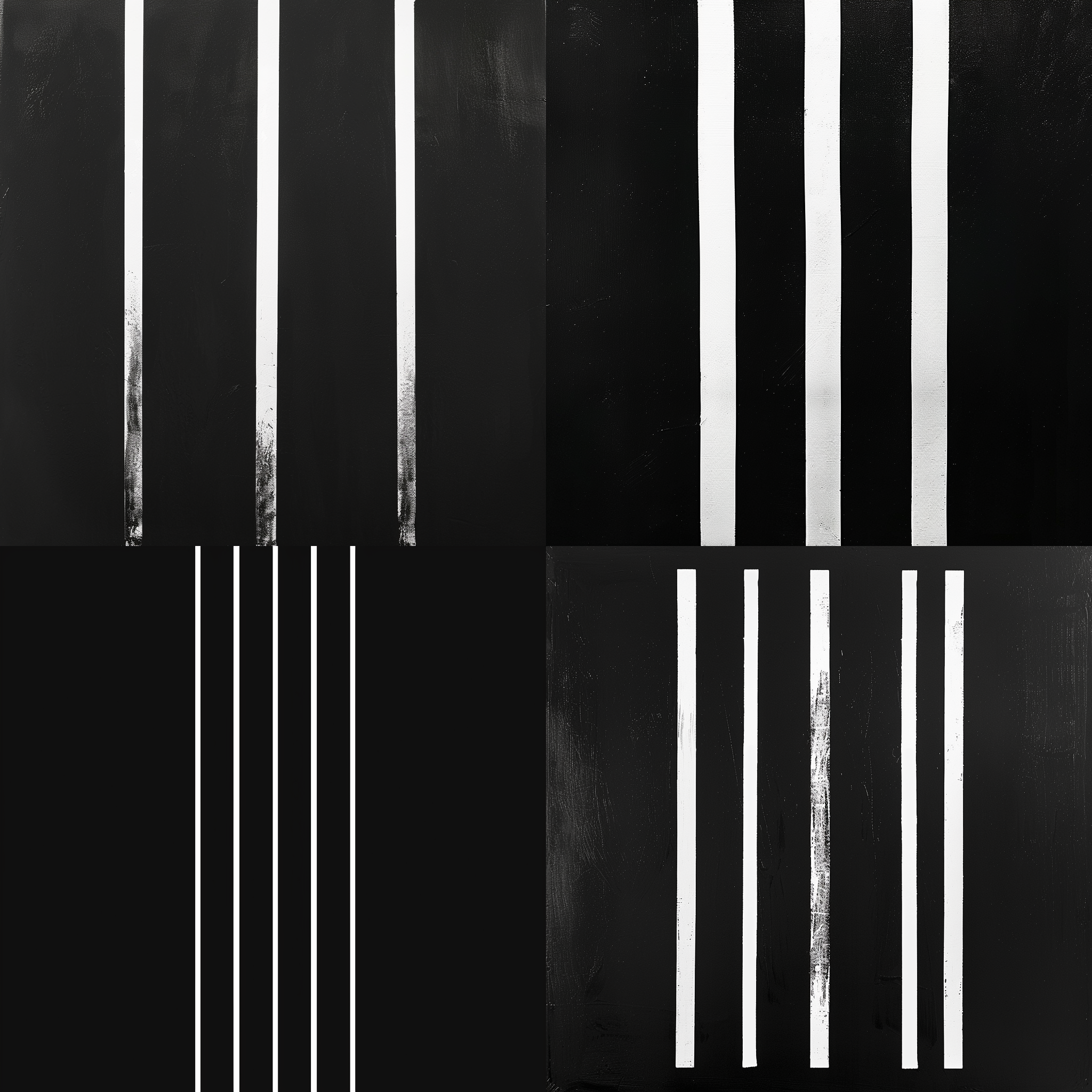
Trois Lignes Blanches par Enzo d’Armenio
Guest: Enzo d’Armenio
Enregistré : vendredi 12 décembre 2025, en ligne
Diffusé : lundi 19 janvier 2026
Langue d’enregistrement : Français
Introduction
Midjourney & visual composition
Abstraction as heuristic
The Evolution of Semiotic Analysis
Semantics of generative images
Future Directions
Résumé
Dans cet épisode, Sophia Burnett reçoit Enzo D’Armenio, sémioticien et professeur junior à l’Université de Lorraine, afin d’examiner les liens entre la sémiotique et les images générées par machine. La discussion se concentre sur l’IA générative et ses implications pour la production d’images. Enzo y présente ses recherches sur la manière dont des modèles d’IA tels que Midjourney et DALL·E produisent des images à partir de consignes verbales, en soulignant les différences de valeurs esthétiques ainsi que le degré de contrôle dont disposent les utilisateurs sur les résultats obtenus.
L’échange aborde également des questions sémiotiques plus larges soulevées par l’IA, notamment l’agentivité des images et le potentiel collaboratif entre humains et machines dans les processus créatifs. Enzo met en lumière à la fois les défis et les opportunités liés à l’IA générative, en particulier quant à la manière dont elle reconfigure notre compréhension du langage visuel et des mécanismes sémiotiques impliqués dans la création d’images. L’épisode se conclut par une réflexion sur l’évolution des relations entre créativité humaine et intelligence artificielle, prises entre concurrence et collaboration.
Summary
In this episode, Sophia Burnett engages with Enzo D’Armenio, a semiotician and junior professor at the University of Lorraine, to examine the intersection of semiotics and machine-generated images. The conversation centers on generative AI and its implications for image production. Enzo presents his research on how AI models such as Midjourney and DALL·E generate images from verbal prompts, highlighting differences in aesthetic values as well as the degree of control users can exert over the outputs.
The discussion also addresses broader semiotic questions raised by AI, including the agency of images and the collaborative potential between humans and machines in creative processes. Enzo outlines both the challenges and the opportunities posed by generative AI, particularly in terms of how it reshapes our understanding of visual language and the semiotic mechanisms involved in image creation. The episode concludes with reflections on the evolving relationship between human creativity and artificial intelligence, situated between competition and collaboration.
Enzo D’Armenio est sémioticien et travaille en tant que professeur junior à l’Université de Lorraine (Chaire « Communication numérique, jeux et santé publique » de l’Université de Lorraine, https://gameandhealthchaire.com). Il a précédemment mené trois projets post-doctoraux à l’Université de Liège, dont le projet Marie Curie (Individual Fellowship) « IMACTIS Fostering Critical Identities Through Social Media Archival Images » (www.imactis.eu), consacré aux images identitaires sur les réseaux socio-numériques. Ses dernières recherches, publiées dans des revues internationales telles que Visual Communication, Semiotica et Games and Culture, portent sur l’IA générative et sur l’étude sémiotique des identités. Il est également l’auteur de la monographie en italien Mondi paralleli. Ripensare l’interattività nei videogiochi (Unicopli, 2014).
Publications récentes :
1. D’Armenio, E., « Enunciation and identification in video game spaces: Towards a semiotics of identity », Signata Annales des sémiotiques 16, 2025. https://doi.org/10.4000/14rhp
2. D’Armenio, E., Rosso, A. et Voto, C., dirs, « Semiotics of Space in the Era of Computational Logic and Digital Practices. A Contemporary Perspective », dossier thématique de la revue Signata Annales des sémiotiques 16, 2025. https://doi.org/10.4000/14rhc
3. D’Armenio, E., « The Case of The Last of Us : Analyzing Identity from the Perspectives of Continental Semiotics and Linguistic Anthropology », Semiotic Review, 2025. https://doi.org/10.71743/tq8dwq65
4. D’Armenio, E., Dondero, M.G., Deliège, A. et Sarti, A., « For a Semiotic Approach to Generative Image AI : On Compositional Criteria », Semiotic Review, 2025. https://doi.org/10.71743/ee5nrx33
Prochaines interventions dans des colloques :
« Identification Processes in Virtual Experiences : Between Semiotics and Linguistic Anthropology”, Workshop VR Studies : State of the Art, organisé par Maria Erofeeva et David Berliner, Université libre de Bruxelles, Bruxelles, Belgique
« Voices of Photography and Visual Registers : The Enunciative Praxis in Gerhard Richter’s Artwork », Congrès de l’Association internationale de sémiotique visuelle,
São Paulo, Brésil, 9-11/02/2026 (Panel : « Speech registers, visual registers and enunciative praxis : between linguistic anthropology and semiotics”, organisé par Enzo D’Armenio et Constantine Nakassis)
« Games and Health : How Ludic Structures Translate Reality into Controlled Experiences », Congrès de l’Association internationale de sémiotique visuelle, São Paulo, Brésil, 9-11/02/2026 (Panel : Intersemiotic Translations in Games and XR : The Ludic Attitude Between Therapeutic Mediation, Identity Experimentation, and interreal translations, organisé par Enzo D’Armenio, Everardo Reyes et Gistavo Moreira Kares).
« Curating and Editing Personal Archives : AI as a Tool for Figuring Imagination », Congrès de l’Association internationale de sémiotique visuelle, São Paulo, Brésil, 9-11/02/2026 (Panel : « Les traductions intersémiotiques de l’espace : pratiques artistiques et interactives à l’ère de l’intelligence artificielle générative », organisé par Aluminé Rosso, Cristina Voto et Enzo D’Armenio).
Organisation de colloques/séminaire :
Séminaire international « Jeux et Santé », Université de Lorraine, Metz, France, 05/03/2026, organisé par Enzo D’Armenio, Sébastien Genvo et Calypso Meszaros (Chaire « Communication numérique, jeux et santé publique » de l’Université de Lorraine, https://gameandhealthchaire.com).
Machine Translated Transcript
Sophia Burnett (00:31)
For this third episode, second in French, I the great pleasure of Enzo D'Armenio, semiotician and junior professor at the University of Lorraine, where he is of the chair of digital games and public health. He previously led several postdoctoral at the University of Liège, including a Sklodowska-Curie, titled IMMACTIS fostering critical identities through social media archival images.
These recent works, published in the communication, semiotics and games and culture, focus on the generative and the semiotic analyses of contemporary identities.
He is also the author of the monograph l'Interattività nei links to his publications and the full of the episode are available on signspodcast.com.
Sophia Burnett (01:55)
Hello Enzo, I'm glad you accepted this invitation.
Enzo (02:03)
Hello Sophia thank you very for the invitation. I am delighted to be with you and to participate in this episode of Signs
and of course...
I was a bit lazy because it's a sign, in reality, it's four images and four images that were produced with Midjourney, is say with a multi-modal And why was I lazy? Because it's a sign that we produced for an article, actually for a series of that I wrote, that I wrote with Maria Giulia Dondere,
Adrian Deliège and in other versions also with Alessandro Sarti in the framework of a series of studies that we are conducting or we have conducted on generative that's it, it's a bit lazy easy because it's something that has already been published, but I think that it allows me to talk in a wider way about the semiotics, my research semiotics, the problems of the semiotics and the methodology that I find effective.
Sophia Burnett (03:29)
No, not at all. It's just because it's very graphic and it evokes things. But now that you it was generated by an LLM or...
Enzo (03:20)
So that's the general of these signs. I hope you are not disappointed.
Mm-hmm.
Sophia Burnett (03:44)
machine learning, mid-journey. So what was the
Enzo (03:47)
All right.
The prompt was a very simple prompt. French it's three vertical lines on a black I can give you other elements.
We tried to
test the generative because is multimodal, so Midjourney and Dali, that say, the time it was ChatGPT quatre The idea was to understand what degree of control users have when they produce images.
how ⁓ generative can produce images from verbal There were a number of theoretical The first one was the intersemiotic of verbal to visual It may seem very banal, but if we talk about a face or a blank line in verbal are at level ⁓ of generality. It's a specific it's all faces in a way.
conceptually,
while when we have to draw, photograph, produce an image, need more or less specific is, these particular these seven white And so that's the first theoretical if you want the intersemiotic to test how these AI could choose good visualizations.
But there were also others, especially in response to the concerns we have about generative For example, the fact that we worried because they can substitute the work of human ⁓
to used in design etc. We tried to ask ourselves more basic which are possibilities and the limits? So we thought we'd start with visual composition, with an abstract where are no questions of design and and see if the AI is effective in making these images. So we started with this image, the first image of our experiments.
and ⁓ we asked for lines of and as you can see in these four visualizations produced by Midjourney there are images that do not have three lines of and we notice other characteristics for example that there a particular in the style and texture, not three lines
simple except in second image from the left. There is always work on the texture, is always work on the style because in the Midjourney we discovered that one of the characteristics is this AI always produces beautiful images.
I chose I won't repeat what we wrote in the articles. I find it interesting for the semiotics because it sums up the look of visual in a certain way. A pretension of visual semiotics is be to analyze any image. If it's an artistic image...
Sophia Burnett (06:47)
Mm.
Enzo (07:10)
We can analyse it. If it's a design it's an advertisement, let's it was at beginning of visual because we're for visual grammars or forms of grammars, in case of verbal And so the image that is most apt for this operation is the abstract
And another thing I find that the images produced by the AI are adapted to the semantics, or rather that the semantics is adapted to the images produced by the AI is it is images that do necessarily have story, that do not necessarily have a context, that do not necessarily have a tradition. And so we can use a methodology that pretends to analyze any image because in any case it is a grammar. That's the adapted then there are also the
We cannot analyze an image without taking into account its circulation, its context, etc. It is an image that takes together traditional and semiotic and the current since 15 years, 20 years. We cannot limit to analyzing a text alone.
⁓ including in case of the AI, because this image alone is used to understand the AI, but it points to other aspects of the image We can discuss, for example, the datasets that have been used to train the AI, but also the ⁓ interaction with the user, because there is a verbal So, the prompts that the user used, the elements that inserted,
if there are verbs in it, if there is style, if there particular So even if the image itself is very simple, if it abstract already to more complex That's why I chose it, even if it comes from an article that we published. So in this way it is an image, it is a choice by itself. These the first groups of reasons why I chose
Sophia Burnett (09:19)
But not at all!
⁓ Yes, the dataset and the training are interesting. The training of these algorithms that produce not three but five lines. know, can wonder if it's not... Obviously, it refers musical instruments, things like that. You immediately of a guitar.
Enzo (09:47)
Hehehe.
Sophia Burnett (09:47)
So,
we moving away from the initial of three lines on a black background
Enzo (10:01)
Yes, that's true. First of could say that this image, some these visualizations, because there are actually four images,
do respect the prompts, that is to that there are several lines, not three. And then other thing is precisely these styles a little different, these styles a little worked, which refers to the idea of producing an artistic
or beautiful according to the algorithm. And that is another aspect.
We cannot know in detail, even if we know the operation of the generative In the case of images, these are very particular called diffusion Because they work through a kind of noise-dealing. They start from completely noisy there is only visual And then through noise-dealing, is, the illumination
the it composes images and follows the user's so, fact, images with these IAs...
is the only way to test them, study them a certain way. That is to that of course if we were computer experts, but even computer scientists have problems because they deep learning and suddenly we do not access to deep The only way as a semiotician in general as a human is to insert prompts, is to test the possibilities and characteristics to see how
and how produce images. This one of we carried out, but we also other tests, because we also to images where there figures, there are human there are spaces. In fact, took categories of visual and analytical semantics to transform into criteria for composition. There are characteristics that are linked to composition, is say, to space.
to color, to the light. And we produced prompts. these cases, it's the dimension in a certain way, topological, three lines, three lines white on a black But then there are other categories that we have tested, precisely the most important.
and the enunciation, I would say is most important in current Semiotics, in Francophone in a certain way. That say, what type of relationship, the image...
produced by the spectator to the observer. So we tested, for example, we could control the eyes of the character. If we could produce an image or a character looking at the spectator. It's already a complex because it requires a metadiscursive is, what is there takes into account...
an element, who looks outside the image. And we saw that in case of DALL-E it was possible, and even in the case of Midjourney, if we used pronouns, an image with a character who looks at me. Very particular as a And the two AI produced portraits, and so it was respected, prompts, there was someone who looked at the spectator. But all that to say that from this image, this test,
We are forced to abandon the semiotic of the 70s and 80s, where could analyse the text in itself, and forced to account interactions. So, when we talk about denunciation, of a portrait, we are forced to call...
the the person who looking at the image. So if it's a portrait, there's a character who is looking us, other images such as landscapes, to take a...
on classical painting that have been studied. There is no regard, it is scene on there is another organisation. This is the most modern of the Semiotics and also the Artificial The fact that cannot limit ourselves to taking into account an image as it were an isolated but that we must take into account all the processes involved in the production and interpretation.
the fact that different spectators have different meanings that can change over time. And in case of AI it's very special because at the same time, for the Semiotic it's reassuring to say to it's an image that doesn't have a story, so we can use it.
Sophia Burnett (15:00)
What fascinates in what you say is the way the image is created which may differ deeply the way human being would produce an image with three lines on a black background. For example, I don't know, maybe the algorithm
Enzo (15:07)
Mm-hmm.
Mm-hmm.
Sophia Burnett (15:24)
I by leaving three spaces that look like white but with the addition of rectangles. I don't know if I'm making myself but...
Enzo (15:41)
Mm-hmm.
Sophia Burnett (15:46)
So that side is what you said earlier, the black box can't even the engineers can't know how the machine processes. we can know that, for example, in his training
It's an algorithm that is intended to create aesthetics, aesthetics in pretty. What you said about the stylistic marks brush things like that. So that is
Enzo (16:17)
Mm-hmm.
Alright.
Sophia Burnett (16:30)
Something that present all the time, even when the aesthetic is not in demand. you
Enzo (16:39)
Indeed, this
is one of the aspects that we noticed. That's why we used two... I remember that I in collaboration with Maria Giulia Donder, Adrienne Deliège and Alessandro Sarti. But must say that was Maria Giulia Donder who opened this path and it was thanks that we started to together. So it's a collaboration between semiotics...
Sophia Burnett (16:59)
. .
Enzo (17:06)
but also computer science because Adrian Deliège is a computer scientist. So we were to his skills We then chose two artificial models, Midjourney This image was produced
using Midjourney but we also compared with Dali, which is part of the GPT OpenAI.
all the images we produced, only abstract also with human with figures, not abstract A fundamental difference between the two models, the two groups of images produced by Midjourney and Dali, was that Midjourney tried systematically to produce images
that are beautiful and have aesthetic value, as if the users who were targeted by this platform were rather designers or artists or categories of users who need to beautiful While in case of Dali Chat GPT in a way.
we obtained much more neutral, almost didactic Indeed, they images that didn't seek beauty at were rather simple. It's hard to define simple for an image, it's hard to define what's beautiful in an image. But they didn't have this treatment of texture, white lines didn't have dark was really three white a bit like the second image, the second figure of this image.
and that's the characteristic we could say. We could almost question that each model has a style. Maybe style is too complicated. Maybe each model uses different We can't really answer But overall, can say that the way we report on the midday is different from the way we the
Of we can even the prompts in different can ask for a particular Especially in research of Maria Giulia, aimed at this study of different to imitate a particular style, for example, the impressionism.
or to ask for an image that resembles a photograph, based on the material. It's fascinating because, in relation to your question, it's as if we could ask for a person or an author to different. So, make an image that resembles...
Impressionist We will look elements that resemble other parts. So, in first question is that it is not about the production of a human being. A fascinating is how...
The verbal becomes a visual language, even if is no human behind it. And second question is how many human are How many human are imitated, are modeled by these AI And that's very interesting because it also the agency.
Is there only one agency in Or can talk about several micro-agencies involved in training? These are very interesting don't necessarily an answer. I think it's more of an compositional agency But it also us to...
To overcome a competitive we normally think that the AI is competition with human the strongest and the least powerful. This is an interesting for society, think it's legitimate. But on the other hand...
We also there is sort of collaboration, of articulation between the vision of the human being who produces the prompts, his dissatisfaction and the fact that he wants to modify the image, relaunch with our prompt. And that, find, perhaps the interesting in relation to study of AI, not only a perspective of competition, but also of collaboration. And other interesting
These AI produces images in a different compared to human beings. It's a reconfiguration between languages. If accept that visual is a language compared to verbal, it's shared in Semiotic. It's accepted. So how will the relationship between languages change when we can write a description or a verbal and produce images?
a sort of democratization of visual language, to some degree, so it will change the relationship between the two languages, will change the ease of to visual
We will always have beautiful images, adapted I don't think that's the case. But access to visual is much easier and it changes society a it changes the semiosphere, it changes the semiotic of our society in certain way. But I don't know if I answered your question.
Sophia Burnett (23:02)
Yes,
I think it's a vast question anyway. think what you said is very interesting about how it will change, will change the way people, human beings describe their world in order to be ⁓
to accept images that resemble what they imagine. Because it's already been a millennium, it's a problem for artists. It's about showing the image they have in their brains and making So there's always a schism between the artist's and his imaginary.
Enzo (23:44)
you
Sophia Burnett (23:56)
And it's a schism that still I find it, personally, although there are lot of conversations about the end of creative not at all. Because precisely, there we have a simple demand, three very white on black background, and the machine...
manages to once, but maybe for the person who asked for it, the person wanted the lines to less thick. It's a process that finally cognitive, that happens in very short time in the human And maybe it's just that we're at the very beginning of something that must...
go much faster to look like an artistic mean, yes, human Thank
Enzo (24:53)
Yeah, but... you know...
I interested in the gap between the imagination and the production of semiotics in the case of images. I agree that
there is On the hand, is what we can imagine and think. There is necessarily a materiality or an intersubjective
subjective to private. And then, on the hand, we signs, audiovisual, even the voice, it becomes intersubjective. And I also think that there is a gap and that this gap...
is something that was important in art, and remains important in general, and remains important even in cinema, the fact that the sequences of different frames play on the fact that they are different and that they are the same time our imagination. But for the generative think it is really a fundamental because it is also the places where we can imagine
At least two different to ⁓ use the AI. On the hand, there is a possible that already A paradigm of delegation, a paradigm of substitution. That to that the AI are more effective than us, of course, it us who have trained and all that. But I don't know, in medical they can substitute doctors ⁓
to faster and identify a disease from very partial so, delegation is really prediction and it's very good. mean, will be effective, will be good news. But there is also, for me, another very interesting perhaps more adapted to human or other approaches. That to that if we keep this gap between imagination and figure, it is another way to use AI, to say that in fact there is for her
simply a new semiotic of the imagination. So for all the steps that concern, for example, memory...
can be used as a way to produce intersubjective in relation to our imagination. we have access to imagination in an easy way without having to account hyper-specific For example, in the field of...
of psychology, in the treatment of problems concerning memory, we could imagine that patients and therapists can simply speak verbally, but that this can help produce visual sometimes even verbal and that it helps to build objective imaginations of the patient without the need to show a photo, etc. So this is a collaboration
with the AI and it's not a delegation. ⁓ It's another track for sciences and I think this aspect is very important, gap that you have pointed out between imagination and figure,
Sophia Burnett (28:15)
Oh yes,
it's an interesting idea of creating in real time, if I understood correctly, of cognitive artifacts allowing...
Enzo (28:24)
Alright.
Sophia Burnett (28:31)
or two interlocutors to position themselves Indeed, it's good to highlight the... the benefits of... the capacities of the AI.
There is. it's true that when you see the five lines, when you know that only three have been asked, it's a somewhat semiotic
Enzo (28:50)
Alright.
Yeah, no, you're right, because, indeed...
Why did start with white And why is the effect We could say that generative are nothing more than a series of algorithms that have a computational logic that animates them in certain way. they will able to three lines, not five. But fact, it's more complicated than that because there are several layers that concern the image
and paradoxically they are almost more efficient at producing images where there are figures of the world, human etc. than lines. And that's another aspect that is to this algorithmic to this computational which is embodied in an emblematic by generative but which is also...
which lives in our society in more global way because in the subjects that concern research there is course the generative recently but I also worked on video games and on social networks and even there there are other actors who are animated by algorithms in video games, simply enemies or other cars in a racing game etc. even if is not generative is still algorithms
artificial and in social networks also the fact that non-continuous images that we produce or images that produce I don't know, press or politicians are treated and shared by algorithms and suddenly these are very particular in the logic that escapes us part because in part the AI seems to be very close to human because we ask for lines and
it understands lines, if sometimes it's not three lines, it's five lines. And on the other hand, there is... it's our logic.
We don't understand why machines that do anything else but calculating are not able to three lines and make five. So it's very fascinating to ask ourselves what kind of actors are these algorithms that study our profiles on social to share the content that is more suitable for us or to transform our sentences into images. It's very fascinating to ask
What status do these actors There is no intentionality of but the time they produce enunciations.
and that's another aspect that characterizes my research. Of course, I don't have definitive because no one has answers to all of this, but I think that there is really the emblem of this new intentionality, we can call intentionality or agency, algorithmic, which has normalized itself because it's part of our...
of daily When we use a phone, when we book a hotel, a trip, or we watch a movie on Netflix, is always an algorithmic of databases, ⁓ clicks that others have made, movies that others have liked, their profile resembles ours. So I find very fascinating. To question these actors, if they are actors.
Sophia Burnett (32:37)
Yes, think you're right to say actors. Since they are...
They are producing only lines like here, but also words that enter the circulation of discourse that are taken up by human at all levels. they are disguised.
We can see the analogy with a three line or five line. So in this case, relation to the demand, the five lines, it's a no, it's not the realization the demand. And we can see it in terms of announcements in the online
Enzo (33:24)
Where?
Sophia Burnett (33:31)
if we use one word rather than another.
Enzo (33:35)
I agree. When we wrote an article for Semiotic Revue, we tried to judge when there were mistakes, but when there were images that were not relevant to the verbal
I that it was a mistake, but for me it was mistake. I totally agree with you. So, yes, we could say that it was a mistake, or in other images we produced, for example,
a group of human beings that being by a car. And was indeed a car behind the but there was nothing in this image, in the faces of human beings that made us that it was about being pursued. It was two different going in the same direction.
We tried to study all these inconsistencies, all these moments where the link was not relevant, because it is an indirect to try to understand what logic the animes are, what are possibilities, limits. But I totally agree with you that it is a mistake. And in this particular we also produced 50 images with the same prompt, because we wanted to be sure.
We could say that we repeat several times, some point the image will be the right We wanted to a of statistical basis to state that our conclusion was correct.
And indeed, always the same errors on the midday and on the chachapeté And it was more or less the same, that is say that there was the same characteristic, very precise and very aesthetic on the texture. There were often images that did three lines, five, six, etc. It was the same characteristic. So we can say that it the way at the moment, because we know that...
the AI can evolve. But yes, are mistakes that we have noticed and that concern, if you will, the basics of composition. We cannot really control which elements are present in the images, where in image. For example, we asked for a circle in the upper right of the image, sometimes it's at bottom, sometimes it's on left.
This is interesting in relation to visual and composition.
Sophia Burnett (36:24)
Yes, yes, yes. No, it's fascinating because, well, somewhere I wonder to what extent, it's not the algorithm that tries to propositions of differentiation.
Enzo (36:38)
Mm-hmm.
Sophia Burnett (36:39)
for
the user to be happy and the possibility of choosing between four proposals which is very good if it's a figurative but there it's the machine that confuses function and form it's really
Enzo (37:04)
What?
Sophia Burnett (37:07)
l’hiérarchisation de la fonction là, qui a pris second place à la proposition artistique en fait.
Enzo (37:18)
Alright.
Yes, that's another question. We don't know which parameters are the in the image in these it's clear that even if we try to produce prompts as simple as possible, precisely to see what the standard of these IAs we can that for us the important thing was the right number of lines, the funds, and since there is a parameter
which seems more important in day-to-day, that say this effect of beauty, this aesthetic and it is true that this is something that can only in the work of...
and images. in relation to what you said, it's also very interesting to propose, as if there is a proposal for differentiation that can be taken up and extended. Because indeed, I think that this really the case. For Dali and for Chachi Petté, it's obvious because it's really an interface that constantly, systematically, re-launches dialogues.
always at the end, an additional You want me to something, I don't know. And in case of half-days, it's a bit different because there is no, we can't dialogue with a single AI We can ask for image but there are all other functions that we can use. For example, from these four images, we can say, here we want to continue to develop the second one.
Sophia Burnett (38:30)
Okay. Okay.
Enzo (38:51)
We want modify this specific We want to a new footprint, only for this area. And so I think it also of...
of what the targets are, what the users are, that fact that is not simply about producing an image and saying it's good or not. It's really a creative where you can re-launch, can select, you can even take an image and say that it needs to the style of this image to do something else.
I think that this logic that you have highlighted, of collaborations, of progressive is really put forward by the producers of these AI. I don't mean that it's the logic of AI itself, but the interface makes this collaboration in the long term put forward. And it's also something else we have to...
When we about competition and collaboration between AI and human it's just about creating a single on the basis of a prompt but it's really a process of collaboration between two entities that have different and that can continue to collaborate. So I totally agree with this aspect, which is very important in my opinion.
Sophia Burnett (40:07)
Yes, there are so many things to about AI Thank you very for this image I think it's a way to explore what AI what our collaboration is simple images that we say a lot.
merci beaucoup pour ton temps, pour avoir parlé de ton travail. puis j'espère à très bientôt. Okay.
Enzo (40:40)
Thank you Sophia for this
invitation and for the specific It was a real pleasure to participate. I hope that this dialogue will interesting for the public.
Sophia Burnett (40:54)
Yes, je suis sûre.